The Pilgrims' Inn

  • Welcome to The Pilgrims’ Inn
‘Do not be content with anything less than Christ.’ Sunday Reflections, 18th Sunday in Ordinary Time, Year B

Month: July 2015

‘Do not be content with anything less than Christ.’ Sunday Reflections, 18th Sunday in Ordinary Time, Year B

July 28, 2015 by Father Sean Coyle


From The Gospel of John (2003)  Directed by Philip Saville. Jesus played by Henry Ian Cusick; narrator, Christopher Plummer.
[John 6:24-35 is found between 2:36 and 4:24 in the video.]


Readings
(New American Bible:
Philippines, USA)
 
Readings
(Jerusalem Bible: Australia,
England & Wales, India [optional], Ireland, New Zealand, Pakistan,
Scotland, South Africa)
 
Gospel John 6:24-35 (New Revised Standard Version, Catholic Edition, Canada) 
 
When the
crowd saw that neither Jesus nor his disciples were there, they themselves got
into the boats and went to Capernaum looking for Jesus.
When they found him on the other side of the sea, they said to him, “Rabbi, when did you come here?” Jesus answered them, “Very truly, I tell you, you are looking for me, not because you saw signs, but because you ate your fill of the loaves. Do not work for the food that perishes, but for the food that endures for eternal life, which the Son of Man will give you. For it is on him that God the Father has set his seal.” Then they said to him, “What must we do to perform the works of God?”  Jesus answered them, “This is the work of God, that you believe in him whom he has
sent.”
 
So they said to him, “What sign are you going to give us then, so that we may see it and believe you? What work are you performing? Our ancestors ate the manna in the wilderness; as it is written, ‘He gave them bread from heaven to eat.’” Then Jesus said to them, “Very truly, I tell you, it was not Moses who gave you the bread from heaven, but it is my Father who gives you the true bread from heaven. For the bread of God is that which comes down from heaven and gives life to the world.” They said to him, “Sir, give us this bread always.”

Jesus said to them, “I am the bread of life. Whoever comes to me will never be hungry, and whoever believes in me will never be thirsty.


Antiphona ad Communionem  Communion Antiphon  Wisdom 16:20
 
Panem de caelo dedisti nobis, Domine,
You have given us, O Lord, bread from heaven,
habentem omne delectamentum, et omnem saporem suavitatis.
endowed with all delights and sweetness in every taste.

Fr Ragheed Aziz Ganni
(20 January 1972 – 3 June 2007)
 
I have featured Fr Ragheed Ganni a number of times on Sunday Reflections, most recently two weeks ago for the 16th Sunday in Ordinary Time, Year B. As a priest and as a Catholic Christian I am truly inspired by this man who was less than half the age I am now when he was assassinated.
 

‘He was a raconteur par excellence and a font of knowledge – we discussed everything and anything from the metaphysical to the trivial. A young and gauche student at the time, I learnt about Iraq and about theology; about the workings of the college in the summer and the best places to eat pizza. I was amazed at his command of English and Italian and his perennial good spirits and big smile – he was and will always be an inspiration’.

 
That is how an Irish student at the Pontifical Irish College in Rome described Fr Ragheed Ganni, a Chaldean Catholic priest murdered along with three subdeacons, Basman Yousef Daud,Wahid Hanna Isho, and Gassan Isam Bidawed, on 3 June 2007 just after the young priest had celebrated Mass in Holy Spirit parish, Mosul, Iraq. Fr Ganni, an engineer, studied theology in Rome, and stayed at the Irish College, where he was known as ‘Paddy the Iraqi’, ‘Paddy’ being a generic term for Irishmen, derived from the name of Ireland’s – and Nigeria’s – patron, St Patrick.

Pope Benedict XVI [Wikipedia]
 
Dear young people, do not be satisfied with anything less than Truth and Love, do not be content with anything less than Christ. Pope Benedict spoke these words at the prayer vigil on 20 August 2011 during the Madrid World Youth Day. He also said, we need to speak with courage and humility of the universal significance of Christ as the Saviour of humanity and the source of hope for our lives.
 
In these words he is echoing the answer of Jesus to the question put to him in today’s gospel, What must we do, to be doing the works of God? His reply: This is the work of God, that you believe in him whom he has sent.
 
In Verbum Domini the Pope wrote, We cannot keep to ourselves the words of eternal life given to us in our encounter with Jesus Christ: they are meant for everyone, for every man and woman . . . It is our responsibility to pass on what, by God’s grace, we ourselves have received. In his Angelus talk on 29 October 2006 Benedict said, The rediscovery of the value of one’s own Baptism is at the root of every Christian’s missionary commitment, because as we see in the Gospel, those who allow themselves to be fascinated by Christ cannot fail to witness to the joy of following in his footsteps. 
 
In that same talk, in which he commented on the gospel of that Sunday, Mark 10:46-52, Pope Benedict said, The decisive moment was the direct, personal encounter between the Lord and that suffering man. They found each other face to face:  God with his desire to heal and the man with his desire to be healed; two freedoms, two converging desires. He was speaking of the meeting between the blind Bartimaeus and Jesus.
 
One theme that comes through repeatedly in the teaching of Pope Benedict is that our faith is in a person, Jesus, God who became man. Jesus tells us clearly that it is his Father’s will that we believe in him.
 
Another theme of Benedict is the joy that Jesus promised those who follow him. This was the theme of the Pope’s message for World Youth Day 2012 held on Palm Sunday in Rome.Pope Benedict uses a very striking term: those who allow themselves to be fascinated by Christ. I don’t think I’ve heard it put that way before by anyone. Benedict insists so often that our faith is faith in the person of Jesus, not in a set of doctrines, though they come to us from Jesus through his Church.Just over a year before his death Father Ragheed spoke at the Eucharistic Conference in Bari, Italy. He said, Mosul Christians are not theologians; some are even illiterate. And yet inside of us for many generations one truth has become embedded: without the Sunday Eucharist we cannot live.


In the context of the war in Iraq he spoke eloquently about the Sunday Eucharist: It is among such difficulties that we understand the real value of Sunday, the day when we meet the Risen Christ, the day of our unity and love, of our (mutual) support and help. There are days when I feel frail and full of fear. But when, holding the Eucharist, I say ‘Behold the Lamb of God, who takes away the sin of the world’, I feel His strength in me. When I hold the Host in my hands, it is really He who is holding me and all of us, challenging the terrorists and keeping us united in His boundless love.


In normal times, everything is taken for granted and we forget the greatest gift that is made to us. Ironically, it is thanks to terrorist violence that we have truly learnt that it is the Eucharist, the Christ who died and risen, that gives us life. And this allows us to resist and hope. 

 
This martyr of our times was clearly fascinated by Christ and understood that it is the Risen Lord himself whom we meet when we come together for Sunday Mass.
 
Jesus chides the people and questions their real reason for coming after him: Truly, truly, I say to you, you seek me, not because you saw signs, but because you ate your fill of the loaves. Yet he doesn’t regret having fed them and he sees that for at least some of them their reason is somewhat deeper. He gives a straight answer to their question about the work of God: This is the work of God, that you believe in him whom he has sent. It is not being ‘good’, it is not being ‘nice’. It is in accepting him for who he is, God who became man, who lived among us, died for us on the Cross, rose from the dead on Easter Sunday and is with us in an intimate and challenging way when we celebrate Mass, especially on Sunday.
 
All who met Father Ragheed described him as a joyful person. There is something very joyful, in the sense that Jesus meant, in a person who can not only tell you where the best pizza in Rome is, who is not content with anything less than Christ and who is prepared to go back to a very dangerous situation in order to be able to celebrate Mass with his people and to stay with them in the midst of war.
 
Read more about Fr Ragheed Ganni here and here.
 

Ave, verum corpus
natum
ex Maria Virgine:
vere passum, immolatum
in cruce pro homine:
cuius latus perforatum
unda fluxit et sanguine:
esto nobis praegustatum,
in mortis examine.
O dulcis, O pie, O Jesu, Fili Mariae.
Miserere mei. Amen.


+++

Hail the true body, born
of the Virgin Mary:
You who truly suffered and were
sacrificed
on the cross for the sake of man.
From whose pierced flank
flowed water and blood:
Be a foretaste for us
in the trial of death.
O sweet, O merciful, O Jesus, Son of
Mary.
Have mercy on me. Amen. 
Posted in: Sunday Reflections Tagged: Fr Ragheed Ganni, Pope Benedict, Sunday Reflections

‘The young boy consented to give Christ his poor offering, not realizing that he would feed the multitude.’ Sunday Reflections, 17th Sunday in Ordinary Time, Year B

July 22, 2015 by Father Sean Coyle
John 6:1-15, from The Gospel of John (2003) Directed by Philip Saville. Jesus played by Henry Ian Cusick; narrator, Christopher Plummer.


Readings
(New American Bible:
Philippines, USA)
 
Readings
(Jerusalem Bible: Australia,
England & Wales, India [optional], Ireland, New Zealand, Pakistan,
Scotland, South Africa)
Gospel John 6:1-15 (New Revised Standard Version, Catholic Edition, Canada)  
 
After
this Jesus went to the other side of the Sea of Galilee, also called the Sea of Tiberias. A large crowd kept following him, because they saw the signs that he was doing for the sick.
  Jesus
went up the mountain and sat down there with his disciples.
 
Now the Passover, the festival of
the Jews, was near.
 
When he looked up and saw a large crowd coming toward him, Jesus said to Philip, “Where are we to buy bread for these people to eat?” He said this to test him, for he
himself knew what he was going to do.
 
Philip answered him, “Six months’ wages would not buy enough bread for each of them to get a little.” One of his disciples, Andrew, Simon
Peter’s brother, said to him,
“There is a boy here who has five barley loaves and two fish. But
what are they among so many people?”
 Jesus said, “Make the people sit down.” Now there was a great deal of grass in the place; so they sat down, about five thousand in all. 
Then Jesus took the loaves, and when he had given thanks, he distributed them to those who were seated; so also the
fish, as much as they wanted.
 
When they were satisfied, he told his disciples, “Gather up the fragments left over, so that nothing may be lost.” So they gathered them up, and from
the fragments of the five barley loaves, left by those who had eaten, they filled twelve baskets.
 
When the people saw the sign that he had done, they began to say, “This is indeed the prophet who is to come into the world.”

When Jesus realized that they were about to come and take him by force to make him king, he withdrew again to the mountain by himself.


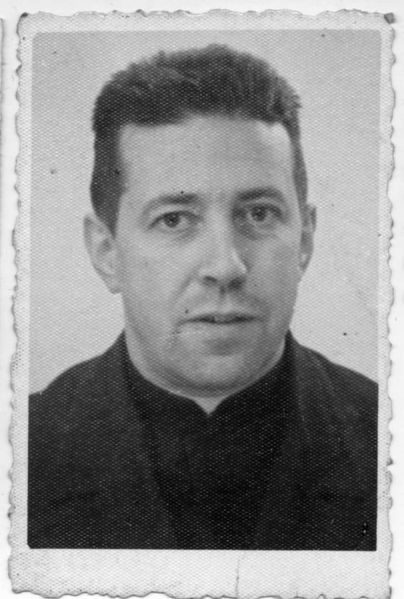
San Alberto Hurtado SJ (1901 – 1951)

St Alberto Hurtado SJ is a man who took today’s gospel very seriously, He established the first Hogar de Cristo, Home of Christ, in Chile in 1944 to care for the many in Santiago who were homeless or had little to eat. There are now many such homes, not only in Chile and in other countries in South America but in the USA. Canonised in 2005 by Pope Benedict, he is still venerated in Chile as he was loved in his lifetime by the simple title of ‘Padre Hurtado’.
 
He can speak to us with authority, as he does in this meditation he gave many years ago. His reference to the Venerable Matt Talbot comes from the time he spent in Dublin learning English.
 
The Multiplication of the Loaves  
Meditation during a retreat on the gift of self and cooperation.
Indecision, faintheartedness is the great obstacle in the plan of cooperation. We think: ‘I’m not worth all that much’, and from this comes discouragement: ‘It makes no difference whether I act or fail to act. Our powers of action are so limited. Is my unpretentious work worthwhile? Does my abstaining from this have any meaning? If I fail to sacrifice myself nothing changes. No one needs me . . . A mediocre vocation?’ How many vocations are lost. It is the advice of the devil that is partly true. The difficulty must be faced.
The solution
Five thousand men along with women and children have been hungry for three days . . . Food? They would need at least 200 denarii to feed them and this is the approximate yearly salary of a labourer.
In the desert! ‘Tell them to go!’ But Andrew, more observant says: ‘There are five loaves and two fish, but what are these among so many?’ Here we have our same problem: the disproportion.
And the loaves. Made of barley, hard as rocks (the Jews used wheat). And the fish. They were from the lake, small, rather mushy in texture, carried by a young boy in a sack that had lain on the ground for three days in the heat . . . not much of a solution. 
Did the Lord despise this offering? No, and with his blessing he fed all the hungry and had leftovers. Neither did he despise the leftovers: twelve baskets of the surplus were gathered, fish heads and bones, but even this he valued. 
The young boy consented to give Christ his poor offering, not realizing that he would feed the multitude. He believed that he had lost his small possession but he found instead that there was even a surplus and that he had cooperated for the good of the others. 
And me . . . like those fish (less than those loaves) bruised and perhaps decomposing but in the hands of Christ my action may have a divine scope a divine reach. 
Remember Ignatius, Augustine, Camillus de Lellis, and Matt Talbot, base sinners whose lives were converted into spiritual nourishment for millions who will continue to feed on their witness. 
My actions and my desires can have a divine scope and can change the face of the earth. I will not know it, the fish did not know it either. I can do a great deal if I remain in Christ; I can accomplish much if I cooperate with Christ . . .

St Alberto Hurtado SJ


Antiphona ad introitum      Entrance Antiphon (Psalm 67[68]: 6-7, 36)
 
Deus in loco sancto suo: 
God is in his holy place,
Deus, qui inhabitare facit unanimes in domo: 
God who unites those who live in his house;
ipse dabit virtutem et fortitudinem plebi suae.
he himself gives might and strength to his people.

Ps 67[68]: 2. Exurgat Deus, et dissipentur inimici eius: et fugiant, qui oderunt eum, a facie eius.
God arises; his enemies are
scattered, and those who hate him flee before him. 
Gloria Patri, et Filio et Spiritu Sancto.
Glory to the Father and to the Son and to the Holy Spirit.  


Deus in loco sancto suo: God is in his holy place,

Deus, qui inhabitare facit unanimes in domo: 

God who unites those who live in his house;

ipse dabit virtutem et fortitudinem plebi suae.

he himself gives might and strength to his people.


The text in bold is that for the Mass of the 17th Sunday in Ordinary Time in the Ordinary Form while the complete text is that for the 11th Sunday after Pentecost in the Extraordinary form (the ‘Old Mass’).

Posted in: Sunday Reflections Tagged: Chile, crSan Alberto Hurtado SJ, Hogar de Cristo, Sunday Reflections

‘I will raise up shepherds . . .’ Sunday Reflections, 16th Sunday in Ordinary Time, Year B

July 15, 2015 by Father Sean Coyle
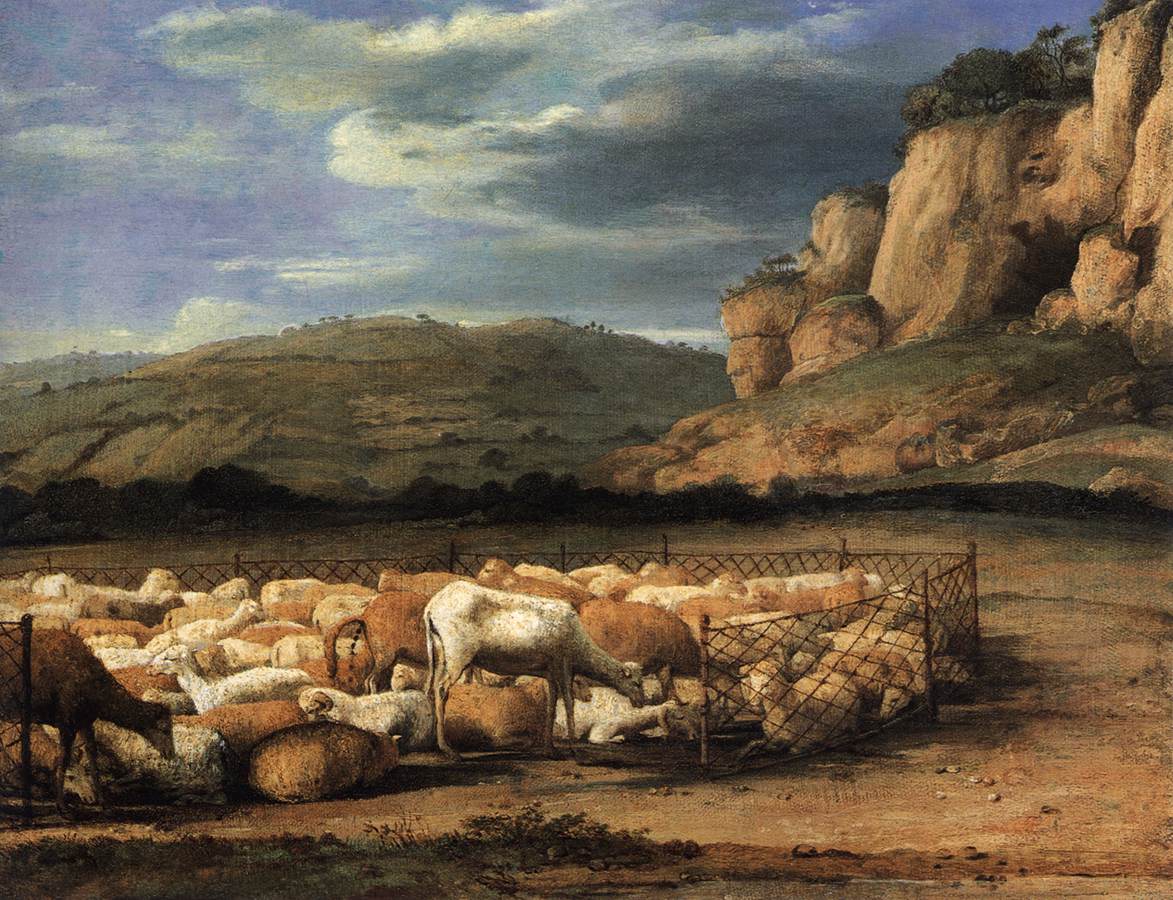
Flock of Sheep in the Campagna, Claude Lorrain
Akademie der bildenden Künste, Vienna [Web Gallery of Art]
‘They were like sheep without a shepherd.’


Readings
(New American Bible:
Philippines, USA)

Readings
(Jerusalem Bible: Australia,
England & Wales, India [optional], Ireland, New Zealand, Pakistan,
Scotland, South Africa)

Gospel Mark 6:30-34 (New Revised Standard Version, Catholic Edition, Canada)   


The apostles gathered around Jesus, and told him
all that they had done and taught.
 He said to them, “Come away to a deserted
place all by yourselves and rest a while.” For many were coming and going, and
they had no leisure even to eat.
 
And they went away in the boat to a
deserted place by themselves.
 
Now many saw them going and recognized
them, and they hurried there on foot from all the towns and arrived ahead of
them.
 
As he went ashore, he saw a great crowd; and he had
compassion for them, because they were like sheep without a shepherd; and he
began to teach them many things.


Fr Ragheed Aziz Ganni 
(20 January 1972 – 3 June 2007)
I will raise up shepherds over them who will shepherd them, and they shall not fear any longer, or be dismayed, nor shall any be missing, says the Lord (Jeremiah
23:4. First Reading).


On at least six occasions during his recent nine-day pastoral visit to Ecuador, Bolivia and Paraguay, Pope Francis asked the people to pray for him, as he did when he addressed the people in St Peter’s Square for the first time as pope in 2013. Perhaps he has constantly in mind two statements in today’s First Reading from the Prophet Jeremiah: ‘Woe to the shepherds who destroy and scatter the sheep of my pasture! says the Lord . . .  I will raise up shepherds over them who will shepherd them, and they shall not fear any longer, or be dismayed, nor shall any be missing, says the Lord.’

Jesus shows his concern for the apostles when they returned from the mission on which he had sent them as shepherds when ‘He said to them, “Come away to a deserted place all by yourselves and rest a while.”’
Ballachulish, Scotland
‘Come away to a deserted place all by yourselves and rest a while.’

Perhaps we can pray in a special way for our priests as we take part in Mass this Sunday. We have countless models of priests who have been worthy shepherds, evening to laying down their lives for the flock they were called to serve. One such shepherd is an Iraqi priest with Irish connections, Fr Ragheed Ganni, assassinated along with three subdeacons, his cousin Basman Yousef Daud, Wahid Hanna Isho, and Gassan Isam Bidawed, after celebrating Mass in Mosul, Iraq, on Trinity Sunday, 3 June 2007.

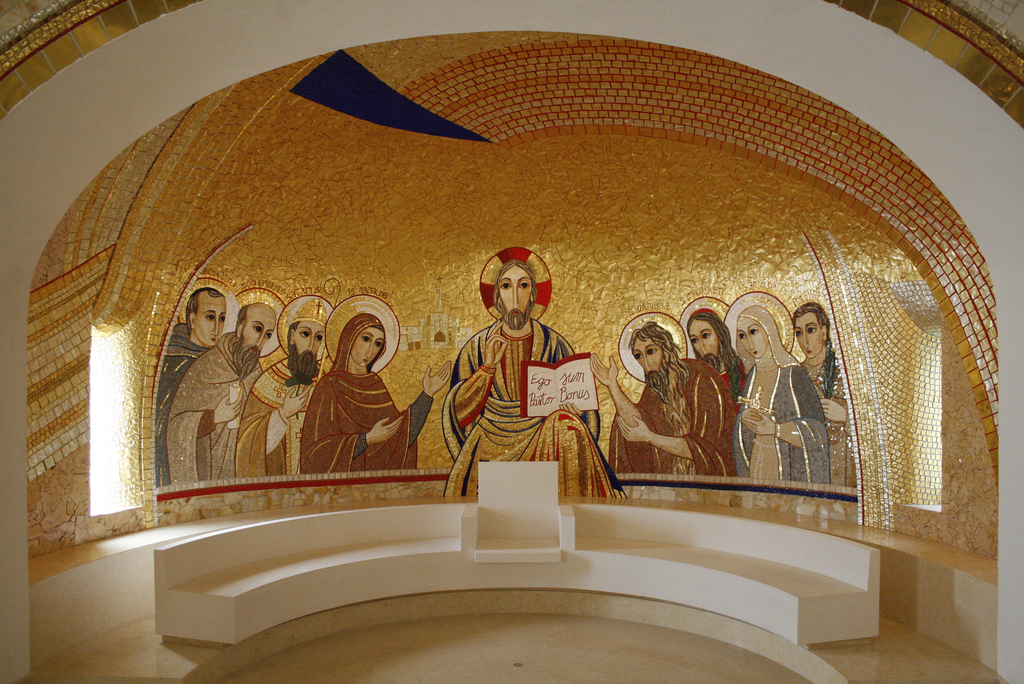
Apse of Chapel, Irish College, Rome
St Columban second from left, Fr Ragheed far right.
[Details at source]

An engineer by profession, Ragheed answered God’s call to become a priest and studied theology in Rome, before and after his ordination in 2003. While there he stayed at the Pontifical Irish College where he became known as ‘Paddy the Iraqi’, ‘Paddy’ being a common nickname for men named Patrick, after Ireland’s national patron, and a humorous generic name for any Irishman. As a priest still studying in Rome he spent part of his summers as a member of the staff at Lough Derg, known as St Patrick’s Purgatory, a place of penitential pilgrimage in Ireland.

Mosaic of Fr Ragheed Ganni with palms of martyrdom, Chapel of Irish College, Rome [Source]

Yet this young Iraqi who, according to the statement of one friend after the priests’ murder, ‘knew where the best pizza in Rome was’, chose to go back to his own country, knowing that his life might be in danger. He spoke of this at a Eucharistic Congress in Bari, Italy, two years before his death. The theme of the Congress was Without Sunday We Cannot Live, ‘Sunday’ meaning most especially the celebration of Holy Mass.

Basilica of St Nicholas, Bari [Wikipedia]

Fr Ragheed Ganni’s Testimony

Mosul Christians are not theologians; some are even illiterate. And yet inside of us for many generations one truth has become embedded: without the Sunday Eucharist we cannot live.
This is true today when evil has reached the point of destroying churches and killing Christians, something unheard of in Iraq till now. In June 2004, a group of young women were cleaning the church to get it ready for Sunday service. My sister Raghad, who is nineteen, was among them. As she was carrying a pale of water to wash the floor, two men drove up and threw a grenade that blew up just a few yards away from her.
She was wounded but miraculously, survived. And on that Sunday, we still celebrated the Eucharist. My shaken parents were also there. For me and my community, my sister’s wounds were a source of strength so that we, too, may bear our cross.
Last August in St Paul’s Church, a car bomb exploded after the 6 pm Mass. The blast killed two Christians and wounded many others. But that, too, was another miracle – the car was full of bombs but only one exploded. Had they all gone off together, the dead would have been in the hundreds since 400 faithful had come on that day.
People could not believe what had happened. The terrorists might think they can kill our bodies or our spirit by frightening us, but, on Sundays, churches are always full. They may try to take our life, but the Eucharist gives it back.
On 7 December, the eve of the Immaculate Conception, a group of terrorists tried to destroy the Chaldean Bishop’s Residence, which is near Our Lady of the Tigris Shrine, a place venerated by both Christians and Muslims. They placed explosives everywhere, and a few minutes later blew the place up. This and fundamentalist violence against young Christians has forced many families to flee. Yet the churches have remained open and people continue to go to Mass, even among the ruins.
It is among such difficulties that we understand the real value of Sunday, the day when we meet the Risen Christ, the day of our unity and love, of our (mutual) support and help. There are days when I feel frail and full of fear. But when, holding the Eucharist, I say ‘Behold the Lamb of God, who takes away the sin of the world’, I feel His strength in me. When I hold the Host in my hands, it is really He who is holding me and all of us, challenging the terrorists and keeping us united in His boundless love.
In normal times, everything is taken for granted and we forget the greatest gift that is made to us. Ironically, it is thanks to terrorist violence that we have truly learnt that it is the Eucharist, the Christ who died and risen, that gives us life. And this allows us to resist and hope. 
[This appeared in The Sacred Heart Messenger (April 2008), a publication of the Irish Jesuits.]
Archbishop Mar Paulos Faraj Rahho 
(20 November 1942 – kidnapped 29 February, body found 13
March 2008) [Photo: The Path to Peace Foundation]

Father Ragheed was secretary to Archbishop Rahho, The Chaldean Archbishop of Mosul. Most Catholics in Iraq and Syria belong to the Chaldean Catholic Church, in full communion with Rome. ‘The Eucharist, the Christ who died and risen, that gives us life’ was celebrated every Sunday in Mosul for 1,600 years – until June 2014 when the ISIS forces drove out the remaining Christians.

The words of Jeremiah, ‘I will raise up shepherds over them who will shepherd them’, have surely been fulfilled in the lives and deaths of such priests as Fr Ragheed Ganni and Archbishop Rahho. As we thank God for them and for countless other faithful priest-shepherds, let us continue to pray for all our priests and for Christians who are being persecuted for their faith.


John Rutter‘s setting of The Lord is my shepherd, Psalm 22[23], which is used as today’s Responsorial Psalm.

Posted in: Sunday Reflections Tagged: Archbishop Mar Paulos Faraj Rahho, Fr Ragheed Ganni, Iraq, John Rutter, persecution, Priests, shepherds, Sunday Reflections

Since we are travellers and pilgrims in the world, let us ever ponder on the end of the road, that is of our life, for the end of our roadway is our home (St Columban, 8th sermon).

July 13, 2015 by Father Sean Coyle

Columban Fr Patrick Meehan RIP

Fr Patrick Meehan

(1925 – 2015)
 
Fr Patrick (Paddy) Meehan was born on 24 August 1925 in Innishammon, Smithboro, County Monaghan, Ireland. His father died when he was only four years of age, a baby sister died in 1931 and his mother died when he was seven. Now the youngest of three surviving children, Paddy was reared by an uncle and aunt who moved into their home and small farm.
Smithboro, County Monaghan
 
A scholarship got him a place in St Macartan’s College and in 1943 he was one of the seven in a class of thirteen who choose to study for the priesthood.
 
St Macartan’s College
 
He entered St Columban’s College, Dalgan Park, Ireland, in 1943 and was ordained priest on 21 December 1949. He was appointed to post-graduate studies in theology at Dunboyne House, a house of higher studies at St Patrick’s, Maynooth, the national seminary, in 1950-’51 and then to the seminary staff at St Columban’s, Nebraska, and later to Milton, MA, USA until 1964.
 
He was appointed to the Philippines in 1964. After language studies in Ozamis, he served as Pastor in Clarin, then assistant in Pagadian, and later Pastor of Dumingag. In 1972 he served in Lanipao and Maranding in the Diocese of Iligan and then as Chancellor of the Diocese of Pagadian from 1974 to 1981 and spent a three-year period in San Miguel.
 
Lala, Lanao del Norte [Wikipedia]
[Lanipao is in the Municipality of Lala]
 
This was followed by an appoinment to promotion work in the US Region, from the Columban house in Bayside, Queens, NYC, from 1981 to 1986. Returning to the Philippines he served briefly in Marihatag, Diocese of Tandag, and then in Linamon, Corpus Christi Parish and St Michael’s Parish, Iligan City, all in the Diocese of Iligan. 
 
St Michael’s Cathedral, Iligan City [Wikipedia]
 
From 1992 to 1998 he was once again on promotion work in the USA, from the Omaha and New York houses.
 
In 1998, he ‘retired’ to Ireland but was very happy to serve in pastoral work, in his home Diocese of Clogher as long as his health permitted. He was admitted to the Dalgan Nursing Home in April 2008. 
 
Father Paddy was a kind, pleasant, humble man, who never flaunted his considerable learning, but was a steady, good-humoured presence in many difficult areas of Mindanao. He once concluded a note on his life quoting the psalm: ‘The mercies of the Lord I will sing for ever.’ And added: ‘Given the chance, I probably wouldn’t do it differently, only better.’
 
Father Paddy died peacefully in the Nursing Home in St Columban’s, Dalgan Park, on Thursday, 18 June, 2015. May God reward his caring and generous spirit. 
 
+++
 
Father Paddy lost his father when he was only four and his mother three years later. One of Monaghan’s most famous sons was the poet and novelist Patrick Kavanagh (1904 – 1967) who wrote the poem below.
 
 
In Memory Of My Mother 

I do not think of you lying in the wet clay
Of a Monaghan graveyard; I see
You walking down a lane among the poplars
On your way to the station, or happily

Going to second Mass on a summer Sunday –
You meet me and you say:
'Don't forget to see about the cattle – '
Among your earthiest words the angels stray.

And I think of you walking along a headland
Of green oats in June,
So full of repose, so rich with life –
And I see us meeting at the end of a town

On a fair day by accident, after
The bargains are all made and we can walk
Together through the shops and stalls and markets
Free in the oriental streets of thought.

O you are not lying in the wet clay,
For it is a harvest evening now and we
Are piling up the ricks against the moonlight
And you smile up at us – eternally.

May Father Paddy, his father and mother, his deceased Columban confreres and
all his loved ones 'smile up at us – eternally.'

Posted in: Obituaries Tagged: Columbans, Fr Patrick Meehan, Monaghan, Philippines

‘Jesus called the twelve and began to send them out two by two.’ Sunday Reflections, 15th Sunday in Ordinary Time, Year B

July 8, 2015 by Father Sean Coyle
Young Jew as Christ, Rembrandt, c.1656
Stattliche Museen, Berlin [Web Gallery of Art]


Readings
(New American Bible:
Philippines, USA)
Readings
(Jerusalem Bible: Australia,
England & Wales, India [optional], Ireland, New Zealand, Pakistan,
Scotland, South Africa)
Gospel Mark 6:7-13 (New Revised Standard Version, Catholic Edition, Canada) 
 
Jesus called the twelve and began to send them out two by
two, and gave them authority over the unclean spirits.
 He ordered them to take nothing for their journey except a
staff; no bread, no bag, no money in their belts;
 
but to wear sandals and
not to put on two tunics.
 
He said to them, “Wherever you enter a house, stay there
until you leave the place.
 
If any place will not welcome you and they refuse to hear
you, as you leave, shake off the dust that is on your feet as a testimony
against them.”
 
So they went out and
proclaimed that all should repent.
 
They cast out many demons, and anointed with oil many who
were sick and cured them.
Green Drove, Pewsey, with the Pewsey White Horse, south of the village
 
Today’s gospel reminds me of experiences as a seminarian while on Peregrinatio pro Christo with the Legion of Mary, in St Anne’s Parish, Edge Hill, Liverpool, in 1963, in St Fergus’ Parish, Paisley, Scotland in 1965 and in Holy Family Parish, Pewsey, Wiltshire, England, in 1966. Peregrinatio pro Christo, or PPC, is a programme of the Legion of Mary that began in 1958 or 1959. Legionaries give up a week or two of their summer vacation to do full-time Legion work in another country. The name comes from the motto that inspired St Columban and many Irish missionary monks, Peregrinari pro Christo, ‘to be a pilgrim for Christ’. Saint Pope John XXIII quoted this in a letter to the Irish Hierarchy in 1961 on the occasion of the Patrician Year, commemorating 1,500 years of the Catholic faith in Ireland. In the same letter he specifically referred to the involvement in this spirit of the Society of St Columban in Latin America. (Thanks to Shane for the link). 
 
Many of us in the seminary, including some of the priests, used to go for a week or two during our summer break. Like the apostles, we depended on the hospitality of parishioners for board and lodging. In my three experiences I was in parishes and the main work was going from house-to-house in pairs, rather like what the Apostles were sent by Jesus to do in today’s gospel. Legionaries never work alone. Occasionally people would close their door once we announced who we were but very few were impolite. Some would give us a warm welcome.    
 
I remember one family we visited in Liverpool. They were lapsed Catholics and the parish records showed they were rather hostile to the Church. However, when the man who opened the door heard our Irish accents he began to tell us about his pleasant experiences on visits to Ireland. I spoke of this as an expression of our faith. We had a very friendly conversation with hi and when we leaving seemed to have let go of his hostility to the Church.
 
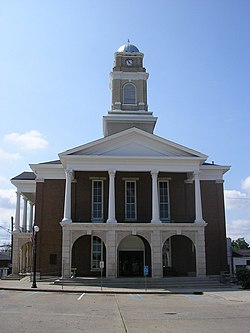
Garrard County Courthouse, Lancaster, Kentucky [Wikipedia]
 
As a young priest studying in the USA I had similar experiences in Lancaster, Kentucky, during the summers of 1969 and 1970. The parish priest, Fr Ralph Beiting, had college students from other parts of the USA work on various projects in his parish that covered nearly four counties and that had very few Catholics. There was still lingering prejudice against Catholics. One of the projects was to visit each home, in pairs, just as the Legion does, and introduce ourselves as being from the Catholic Church, and telling the people about our programmes. Again, the response was generally positive. In some rural homes we’d meet older people sitting on their rocking chairs on the veranda. They’d invite us to sit down and relax and would sometimes share a bit about their Bible-based faith. As we’d leave we’d hear the friendly farewell so common in the area, ‘Y’all come back!’
 
Fr Ralph Beiting
 
Some of the programmes we invited children to were summer Bible schools and five-day vacations for poor children in a summer camp, boys one week and girls another week. Black and white children would be together at a time when this was rare in that part of the USA.
 
Only God knows what can result from going from house to house as a way of carrying the mission that Jesus gave to the Twelve and that he gives to us. He doesn’t guarantee ‘success’ but simply sends us out in trust.
 
One of Father Beiting’s summer apostolates for many years was street-preaching, very often with seminarians. On one occasion years ago he was driven out of one town at gunpoint but returned the next day, not to preach but simply to show himself. He was eventually not only accepted but welcomed. He, a Catholic priest, was continuing an old tradition in the area, the travelling preacher. He was one of the very few left. Fr Beiting, born on 1 January 1924,  was ordained in 1949 and up to his late 80s he was still going strong. Here he is preaching during the summer of 2011. He died the following summer on 9 August 2012. What a wonderful example he was as a disciple of Jesus and as a Catholic priest!


A favourite hymn of Fr Beiting and of the people in Kentucky was The Old Rugged Cross, written in 1912 by Methodist evangelist George Bennard.


Posted in: Sunday Reflections Tagged: Christian Appalachian Project, Fr Ralph Beiting, Kentucky, Legion of Mary, Liverpool, Peregrinatio pro Christo, Pewsey, Sunday Reflections

‘A spring flower in the desert.’ Sunday Reflections, 14th Sunday in Ordinary Time, Year B

July 2, 2015 by Father Sean Coyle

Keiko Shemura on her First Communion Day, December 1971
Keiko died 27 April 1972, aged 14
Readings
(New American Bible:
Philippines, USA)
Readings
(Jerusalem Bible: Australia,
England & Wales, India [optional], Ireland, New Zealand, Pakistan,
Scotland, South Africa)
Gospel Mark 6:1-6 (New Revised Standard Version, Catholic Edition, Canada) 


Jesus left that place and came to his hometown, and his disciples followed him. On the sabbath he began to teach in the synagogue, and many who heard him were astounded. They said, “Where did this man get all this? What is this wisdom that has been given to him? What deeds of power are being done by his hands! Is not this the carpenter, the son of Mary and brother of James and Joses and Judas and Simon, and are not his sisters here with us?” And they took offense at him. Then Jesus said to them, “Prophets are not without honor, except in their hometown, and among their own kin, and in their own house.” And he could do no deed of power there, except that he laid his hands on a few sick people and cured them. And he was amazed at their unbelief.


Cherry blossoms in Fukushima [Wikipedia]
Both the New American Bible and the Jerusalem Bible lectionaries read, He was amazed at their lack of faith. Jesus was among his own people, in the town where his brothers and sisters, ie, his cousins, lived. Perhaps his amazement was a form of frustration. Missionaries are men and women who are often ‘amazed’ at what seems to be their lack of ‘success’ in changing the situation, whether it is leading people to faith in Jesus Christ or working among baptised people for the justice that the Gospel demands but evidently isn’t there.
 
Yet Jesus laid his hands on a few sick people and cured them. In other words, he found some who responded in faith.
 
One Columban priest who found faith in Keiko, a very sick 14-year-old girl in Japan, was Fr James Norris, a New Zealander who died on 6 October 2007. Japan is still a country where fewer than one in two hundred are Catholics. He wrote about his experience in Far East, the magazine of the Columbans in Ireland and Britain, in 1973. Father Jim’s article made a profound impact on me and I reprinted it in Misyon in March-April 2008. our last printed edition. It is a story that moves me each time I think about it. Maybe the few who believed and were healed consoled Jesus in his humanity. Maybe he felt something of what Father Norris describes in the closing paragraph of his article.

The story of Keiko and her parents shows us that our Catholic Christian faith is a gift from God, a gift for which we should thank him every day.
 
A Spring Flower
by Fr James Norris 
 
Cherry blossoms at the Tokyo Imperial Palace [Wikipedia]
 
There is a high school in our parish for nearly 2,000 girls conducted by the Sisters of the Infant of Jesus. Very few of these girls are baptized Christians. As a means of contact, I teach English to the junior high school pupils three times a week. My classes are very informal and I am afraid the young ladies don’t take me very seriously, possibly because I give them no homework or exams. My specialty is supposed to be pronunciation and intonation.
 
One day, early in November 1971, I received a summons from one of my little pupils, Keiko Uemura, aged 14. She was very sick in the hospital and wished to be baptized. I hadn’t noticed her absence at school. The nuns were full of apologies for not letting me know, but they hadn’t thought her illness was serious; moreover, she had never shown any real interest in religion but on the contrary, during religious classes seemed to take a delight in trying to tie the Sister up in knots with embarrassing questions.
 
When I visited her she seemed in good spirits. After ascertaining that she really did believe and had sufficient knowledge to realize what she was doing, I baptized her. A few days later I returned to the hospital with several books that explained the faith simply and would help her to pray. She began to prepare for her first Holy Communion. I discovered that despite her seemingly frivolous behavior during religion classes, she had retained quite a lot and what was more, in her present crisis could believe, simply and totally, with no reservations. 
 
In December she was moved to the University hospital, the largest in town and the best equipped. Keiko herself was not aware of it, but she was suffering from a rare type of bone cancer that sometimes afflicted children. The doctor gave her three months to live. Her parents were wonderful. One of them was always near her, day and night. In her case this devoted warm parental love was an actual grace that served to open out and expand her soul to receive the grace of God’s love. As Keiko responded to God’s love, the change in her thinking and outlook, her values, could not fail to impress her parents who in turn were drawn along by the girl towards God.
 
About Christmas time she made her first Holy Communion. She was radiantly happy that day, as is evident from the photo. Present for the occasion were her parents and some of the Sisters from the school. I made a tape recording for future use. Each week I took her Holy Communion. Her mother prepared the altar and with Keiko read the book on doctrine explaining the faith.
 
Home for the New Year
The girl was permitted to return home for three days over the New Year. As a result of an operation she had recovered so well that she could walk about slowly with the aid of crutches. She believed she was on the way to complete recovery; she was full of roseate plans for her future, a trip to Lourdes followed by a life of service as a nurse to crippled children. Her father hoped against hope for a miracle, but on the quiet he assured me that it was only a question of time.
 
Spiritual progress
During the next three months she made tremendous spiritual progress. Her mother told me that she herself was sometimes concerned by the flood of visitors, who often outstayed their welcome, even when Keiko was in pain. But the girl never showed it; she always put on a cheerful front and showed her gratitude to all-comers. Later when her mother grumbled about the inconsiderateness of some people, the girl stopped her with: ‘Mother, it may be alright for you to complain because you are not a Christian, but I am one now and must love everybody. Besides, the visitors come because they are interested in me and I am grateful for this.’ Apart from the occasional sigh or moan that escaped her lips, she never complained of the pain.
 
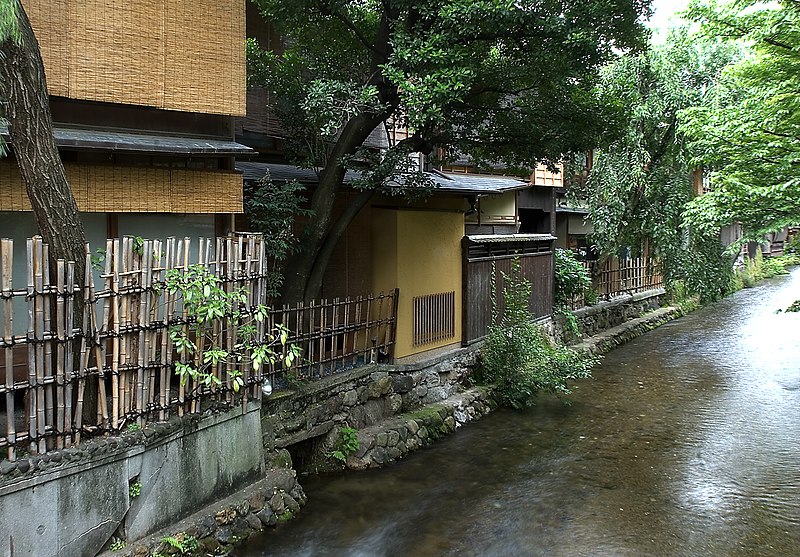
Shirakawa River [Wikipedia]
 
As the long winter faded, the cherry blossom trees along the Shirakawa River responded to the warm April sun and flooded the banks with a soft pink mist. I could see the blossoms from the window of her room, but the girl was too young to appreciate the pathos of their beauty – those petals whose destiny was to diffuse their delicate beauty for a brief span, only to be caught by the slightest breeze and flutter to the earth from which they sprang. Keiko never saw her own life and destiny in those blossoms.
 
About the middle of April she began to weaken. Within a week, she had lost consciousness and was given oxygen. She died peacefully on 27 April. The church was filled at her funeral. Her classmates were heartbroken and inconsolable, far more emotionally upset than her family. Indeed, I was surprised at how calmly her parents bore their great loss. I discovered it was because they had received the grace of the faith through the girl’s influence, even before they had begun any formal instructions. They were convinced that she still lived on in God and that they would meet her again.
 
Whole family converted
A week after the funeral her parents and her brother began their study of the doctrine. They were model catechumens. Every night before the family altar, united to Keiko in spirit, they said the rosary and read a chapter from the Scriptures. I baptized them on 6 November, the anniversary of Keiko’s baptism. There were tears of joy in their eyes that day as they realized they were united to their daughter by grace within the bosom of God the Father.
 
One of Keiko’s closest friends who was shattered by her death but very impressed by the spiritual change in the girl before her death, has resolved to follow in her footsteps and pursue the ideal of service Keiko set for herself had she lived. She is now under instructions and intends to become a nurse.
 
Fr James Norris after officiating at the joint wedding ceremony of three brothers in Japan
Testimony of her faith
There was nothing sensational about this girl’s short life. She did nothing that would merit notice in the mass media; her life created no more of a stir in society than a petal falling to the ground. But I am convinced her story is real news and a genuine success story. In these days of superficial sensationalism, even we Christians tend to forget that the real battles of life are won or lost within the depths of the heart where a man meets his God and says yes or no.
 
Moreover, in a country like Japan, a missioner seldom sees the grace of God’s action working so powerfully and swiftly in a soul. Such tangible evidence of God’s presence is almost a physical sign of His love which bolsters one’s hope no end, enabling the missioner to keep going. This slip of a girl was a candle in the darkness, a spring flower in the desert.
 Mater Dei, Mother of God, Japan
Unknown artist, c.1900-05, painting on silk
 
Ave Maria in Japanese
Composer: Saburo Takada; singer: Atsuko Azuma
Posted in: Sunday Reflections Tagged: faith, Fr James Norris, Japan, Keiko Uemura, Sunday Reflections

Recent Posts

  • ‘I do choose. Be made clean!’ Sunday Reflections, 6th Sunday in Ordinary Time, Year B
  • ‘They brought to him all who were sick.’ Sunday Reflections, 5th Sunday in Ordinary Time, Year B
  • ‘He taught them as one having authority.’ Sunday Reflections, 4th Sunday in Ordinary Time, Year B
  • Columban Fr Donal O’Farrell RIP
  • Columban Fr Matthew Reilly RIP

Archives

  • February 2018
  • January 2018
  • December 2017
  • November 2017
  • October 2017
  • September 2017
  • August 2017
  • July 2017
  • June 2017
  • May 2017
  • April 2017
  • March 2017
  • February 2017
  • January 2017
  • December 2016
  • November 2016
  • October 2016
  • September 2016
  • August 2016
  • July 2016
  • June 2016
  • May 2016
  • April 2016
  • March 2016
  • February 2016
  • January 2016
  • December 2015
  • November 2015
  • October 2015
  • September 2015
  • August 2015
  • July 2015
  • June 2015
  • May 2015
  • April 2015
  • March 2015
  • February 2015
  • January 2015
  • December 2014
  • November 2014
  • October 2014
  • September 2014
  • August 2014
  • July 2014
  • June 2014
  • May 2014
  • April 2014

Copyright © 2026 The Pilgrims' Inn.

Hotel WordPress Theme by themehall.com