The Pilgrims' Inn

  • Welcome to The Pilgrims’ Inn
‘I do choose. Be made clean!’ Sunday Reflections, 6th Sunday in Ordinary Time, Year B

El Greco

‘I do choose. Be made clean!’ Sunday Reflections, 6th Sunday in Ordinary Time, Year B

February 7, 2018 by Father Sean Coyle

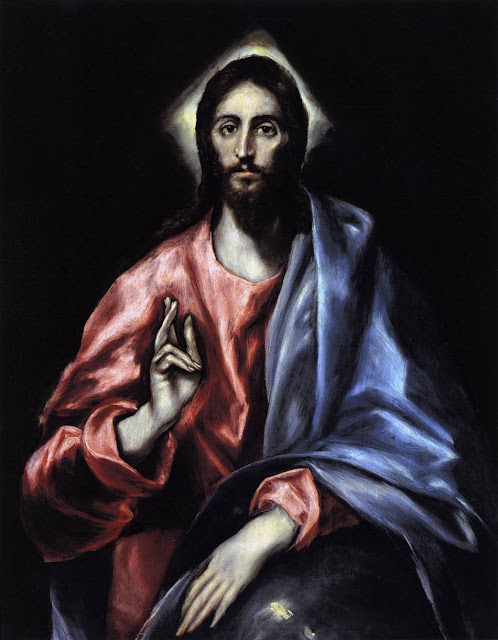
Christ as Saviour, El Greco [Web Gallery of Art]

Readings (New American Bible: Philippines, USA)

Readings (Jerusalem Bible: Australia, England & Wales, India [optional], Ireland, New Zealand, Pakistan, Scotland, South Africa)

Gospel Mark 1:40-45 (New Revised Standard Version, Anglicised Catholic Edition) 

A leper came to Jesus begging him, and kneeling he said to him, ‘If you choose, you can make me clean.’ Moved with pity, Jesus stretched out his hand and touched him, and said to him, ‘I do choose. Be made clean!’ Immediately the leprosy left him, and he was made clean. After sternly warning him he sent him away at once, saying to him, ‘See that you say nothing to anyone; but go, show yourself to the priest, and offer for your cleansing what Moses commanded, as a testimony to them.’ But he went out and began to proclaim it freely, and to spread the word, so that Jesus could no longer go into a town openly, but stayed out in the country; and people came to him from every quarter.

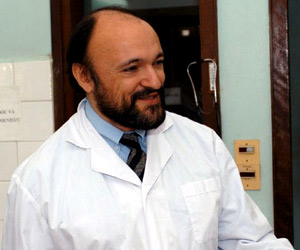
Dr Carlo Urbani

(1956 – 2004) [Wikipedia]

Towards the end of February 2003 Dr Carlo Urbani, an Italian, went to Vietnam, representing the World Health Organisation, to investigate an American businessman who was showing unusual symptoms. It turned out to be severe acute respiratory syndrome (SARS), a highly contagious virus. The man who discovered this new disease died from it himself about a month later on 29 March. In a conscious moment, while in the ICU in a hospital in Bangkok, he asked for a priest to give him the Last Rites.

Vladimir Redzioch of Inside the Vatican interviewed Giuliana Chiorrini, the widow of Dr Urbani. MISYON, the Columban magazine in the Philippines, published the interview, with permission, in its March-April 2004 issue. Here are extracts from the interview.

ITV: Your husband chose to work with the sick and poor around the world. Why?

Giuliana Chiorrini: Carlo was always involved in volunteer work and since his youth was attracted by the poor. He cultivated the desire to discover new horizons. To do this he left for Africa with the missionaries. Since his days as a young student with a backpack full of medicines, he had traveled in Africa (Mali, Niger, and Benin). Afterwards he work in solidarity camps run by the Xaverian Fathers, Catholic Action and Open Hands. He was always in contact with missionaries. As a doctor he wrote for the missionary magazine Missioni Consolata. Carlo also fulfilled his desire to help he poor during his 10 years working at the hospital in Macerata. This confirmed him in his work with Médecins Sans Frontières, of which he was the president, and in this capacity he received the Nobel Peace Prize when it was conferred on the organization in 1999.

ITV: What role did his faith play in his choice of life?

Chiorrini: Faith had an extremely important role in my husband’s life. Everything he did enriched the spiritual lives of the people who were in contact with him. He was also very sensitive to the beauty of creation – he even used to go hang-gliding to admire nature.

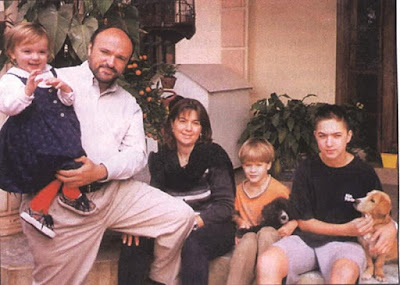
Dr Carlo Urbani with his wife, Giuliana, and their children, Maddalena, Luca and Tommaso [Source]

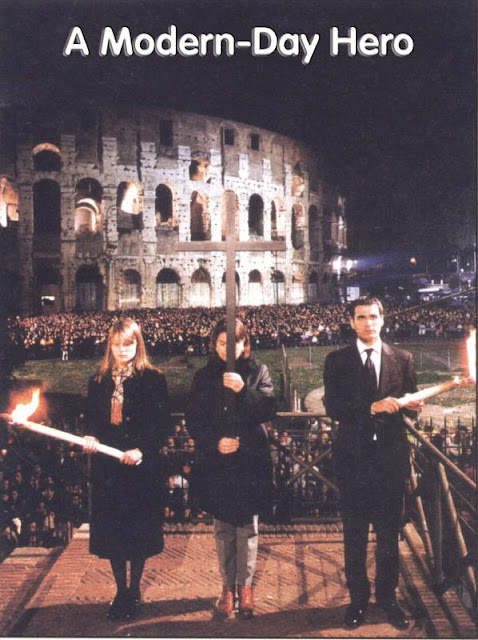
That year St John Paul II invited the family of Dr Urbani to carry the Cross during the Via Crucis on Good Friday, 18 April, in the Colosseum.
ITV: This year, during the Via Crucis at the Colosseum, you and your son carried the cross. How did you react when you heard you had been chosen by the Holy Father, and what significance did it have for your family to participate in this Good Friday liturgy?
Chiorrini: I am a believer, as was my husband, and knowing I was to carry the cross during the Via Crucis touched me a great deal, as well as giving me an enormous joy. It was a very intense moment of the interior spirituality and in all honesty it was also very moving, with the evocative atmosphere which was created that evening.

Giuliana Chiorrini, Dr Urbani’s widow, carries the cross during the Via Crucis at the Colosseum, Good Friday 2003

If you choose, you can make me clean. Like Jesus, Dr Carlo Urbani chose and made many clean, sacrificing his own life in doing so.

Antiphona ad communionem
Communion Antiphon  Cf Psalm 77[78]:29-30

Manducaverunt, et saturati sunt nimis,

They ate and had their fill,

et desiderium eorum attulit eis Dominus;

and what they craved the Lord gave them;

non sunt fraudati a desiderio suo.

they were not disappointed in what they craved.

In the Ordinary Form of the Mass this is the first of two options for the Communion Antiphon. In the Extraordinary Form of the Mass it is the Communion Antiphon for Quinquagesima Sunday, the Sunday before Ash Wednesday.

Posted in: Sunday Reflections Tagged: Dr Carlo Urbani, El Greco, Giuliana Chiorrini, SARS, Sunday Reflections

‘Jesus said to them,”Come and see”.’ Sunday Reflections, 2nd Sunday in Ordinary Time, Year B

January 10, 2018 by Father Sean Coyle

From The Gospel of John, directed by Philip Saville

Readings (New American Bible: Philippines, USA)

Readings (Jerusalem Bible: Australia, England & Wales, India [optional], Ireland, New Zealand, Pakistan, Scotland, South Africa)

Gospel John 1:35-42 (New Revised  Standard Version, Anglicised CatholicEdition) 

The next day John again was standing with two of his disciples, and as he watched Jesus walk by, he exclaimed, ‘Look, here is the Lamb of God!’ The two disciples heard him say this, and they followed Jesus. When Jesus turned and saw them following, he said to them, ‘What are you looking for?’ They said to him, ‘Rabbi’ (which translated means Teacher), ‘where are you staying?’ He said to them, ‘Come and see.’ They came and saw where he was staying, and they remained with him that day. It was about four o’clock in the afternoon. One of the two who heard John speak and followed him was Andrew, Simon Peter’s brother. He first found his brother Simon and said to him, ‘We have found the Messiah’ (which is translated Anointed. He brought Simon to Jesus, who looked at him and said, ‘You are Simon son of John. You are to be called Cephas’ (which is translated Peter).

St Andrew the Apostle, El Greco [Web Gallery of Art]

God calls each of us to our particular vocation in life in a unique way. Pope Francis has told us, for example, that it was on the occasion of going to confession when he was 17 that he saw clearly that God was calling him to be a priest. A couple at whose wedding I officiated some years ago were members of the same Catholic organisation in the university they attended. They became an ‘item’, as they say in the Philippines, when they were the only members of the group to turn up at the appointed time for an outing. While waiting for the others to arrive they discovered that they were more than just casual friends. Now they are happily married with four children.

I’m always amused by the Second Reading from the Office of Readings for the feast of St Anthony the Abbot, 17 January. St Athanasius tells us: He went into the church. It happened that the gospel was then being read, and he heard what the Lord had said to the rich man ‘If you would be perfect, go, sell what you possess and give to the poor, and you will have treasure in heaven; and come, follow me.’

The young man Anthony, whose parents had died about six months previously, took these words to heart and went to live in the desert. He became, without planning it, the ‘Father of Monasticism’ in the Church. And perhaps if he had not been late for Mass that day the Gospel might not have struck him as it did. He was to be ‘later’ than most in another sense in that he was 105 when he died, a remarkable age to live to now but even more remarkable in the fourth century! Unlike the married couple above whose punctuality led them to discover God’s call for them, it was through being late for Mass that Anthony discovered what God had in mind for him.

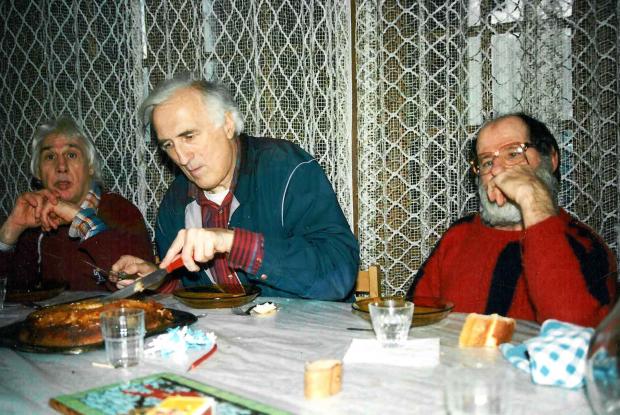
Raphaël Simi, Jean Vanier and Philippe Seux, 2014

In 1964 Jean Vanier invited two men with learning disabilities, Raphael Simi and Philippe Seux, who had been living in institutions, to live with him in a small cottage that he bought and renovated in France. Having done so he realized that he had made a commitment to these two men and that his commitment involved remaining single. He had no intention of founding a movement but, in God’s plan, that’s what came about: L’Arche. Raphaël and Philippe are now considered, with Jean, co-founders of L’Arche.

Fr Hans Urs von Balthasar, a great Swiss theologian much admired by St John Paul II, in reflecting on today’s Gospel from the First Chapter of St John, links it to an incident in the last chapter, John 21: 15 ff [starting at 0:55 in the video below].

Fr von Balthasar writes: In the last chapter of the book Peter will be the foundation stone to such a degree that he will also have to undergird ecclesial love: ‘Simon, do you love me more than these?’

John 21:15-17 was the gospel read at the Pope’s Mass in Manila Cathedral on 16 January 2015 with priests, religious, consecrated persons and seminarians. This passage shows what is at the heart of every call from God, whether to marriage, to the priesthood, to the consecrated life, to the single life. The call is above all to an intimate relationship with Jesus. Pope Francis highlighted this in his homily: For us priests and consecrated persons, conversion to the newness of the Gospel entails a daily encounter with the Lord in prayer. The saints teach us that this is the source of all apostolic zeal! For religious, living the newness of the Gospel also means finding ever anew in community life and community apostolates the incentive for an ever closer union with the Lord in perfect charity. For all of us, it means living lives that reflect the poverty of Christ, whose entire life was focused on doing the will of the Father and serving others.

Pope Francis also said, The poor are at the center of the Gospel, are at heart of the Gospel; if we take away the poor from the Gospel we can’t understand the whole message of Jesus Christ.

Living the Gospel within the context of a deep personal relationship with Jesus the Risen Lord involves seeing reality through the eyes of those with little in life. Pope Francis showed this in a beautiful way by an unplanned – at least it wasn’t on the official schedule – to a group of very poor children at TNK in Manila, near the Cathedral. (‘Tulay ng Kabataan’ means ‘A Bridge to Children’).

Posted in: Sunday Reflections Tagged: El Greco, Jean Vanier, Manila, Pope Francis, Sunday Reflections, Tulay ng Kabataan

‘The seed of eternal life.’ Sunday Reflections, The Baptism of the Lord, Year B

January 6, 2018 by Father Sean Coyle

Baptistry, St Mark’s, Venice [Web Gallery of Art]

Readings (New American Bible: Philippines, USA)

Readings (Jerusalem Bible: Australia, England & Wales, India [optional], Ireland, New Zealand, Pakistan, Scotland, South Africa)

Gospel Mark 1:7-11 (New Revised  Standard Version, Anglicised CatholicEdition) 

John the Baptist proclaimed, ‘The one who is more powerful than I is coming after me; I am not worthy to stoop down and untie the thong of his sandals. I have baptized you with water; but he will baptize you with the Holy Spirit.’

In those days Jesus came from Nazareth of Galilee and was baptized by John in the Jordan. And just as he was coming up out of the water, he saw the heavens torn apart and the Spirit descending like a dove on him. And a voice came from heaven, ‘You are my Son, the Beloved; with you I am well pleased.’

In countries where the Baptism of the Lord is celebrated this year on Monday 8 January, eg the Philippines and the USA, there is only one reading before the Gospel and the Creed is omitted.

Feast of the Baptism of the Lord 2013

FEAST OF THE BAPTISM OF THE LORD

MASS AND ADMINISTRATION OF THE SACRAMENT OF BAPTISM

HOMILY OF HIS HOLINESS BENEDICT XVI

Sistine Chapel, Sunday, 8 January 2012

[I have highlighted parts of the Pope’s homily]

Dear Brothers and Sisters,

It is always a joy to celebrate this Holy Mass with the baptism of children on the Feast of the Baptism of the Lord. I greet you all with affection, dear parents, godparents and all of you, relatives and friends! You have come here — you said so aloud — so that your newborn babies may receive the gift of God’s grace, the seed of eternal life. You, parents, have desired this. You thought of Baptism even before your child was born. Your duty as Christian parents made you think immediately of the sacrament that marks entry into divine life and into the community of the Church. We can say that this was your first educational decision as witnesses of the faith to your children: it is a fundamental decision!

The parents’ task, helped by the godfather and godmother, is to raise their son or daughter. Raising children is very demanding and at times taxes our human capability, which is always limited. However, educating becomes a marvellous mission if it is carried out in collaboration with God who is the first and true educator of every human being.

In the First Reading, we heard from the Book of the Prophet Isaiah, God addresses his people precisely as a teacher. He puts the Israelites on their guard against the danger of quenching their thirst and appeasing their hunger at the wrong sources: “Why”, he says, “do you spend your money for that which is not bread, and your labour for that which does not satisfy?” (Is 55:2). God wants to give us good things to drink and to eat, things that do us good; whereas at times we use our resources mistakenly, we use them for things that are useless, indeed, even harmful. Above all, God wants to give us himself and his Word. He knows that in distancing ourselves from him we will soon run into difficulty — like the Prodigal Son of the parable — and, especially, that we will lose our human dignity. And for this reason he assures us that he is infinite mercy, that his thoughts and ways are unlike ours — fortunately! — and that we can always return to him, to the Father’s house. Thereafter he assures us that if we receive his Word it will bear good fruits in our life, like the rain that waters the earth (cf. Is 55:10-11).

We responded to these words which the Lord has addressed to us through the Prophet Isaiah with the refrain of the Psalm: We will “draw water joyfully from the springs of salvation”. As adults, we have striven to draw from the good springs for our own good and for the good of those entrusted to our responsibility, and you in particular, dear parents and godparents, for the good of these children.

And what are “the springs of salvation”? They are the Word of God and the sacraments. Adults are the first who should nourish themselves at these sources, so as to be able to guide those who are younger in their development. Parents must give much, but in order to give they need in turn to receive, otherwise they are drained, they dry up. Parents are not the spring, just as we priests are not the spring. Rather, we are like channels through which the life-giving sap of God’s love must flow. If we cut ourselves off from his spring, we ourselves are the first to feel the negative effects and are no longer able to educate others. For this reason we have committed ourselves by saying: We will “draw water joyfully from the springs of salvation”.

The Baptism of Christ, El Greco [Web Gallery of Art]

The Baptism of Christ, El Greco [Web Gallery of Art]

And we now come to the Second Reading and to the Gospel. They say that the first and principal education takes place through witness. The Gospel speaks of John the Baptist. John was a great educator of his disciples, because he led them to the encounter with Jesus to whom he bore witness. He did not exalt himself, he did not wish to keep his disciples bound to him. Yet John was a great prophet, his fame was very great. When Jesus arrived John drew back and pointed to him: “After me comes he who is mightier than I…. I have baptized you with water; but he will baptize you with the Holy Spirit” (Mk 1:7-8).

The true teacher does not bind people to himself, he is not possessive. He wants his son or daughter, or disciple, to learn to know the truth and to establish a personal relationship with it. The educator does his duty fully, he assures his attentive and faithful presence because his objective is that the person being educated listen to the voice of truth speaking to his heart and follow it on a personal journey.

Let us return once again to the witness. In the Second Reading, the Apostle John writes: “And the Spirit is the witness” (1 Jn 5:7). He is referring to the Holy Spirit, the Spirit of God, who bears witness to Jesus, testifying that he is the Christ, the Son of God. This is also apparent in the scene of the Baptism in the River Jordan: the Holy Spirit descends upon Jesus as a dove to reveal that he is the Only-Begotten Son of the eternal Father (cf. Mk 1:10). In his Gospel too, John underlines this aspect where Jesus says to the disciples: “When the Counselor comes, whom I shall send to you from the Father, even the Spirit of truth, who proceeds from the Father, he will bear witness to me; and you also are witnesses, because you have been with me from the beginning” (Jn 15:26-27). This is a great comfort to us in the work of educating in faith, because we know that we are not alone and that our witness is sustained by the Holy Spirit.

It is very important for you parents, and also for the godparents, to believe strongly in the presence and in the action of the Holy Spirit, to invoke him and to welcome him within you, through prayer and through the sacraments. It is he, in fact, who illumines the mind and warms the heart of the educator so that he or she can pass on the knowledge and love of Jesus. Prayer is the first condition for teaching because by praying we prepare ourselves to leave the initiative to God, to entrust children to him, who knows them before and better than we, and who knows perfectly what their true good is. And at the same time, when we pray we listen to God’s inspiration in order to do our part well, which in any case is our duty and which we are bound to do. The sacraments, especially the Eucharist and Penance, enable us to carry out our educational action in union with Christ, in communion with him and continuously renewed by his forgiveness. Prayer and the sacraments obtain for us that light of truth thanks to which we are able to be at once tender and strong, gentle and firm, silent and communicative at the right time, admonishing and correcting in the right way.

Dear friends, let us therefore all invoke the Holy Spirit together so that he may come down upon these children in abundance, consecrate them in the image of Jesus Christ and always go with them on their journey through life. Let us entrust them to the motherly guidance of Mary Most Holy, so that they may grow in age, wisdom and grace and become true Christians, faithful and joyful witnesses of God’s love. Amen.

A Catholic baptism [Wikipedia]

May each of us thank God today for our parents and godparents who brought us to be baptized so that we might receive ‘the seed of eternal life’.

Posted in: Sunday Reflections Tagged: Baptism, Baptism of Jesus, El Greco, Pope Benedict XVI, St John the Baptist, Sunday Reflections

‘Both Son of God and Son of Man together had one name.’ Sunday Reflections, 4th Sunday of Advent and Christmas

December 20, 2017 by Father Sean Coyle

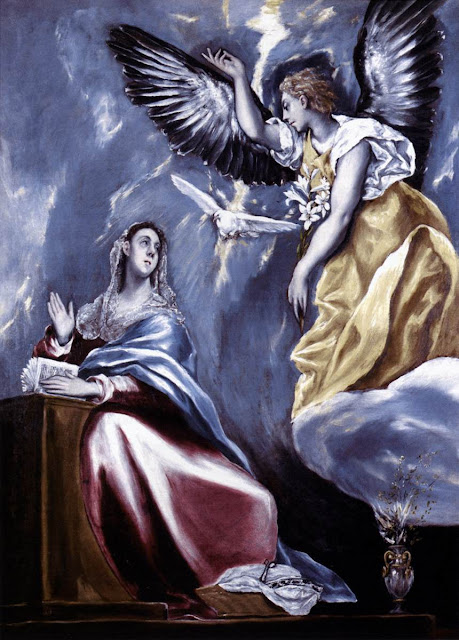
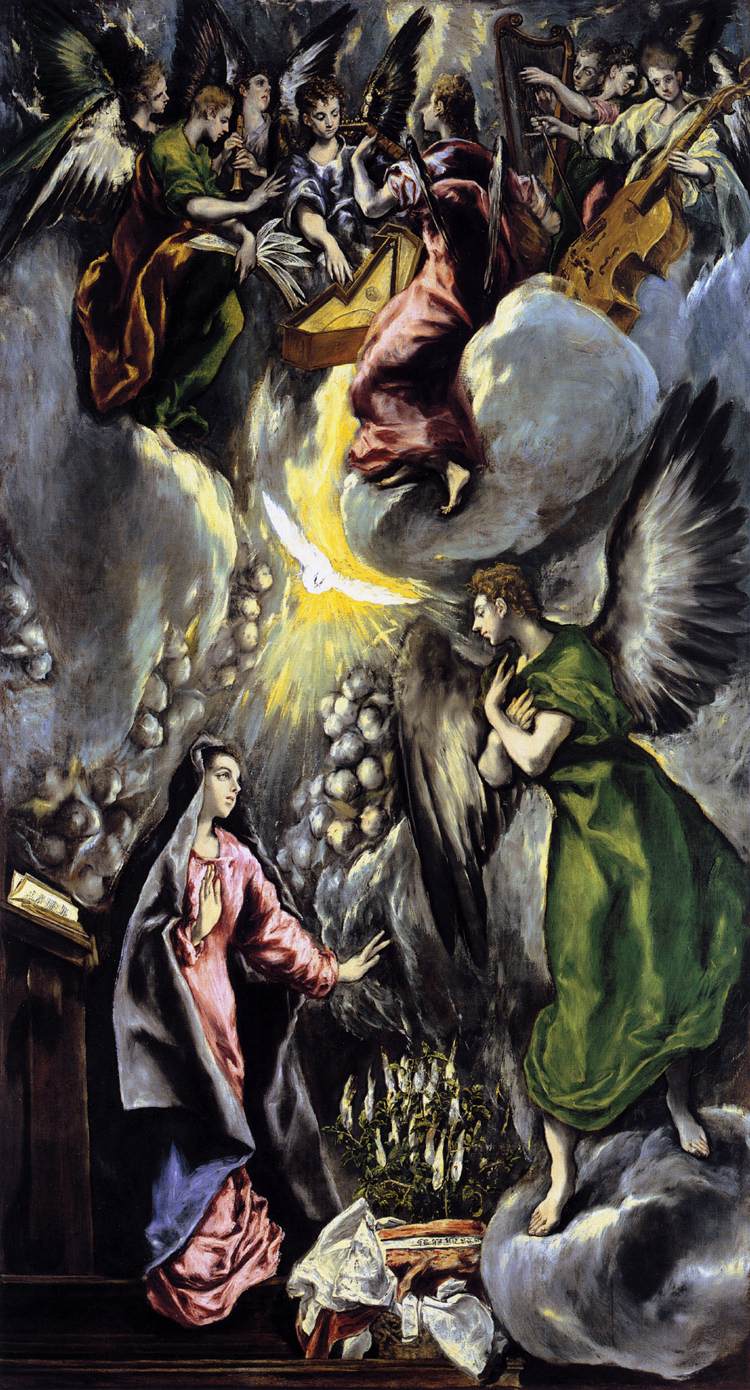
The Annunciation, El Greco [Web Gallery of Art]

Readings (New American Bible: Philippines, USA)

Readings (Jerusalem Bible: Australia, England & Wales, India [optional], Ireland, New Zealand, Pakistan, Scotland, South Africa)

Gospel Luke 1:26-38 (New Revised  Standard Version, Anglicised CatholicEdition) 

In the sixth month the angel Gabriel was sent by God to a town in Galilee called Nazareth, to a virgin engaged to a man whose name was Joseph, of the house of David. The virgin’s name was Mary. And he came to her and said, ‘Greetings, favoured one! The Lord is with you.’ But she was much perplexed by his words and pondered what sort of greeting this might be. The angel said to her, ‘Do not be afraid, Mary, for you have found favour with God. And now, you will conceive in your womb and bear a son, and you will name him Jesus. He will be great, and will be called the Son of the Most High, and the Lord God will give to him the throne of his ancestor David. He will reign over the house of Jacob for ever, and of his kingdom there will be no end.’ Mary said to the angel, ‘How can this be, since I am a virgin?’  The angel said to her, ‘The Holy Spirit will come upon you, and the power of the Most High will overshadow you; therefore the child to be born will be holy; he will be called Son of God. And now, your relative Elizabeth in her old age has also conceived a son; and this is the sixth month for her who was said to be barren. For nothing will be impossible with God.’ Then Mary said, ‘Here am I, the servant of the Lord; let it be with me according to your word.’ Then the angel departed from her.

The Annunciation, Gerard David [Web Gallery of Art]

The Incarnation

by St John of the Cross

Then He summoned an archangel, 

Saint Gabriel: and when he came, 

Sent him forth to find a maiden, 

     Mary was her name.


Only through her consenting love 

Could the mystery be preferred 

That the Trinity in human 

     Flesh might clothe the Word.


Though the three Persons worked the wonder 

It only happened to the One. 

So was the Word made incarnation 

     In Mary’s womb, a son.


So He who only had a Father 

Now had a Mother undefiled, 

Though not as ordinary maids 

     Had she conceived the Child.


By Mary, and with her own flesh 

He was clothed in His own frame: 

Both Son of God and Son of Man 

     Together had one name.   

                  [Translation by Roy Campbell]

In both paintings above Mary has the word of God, the Hebrew Bible, what we Christians call the Old Testament, open in front of her. And when she says, let it be with me according to your word, she is accepting the Word. The opening words of St John’s Gospel, read at the Mass During the Day on Christmas Day and read at the end of every Mass in the Extraordinary Form, tells us who the Word is: In the beginning was the Word, and the Word was with God, and the Word was God. Further on, in Verse 14, St John writes those magnificent words that are at the centre of our faith: And the Word became flesh and lived among us.

The Catechism of the Catholic Church quotes what St John of the Cross said about this: In giving us his Son, his only Word (for he possesses no other), he spoke everything to us at once in this sole Word – and he has no more to say. . . because what he spoke before to the prophets in parts, he has now spoken all at once by giving us the All Who is His Son. Any person questioning God or desiring some vision or revelation would be guilty not only of foolish behavior but also of offending him, by not fixing his eyes entirely upon Christ and by living with the desire for some other novelty.

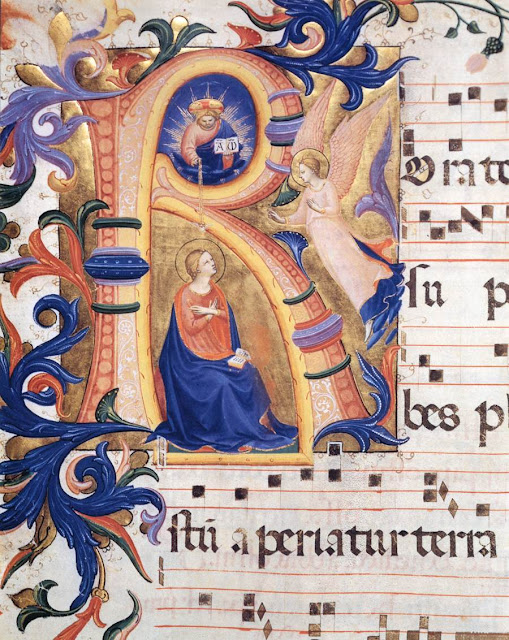
The Annunciation in an Initial R, Fra Angelico [Web Gallery of Art]

‘Silence’ is not what most of us associate with the days coming up to Christmas. But the Church invites us to enter into an inner silence during these days, difficult though that may be. The above is on a parchment, part of a Missal, which in the old days included the readings during Mass. Fra Angelico, a Dominican friar, was declared ‘Blessed’ by St John Paul II in 1982. This work again invites us into contemplation of the wondrous event of the Annunciation, the moment of the Incarnation when God became Man in the womb of Mary.

Julian of Vézelay (c.1080 – 1165), a French Benedictine monk, reflects on the silence into which Jesus entered, the silence that Mary bore in our heart, the silence that God invites us to enter at this time:

There came a deep silence. Everything was still. The voices of prophets and apostles were hushed, since the prophets had already delivered their message, while the time for the apostles’ preaching had yet to come. Between these two proclamations a period of silence intervened, and in the midst of this silence the Father’s almighty Word leaped down from his royal throne. There is a beautiful fitness here: in the intervening silence the Mediator between God and the human race also intervened, coming as a human being to human beings, as mortal to mortals, to save the dead from death.

I pray that the Word of the Lord may come again today to those who are silent, and that we may hear what the Lord God says to us in our hearts. Let us silence the desires and importunings of the flesh and the vainglorious fantasies of our imagination, so that we can freely hear what the Spirit is saying. Let our ears be attuned to the voice that is heard above the vault of heaven, for the Spirit of life is always speaking to our souls; as scripture says, a voice is heard above the firmament which hangs over our heads. But as long as we fix our attention on other things, we do not hear what the Spirit is saying to us.

Collect


Pour forth, we beseech you, O Lord,

your grace into our hearts,

that we, to whom the Incarnation of Christ your Son

was made known by the message of an Angel,

may by his Passion and Cross

be brought to the glory of the Resurrection.

Who lives and reigns with you in the unity of the Holy Spirit,

one God, for ever and ever.

  1. The angel Gabriel from heaven came
    His wings as drifted snow his eyes as flame
    ‘All hail’ said he ‘thou lowly maiden Mary,
    Most highly favored lady,’ Gloria!
  1. ‘For know a blessed mother thou shalt be,
    All generations laud and honor thee,
    Thy Son shall be Emanuel, by seers foretold
    Most highly favored lady,’ Gloria!
  1. Then gentle Mary meekly bowed her head
    ‘To me be as it pleaseth God,’ she said,
    ‘My soul shall laud and magnify his holy name.’
    Most highly favored lady. Gloria!
  1. Of her, Emmanuel, the Christ was born
    In Bethlehem, all on a Christmas morn
    And Christian folk throughout the world will ever say:
    ‘Most highly favored lady,’ Gloria!

The Nativity (Christmas) 

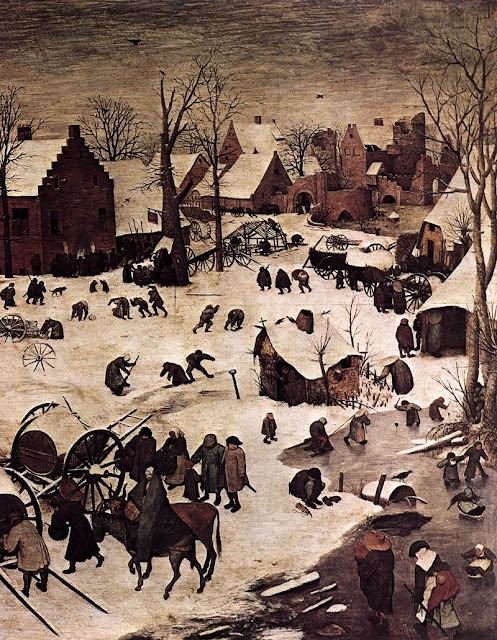
The Census at Bethlehem (detail)

Pieter Bruegel the Elder [Web Gallery of Art]

This was the moment when even energetic Romans

Could find nothing better to do

Than counting heads in remote provinces.

BC : AD

By U.A. Fanthorpe

This was the moment when Before

Turned into After, and the future’s

Uninvented timekeepers presented arms.


This was the moment when nothing

Happened. Only dull peace

Sprawled boringly over the earth.


This was the moment when even energetic Romans

Could find nothing better to do

Than counting heads in remote provinces.


And this was the moment

When a few farm workers and three

Members of an obscure Persian sect

Walked haphazard by starlight straight

Into the kingdom of heaven.

The Solemnity of the Nativity of the Lord has four different Mass formularies, each with its own prayer and readings. Any of the four fulfills our obligation to attend Mass. These are:

Vigil Mass, celebrated ‘either before or after First Vespers (Evening Prayer) of the Nativity’; that means starting between 5pm and 7pm.

Mass During the Night, known before as ‘Midnight Mass’. In many parts of the world it does begin at midnight but here in the Philippines since the 1980s it begins earlier, usually at 8:30pm or 9pm.

Mass at Dawn.

Mass During the Day.

When you click on ‘Readings’ below from the New American Bible you will find links to the readings for each of the four Masses. The readings from the Jerusalem Bible for the four Masses are all on one page.

Readings (New American Bible: Philippines, USA)

Readings (Jerusalem Bible: Australia, England & Wales, India [optional], Ireland, New Zealand, Pakistan, Scotland, South Africa)

Posted in: Sunday Reflections Tagged: Advent, Annunciation, Christmas, El Greco, Gerard David, Harry Belafonte, Jester Hairston, Sunday Reflections

‘Just as you did it to one . . . of my family, you did it to me.’ Sunday Reflections, Christ the King, Year A

November 24, 2017 by Father Sean Coyle

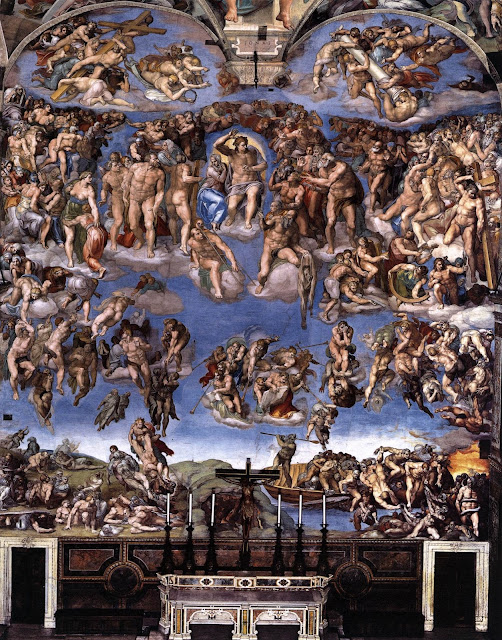
The Last Judgement, Michelangelo [Web Gallery of Art]

Readings (New American Bible: Philippines, USA)

Readings (Jerusalem Bible: Australia, England & Wales, India [optional], Ireland, New Zealand, Pakistan, Scotland, South Africa)

Gospel Matthew 25:31-46 (New Revised  Standard Version, Anglicised CatholicEdition) 

Jesus said to his disciples:

 ‘When the Son of Man comes in his glory, and all the angels with him, then he will sit on the throne of his glory. All the nations will be gathered before him, and he will separate people one from another as a shepherd separates the sheep from the goats, and he will put the sheep at his right hand and the goats at the left. Then the king will say to those at his right hand, “Come, you that are blessed by my Father, inherit the kingdom prepared for you from the foundation of the world; for I was hungry and you gave me food, I was thirsty and you gave me something to drink, I was a stranger and you welcomed me, I was naked and you gave me clothing, I was sick and you took care of me, I was in prison and you visited me.”  Then the righteous will answer him, “Lord, when was it that we saw you hungry and gave you food, or thirsty and gave you something to drink? And when was it that we saw you a stranger and welcomed you, or naked and gave you clothing? And when was it that we saw you sick or in prison and visited you?” And the king will answer them, “Truly I tell you, just as you did it to one of the least of these who are members of my family, you did it to me.” Then he will say to those at his left hand, “You that are accursed, depart from me into the eternal fire prepared for the devil and his angels; for I was hungry and you gave me no food, I was thirsty and you gave me nothing to drink, I was a stranger and you did not welcome me, naked and you did not give me clothing, sick and in prison and you did not visit me.” Then they also will answer, “Lord, when was it that we saw you hungry or thirsty or a stranger or naked or sick or in prison, and did not take care of you?” Then he will answer them, “Truly I tell you, just as you did not do it to one of the least of these, you did not do it to me.” And these will go away into eternal punishment, but the righteous into eternal life.’

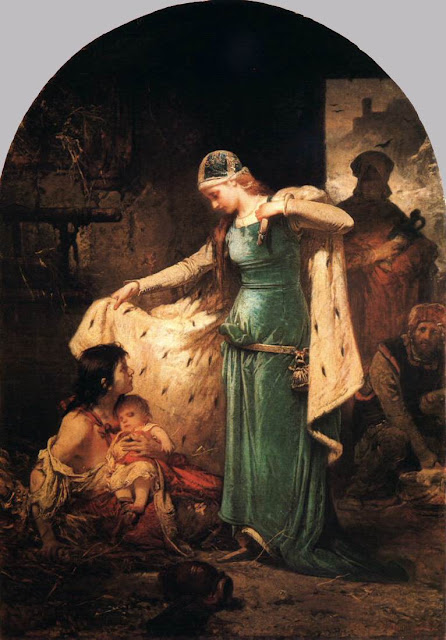
St Elizabeth of Hungary, Sándor Liezen-Mayer [Web Gallery of Art]

In November 1974 some members of the Praesidium of the Legion of Mary of which I was spiritual director came to me and told me of two starving children, a brother and sister, that they had come across on home visitation. The Legionaries were students in the college department of what was then Immaculate Conception College, Ozamiz City, where I was chaplain. At the time ICC was run by the Columban Sisters. It is now La Salle University, under the care of the De La Salle Brothers.

We arranged with the parents to take the two children to the local government hospital. When I saw Linda, as I will call her, I thought she was a malnourished eight year old. I was utterly shocked when I learned that she was twelve. Her brother, whom I’ll call Nonoy, was five. His ribs were sticking out and his stomach severely bloated. The eldest in the family, a girl aged 13 or 14, showed no signs of malnutrition. This was the first time I had ever met anyone with signs of starvation. I never discovered why the children were in such a state.

After a few days Linda began to shyly smile and slowly got a little better, due to the nourishment and attention she was getting. But Nonoy showed no signs of improvement. He died two days before Christmas, without once smiling. We buried him on Christmas Eve.

Linda was able to go home and on at least once occasion we took her on an outing. She was still very small for her age but always cheerful whenever we met her. However, the severe malnutrition had taken its toll and she died in September 1975 while I was at home in Ireland.

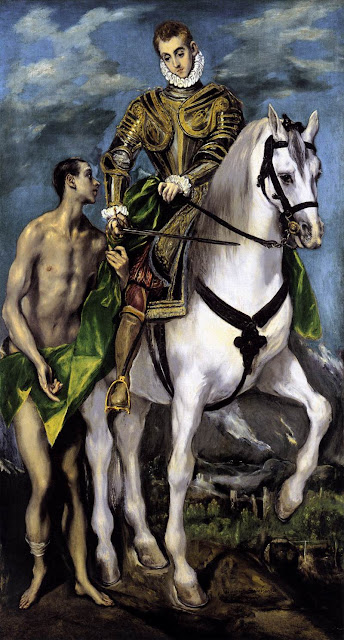
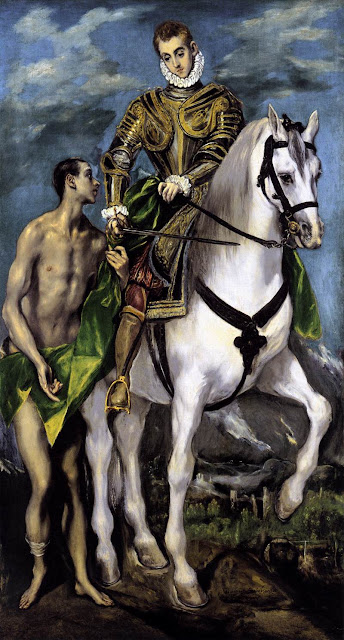
St Martin and the Beggar, El Greco [Web Gallery of Art]

 Today’s Gospel makes me both fearful and hopeful. 

Fearful, because Jesus speaks such harsh language: You that are accursed, depart from me into the eternal fire prepared for the devil and his angels. This is not ‘the Church of nice’.

Hopeful, because Linda and Nonoy will be there at the Last Judgment to speak in my behalf.

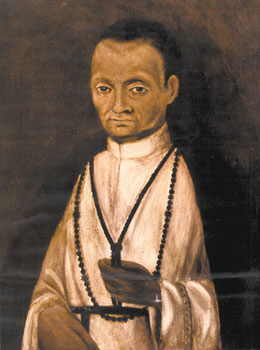
St Martin de Porres OP [Wikipedia]

This portrait was painted during his lifetime or very soon after his death, hence it is probably the most true to his appearance.

During November the Church honours three saints noted for their extraordinary love for the poor, St Martin de Porres (1579 – 1639) on the 3rd, St Martin of Tours (316 – 397) on the 11th and St Elizabeth of Hungary (1207 – 1231) on the 17th. These three gave of their very self. These exemplified in their lives what Jesus is teaching us in today’s gospel.

El Greco is one of many artists who have depicted the scene of St Martin of Tours, then a young soldier and preparing for baptism, giving half of his cloak in the depths of winter to a beggar clad only in rags. The following night, the story continues, Martin in his sleep saw Jesus Christ, surrounded by angels, and dressed in the half of the cloak he had given away. A voice bade him look at it well and say whether he knew it. He then heard Jesus say to the angels, ‘Martin, as yet only a catechumen, has covered me with his cloak.’ Sulpicius Severus, the saint’s friend and biographer, says that as a consequence of this vision Martin ‘flew to be baptized’.

Sándor Liezen-Mayer in his painting of St Elizabeth of Hungary above, shows her protecting a young mother and baby with her cloak. The saint herself was a young mother. She married at 14, bore three children and was widowed at 20. The painting reminds me of a beautiful Irish blessing, Faoi bhrat Mhuire thú/sibh (‘May thou/you be protected by the cloak of Mary’). The young saint, who was only 24 when she died, followed the example of St Francis, with the blessing of her husband, lived very simply and served the poor and the sick each day personally and ate with them at the same table.

Shrine of St Martin de Porres in Lima [Wikipedia]

St Martin de Porres, born outside of marriage and of mixed blood, learned some of the medical arts by working with a barber/surgeon in his young days. He devoted his life as a Dominican lay brother to caring for the sick, whether they were rich or poor. It was mostly the latter who came to him and whom he went looking for. Like St Francis he had a special closeness to animals and people brought these to him to be healed. He is often depicted carrying a broom, with a dog, a cat and a mouse at his feet eating from the same plate. 

These three saints from different social backgrounds wrestled with situations we wrestle with today. They spent themselves in bringing about the Kingdom of God by serving the very poorest. St Martin of Tours, who like St Elizabeth was born in Hungary, asked himself as a soldier if it was proper to engage in battle, where he would kill others. Wikipedia tells us: Regardless of whether or not he remained in the army, academic opinion holds that just before a battle with the Gauls at Borbetomagus (now Worms, Germany), Martin determined that his faith prohibited him from fighting, saying, ‘I am a soldier of Christ. I cannot fight.’ He was charged with cowardice and jailed, but in response to the charge, he volunteered to go unarmed to the front of the troops. His superiors planned to take him up on the offer, but before they could, the invaders sued for peace, the battle never occurred, and Martin was released from military service.

Conscientious objection doesn’t only concern those called to join an army. A Swedish midwife,  Ellinor Grimmark, was fired in 2014 for refusing to do abortions. This is an area where, more and more, individuals will have to make choices that may involve losing their jobs, or even worse. (This year a Swedish court ruled against Ellinor Grimmark).

The world is still overwhelmed with the needs of those trapped in poverty, victims of wars, of natural calamities. Pope Francis has spoken of the Church as being ‘a field hospital’. He has asked priests and others to know ‘the smell of the sheep’. St Elizabeth of Hungary and St Martin de Porres immersed themselves in that every day, seeing in each one they served Jesus Christ himself. And those they took care of, whether they were aware of it or not, were being served by Jesus himself through those saints and through the many others down the centuries who have been doing the same.

I am certain that Linda and Nonoy will hear Jesus say to them, Come, you that are blessed by my Father . . . I hope and pray that they and others like them who have crossed my path down the years will put in a good word for me so that I will hear Jesus say the same to me.

Christus Vincit! Christus Regnat! Christus Imperat!

Christ Conquers! Christ Rules! Christ Commands!

This very ancient Latin hymn, which is a litany, is also known as Laudes Regiae. In the video above it is sung in St Mary’s Cathedral, Tokyo.

Posted in: Sunday Reflections Tagged: Christ the King, El Greco, Michelangelo, Sándor Liezen-Mayer, St Elizabeth of Hungary, St Martin de Porres, St Martin of Tours, Sunday Reflections

The Immaculate Conception and the Extraordinary Jubilee of Mercy

December 7, 2015 by Father Sean Coyle

The Virgin of the Immaculate Conception

El Greco, 1608-13, Museo de Santa Cruz, Toledo, Spain [Web Gallery of Art]

Gospel Luke 1:26-38 (New Revised Standard Version, Catholic Edition) 

In the sixth month the angel Gabriel was sent by God to a town in Galilee called Nazareth, to a virgin engaged to a man whose name was Joseph, of the house of David. The virgin’s name was Mary. And he came to her and said, “Greetings, favored one! The Lord is with you.” But she was much perplexed by his words and pondered what sort of greeting this might be. The angel said to her, “Do not be afraid, Mary, for you have found favor with God. And now, you will conceive in your womb and bear a son, and you will name him Jesus. He will be great, and will be called the Son of the Most High, and the Lord God will give to him the throne of his ancestor David. He will reign over the house of Jacob forever, and of his kingdom there will be no end.” Mary said to the angel, “How can this be, since I am a virgin?” The angel said to her, “The Holy Spirit will come upon you, and the power of the Most High will overshadow you; therefore the child to be born will be holy; he will be called Son of God. And now, your relative Elizabeth in her old age has also conceived a son; and this is the sixth month for her who was said to be barren. For nothing will be impossible with God.” Then Mary said, “Here am I, the servant of the Lord; let it be with me according to your word.” Then the angel departed from her.

The Annunciation

El Greco, 1596-1600, Museo del Prado, Madrid [Web Gallery of Art]

Logo, Jubilee of Mercy

Misericordiae Vultus

BULL OF INDICTION
OF THE EXTRAORDINARY
JUBILEE OF MERCY

FRANCIS
BISHOP OF ROME
SERVANT OF THE SERVANTS OF GOD
TO ALL WHO READ THIS LETTER
GRACE, MERCY, AND PEACE

Young Jew as Christ 

Rembrandt, c.1648, Staatliche Museen, Berlin [Web Gallery of Art]

Jesus Christ is the face of the Father’s mercy. These words might well sum up the mystery of the Christian faith. Mercy has become living and visible in Jesus of Nazareth, reaching its culmination in him. The Father, ‘rich in mercy’ (Eph 2:4), after having revealed his name to Moses as ‘a God merciful and gracious, slow to anger, and abounding in steadfast love and faithfulness’ (Ex34:6), has never ceased to show, in various ways throughout history, his divine nature. In the ‘fullness of time’ (Gal 4:4), when everything had been arranged according to his plan of salvation, he sent his only Son into the world, born of the Virgin Mary, to reveal his love for us in a definitive way. Whoever sees Jesus sees the Father (cf. Jn 14:9). Jesus of Nazareth, by his words, his actions, and his entire person reveals the mercy of God.

The above are the opening words of Misericordiae Vultus, the proclamation by Pope Francis of the Extraordinary Jubilee of Mercy that starts tomorrow, the Solemnity of the Immaculate Conception, when the Pope opens the Holy Door at St Peter’s Basilica in Rome. The Jubilee Year will end on the Solemnity of Christ the King, 20 November 2016. The Vatican has a website dedicated to the Jubilee Year.

In No 24 of Misericordiae Vultus Pope Francis writes:

My thoughts now turn to the Mother of Mercy. May the sweetness of her countenance watch over us in this Holy Year, so that all of us may rediscover the joy of God’s tenderness. No one has penetrated the profound mystery of the incarnation like Mary. Her entire life was patterned after the presence of mercy made flesh. The Mother of the Crucified and Risen One has entered the sanctuary of divine mercy because she participated intimately in the mystery of His love.

Chosen to be the Mother of the Son of God, Mary, from the outset, was prepared by the love of God to be the Ark of the Covenant between God and man. She treasured divine mercy in her heart in perfect harmony with her Son Jesus. Her hymn of praise, sung at the threshold of the home of Elizabeth, was dedicated to the mercy of God which extends from ‘generation to generation’ (Lk 1:50). We too were included in those prophetic words of the Virgin Mary. This will be a source of comfort and strength to us as we cross the threshold of the Holy Year to experience the fruits of divine mercy.

At the foot of the Cross, Mary, together with John, the disciple of love, witnessed the words of forgiveness spoken by Jesus. This supreme expression of mercy towards those who crucified him show us the point to which the mercy of God can reach. Mary attests that the mercy of the Son of God knows no bounds and extends to everyone, without exception. Let us address her in the words of the Salve Regina, a prayer ever ancient and ever new, so that she may never tire of turning her merciful eyes upon us, and make us worthy to contemplate the face of mercy, her Son Jesus.

Let us address her in the words of the Salve Regina, a prayer ever ancient and ever new (Misericordiae Vultus).

The Crucifixion

El Greco, 1596-1600, Museo del Prado, Madrid [Web Gallery of Art]

At the foot of the Cross, Mary, together with John, the disciple of love, witnessed the words of forgiveness spoken by Jesus (Misericordiae Vultus).

Posted in: Pope Francis Tagged: El Greco, Extraordinary Jubilee of Mercy, Immaculate Conception, Pope Francis, Rembrandt

‘But she out of her poverty has put in everything she had, all she had to live on.’ Sunday Reflections, 32nd Sunday in Ordinary Time, Year B

November 7, 2015 by Father Sean Coyle

Readings (New American Bible: Philippines, USA)

Readings (Jerusalem Bible: Australia, England & Wales, India [optional], Ireland, New Zealand, Pakistan, Scotland, South Africa) 

Gospel Mark 12:38-44 [or 12:41-44] (New Revised Standard Version, CatholicEdition, Canada) 

[As Jesus taught, he said, “Beware of the scribes, who like to walk around in long robes, and to be greeted with respect in the marketplaces, and to have the best seats in the synagogues and places of honor at banquets! They devour widows’ houses and for the sake of appearance say long prayers. They will receive the greater condemnation.”]

Jesus sat down opposite the treasury, and watched the crowd putting money into the treasury. Many rich people put in large sums.  A poor widow came and put in two small copper coins, which are worth a penny.  Then he called his disciples and said to them, “Truly I tell you, this poor widow has put in more than all those who are contributing to the treasury. For all of them have contributed out of their abundance; but she out of her poverty has put in everything she had, all she had to live on.”

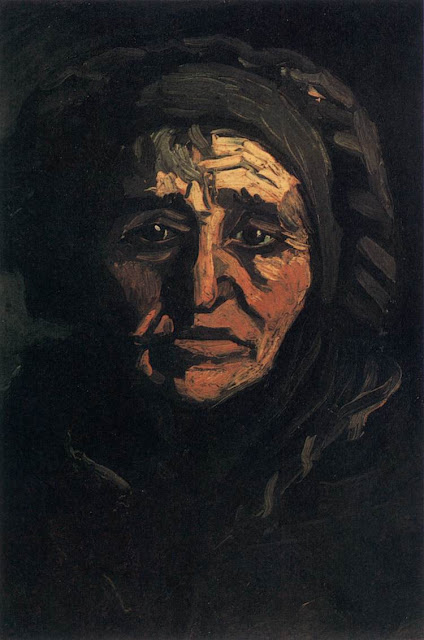
Head of a Peasant Woman with Greenish Lace Cap, Van Gogh, 1885

Rijksmuseum Kröller-Müller, Otterlo, Netherlands [Web Gallery of Art]

There are moments that remain a grace from God for a person for the rest of his life, moments when he was simply an observer rather than a participant. One such moment for me happened one night about forty years ago in Ozamiz City, Mindanao. It was quite late and I was looking out through an upstairs window in the convento (presbytery/rectory) of the Cathedral. As we say in Ireland, ‘there wasn’t a sinner’ on the cathedral plaza except for two persons. One was a man, a beggar maybe in his 30s. The other was Gregoria, known to everyone as ‘Guria’, a ‘simple’ woman and very gentle who would often wander in an out of classrooms in schools, doodle on the board and leave without having distracted anyone.

I noticed Guria, who was perhaps in her 40s, approach the man. She had two small pieces of bread, what we call pandesal here in the Philippines. She gave one to the beggar, just like St Martin of Tours when still a  soldier cutting his ample cloak in two and giving one half to a beggar. (St Martin’s feast day is on Wednesday 11 November.)

St Martin of Tours and the Beggar, El Greco, 1597-99

National Gallery of Art, Washington DC [Wikipedia]

What Guria did was pure, unselfish love. And yet she was probably unaware of this and certainly totally unaware of the fact that someone was observing her. She did not have a strong gift of reflection whereas God has given this to me and to most of us. But we don’t always use that gift.

St Mark tells us, Jesus sat down opposite the treasury, and watched the crowd putting money into the treasury. And he saw ‘Guria’ there. Perhaps she looked like the Dutch peasant woman in Van Gogh’s painting above. But it would seem that his disciples hadn’t observed her until Jesus drew their attention to her.

It is said that St Martin, after he had shared his cloak with the beggar, saw Jesus in a dream wearing that half-cloak. The reality is that Christ shows himself frequently to us, if we have eyes to see, as he showed himself to me through Guria 40 years ago, and on many other similar occasions down the years.

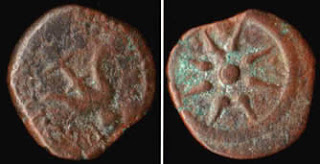
A bronze mite, Judea, 1st century BC [Wikipedia]

In the video below is the story of Kesz Váldez, from Cavite City, near Manila, who when still a ‘mite’ from a very impoverished background shared what he had, his ‘widow’s mite’, with other children on his seventh birthday, the first he had ever celebrated. He received the International Children’s Peace Prize in 2012.


Posted in: Sunday Reflections Tagged: 'Guria', El Greco, International Children's Peace Prize, Kesz Váldez, Ozamiz City, Sunday Reflections, Van Gogh

‘Receive the Holy Spirit.’ Sunday Reflections, Pentecost, Year B

May 19, 2015 by Father Sean Coyle

Pentecost El Greco, painted 1596-1600
Museo del Prado, Madrid [Web Gallery of Art]


Readings (New American Bible: Philippines, USA)

Vigil Mass 

Mass during the Day

Readings (Jerusalem Bible: Australia, England & Wales, India [optional], Ireland, New Zealand, Pakistan, Scotland, South Africa) [This page gives the readings for both the Vigil Mass and the Mass during the Day]

Liturgical Note. Pentecost, like Easter and some other solemnities, has a Vigil, properly so-called. This is not an ‘anticipated Mass’ but a Vigil Mass in its own right, with its own set of prayers and readings. It fulfils our Sunday obligation. There may be an extended Liturgy of the Word,er similar to the Easter Vigil, with all the Old Testament readings used. 


The prayers and readings of the Mass During the Day should not be used for the Vigil Mass, nor those of the Vigil Mass for the Mass During the Day. 

Gospel John 20:19-23 (New Revised Standard Version – Catholic Edition, Canada)

When it was evening on that day, the first day of the week, and the doors of the house where the disciples had met were locked for fear of the Jews, Jesus came and stood among them and said, “Peace be with you.&#8221#8221; After he said this, he showed them his hands and his side. Then the disciples rejoiced when they saw the Lord. Jesus said to them again, “Peace be with you. As the Father has sent me, so I send you.” When he had said this, he breathed on them and said to them, “Receive the Holy Spirit. If you forgive the sins of any, they are forgiven them; if you retain the sins of any, they are retained.”


Alternative Gospel


Gospel John 15:26-27; 16:12-15 (New Revised Standard Version – Catholic Edition, Canada)


Jesus said to his disciples:

“When the Advocate comes, whom I will send to you from the Father, the Spirit of truth who comes from the Father, he will testify on my behalf. You also are to testify because you have been with me from the beginning.

 “I still have many things to say to you, but you cannot bear them now. When the Spirit of truth comes, he will guide you into all the truth; for he will not speak on his own, but will speak whatever he hears, and he will declare to you the things that are to come. He will glorify me, because he will take what is mine and declare it to you. All that the Father has is mine. For this reason I said that he will take what is mine and declare it to you.”


Fr Ralph W. Beiting (1 January 1924 – 24 August 2012) street preaching in July 2011

I’m quite happy to live in the present and to look forward to the future without worrying too much. That is all grace from God. There is, however, one event in my life that I would, perhaps, like to relive, if that were possible, which it’s not. It was the summer of 1969, less than two years after my ordination in Ireland, when I was studying in a college north of New York City where I was also one of the chaplains.

One day during Lent of that year while walking across the campus to class I met Betty, a student who was in some classes with me, and asked her what she was doing for Easter. I was just making small talk. But when she told me that she and some other students were going to work in a parish in rural Kentucky as volunteers for that week I got interested – and ended up going with them. I spent most of Easter week in Lancaster, Kentucky, cleaning up buildings, getting them ready for summer programmes such as Bible classes and summer camps for local children. The parish priest, Fr Ralph Beiting, had many projects and invited students, most at college level bu some still in high school, to come during the summer for a week, two weeks, a month or longer, to help run the Bible schools in the four towns in his parish, to staff the two camps for children to spend a five-day vacation in, to do house-to-house visitation in pairs, and some other things. He had also founded the Christian Appalachian Project to help the development of this predominantly poor corner of the USA, and an area where there was only a handful of Catholics. There were still remnants of anti-Catholicism.

Fr Beiting used to go around preaching in towns during the summer, accompanied by seminarians and other male college students. They’d park their truck at a place where people could gather and he’d preach basic Christian truths from the back of the lorry. He was following an old Protestant tradition in the area but one that was dying out. On one occasion he was driven out at gunpoint but next day turned up again, not to preach but simply to show himself.

This great diocesan priest had the great gift of organising and inspiring young people in the service of the Gospel. These gifts of his helped me to discover a gift I was unaware of – the ability to listen to people. When I went back to Kentucky for six weeks in the summer of 1969 he asked me to divide my time between the activities in Lancaster and those in Cliffview Camp, where each week a group of local youngsters went on Monday morning and went home on Friday afternoon, with lots of activities to keep them, and the student volunteers, occupied. Cliffview is now a retreat and conference centre for the Diocese of Lexington.


Part of Cliffview as it looked in 1969.

Father Beiting wasn’t a person you would go to if you had a problem or wanted to talk about something. He was an ‘action man’, though a prayerful one. However, I discovered that many of the young volunteers I was working with, and some persons older than me, found in me somebody who could listen to them. I had never been aware of that ability but it was to become very important in my life as a priest. Indeed, in the case of one young volunteer who became a close friend and to whom I was to be a mentor, that ability that God gave me became helped, 12 years later, to draw her back from the brink of suicide. And in that episode I discovered that sometimes a person of deep and generous faith can also be very fragile. My friend died the following year, aged only 29, peacefully and from natural causes. Some months before her death she told me that she thought she didn’t have long to live. I had the good sense to listen to her and we spoke to each other as persons of faith as to what her death would mean. There was nothing morbid about our conversation and we went for an Italian lunch afterwards – my friend was pure Italian – and had a joyful time together.It was to be our last time to meet.

But what I still marvel at, and thank God for, is that ‘casual’ meeting with another student and a conversation that I didn’t see as having any importance at all. A question that expressed friendliness rather than curiosity was to receive a profound and life-long answer, not from Betty, but from the Holy Spirit.

Receive the Holy Spirit . . . as the Father has sent me, even so I send you.

Veni, Sancte Spiritus (Sequence) 

Veni Sancte Spiritus (Sequence for Mass on Pentecost Sunday)

Veni, Sancte Spiritus,
et emitte
caelitus
lucis tuae
radium.
Come, Holy Spirit,
send forth the heavenly
radiance of your light.
Veni,
pater pauperum,
veni,
dator munerum
veni,
lumen cordium.
Come, father of the poor,
come giver of gifts,
come, light of the heart
Consolator
optime,
dulcis
hospes animae,
dulce
refrigerium.
Greatest comforter,
sweet guest of the soul,
sweet consolation.
In labore
requies,
in aestu
temperies
in fletu
solatium.
In labor, rest,
in heat, temperance,
in tears, solace.
O lux
beatissima,
reple
cordis intima
tuorum
fidelium.
O most blessed light,
fill the inmost heart
of your faithful.
Sine tuo
numine,
nihil est
in homine,
nihil est
innoxium.
Without your grace,
there is nothing in us,
nothing that is not harmful.
Lava quod
est sordidum,
riga quod
est aridum,
sana quod
est saucium.
Cleanse that which is unclean,
water that which is dry,
heal that which is wounded.
Flecte
quod est rigidum,
fove quod
est frigidum,
rege quod
est devium.
Bend that which is inflexible,
fire that which is chilled,
correct what goes astray.
a tuis
fidelibus,
in te
confidentibus,
sacrum
septenarium.
Give to your faithful,
those who trust in you,
the sevenfold gifts.
Da
virtutis meritum,
da salutis
exitum,
da perenne
gaudium,
Grant the reward of virtue,
grant the deliverence of
salvation,
grant eternal joy.
Posted in: Sunday Reflections Tagged: El Greco, Fr Ralph W. Beiting, Kentucky, Pentecost

Recent Posts

  • ‘I do choose. Be made clean!’ Sunday Reflections, 6th Sunday in Ordinary Time, Year B
  • ‘They brought to him all who were sick.’ Sunday Reflections, 5th Sunday in Ordinary Time, Year B
  • ‘He taught them as one having authority.’ Sunday Reflections, 4th Sunday in Ordinary Time, Year B
  • Columban Fr Donal O’Farrell RIP
  • Columban Fr Matthew Reilly RIP

Archives

  • February 2018
  • January 2018
  • December 2017
  • November 2017
  • October 2017
  • September 2017
  • August 2017
  • July 2017
  • June 2017
  • May 2017
  • April 2017
  • March 2017
  • February 2017
  • January 2017
  • December 2016
  • November 2016
  • October 2016
  • September 2016
  • August 2016
  • July 2016
  • June 2016
  • May 2016
  • April 2016
  • March 2016
  • February 2016
  • January 2016
  • December 2015
  • November 2015
  • October 2015
  • September 2015
  • August 2015
  • July 2015
  • June 2015
  • May 2015
  • April 2015
  • March 2015
  • February 2015
  • January 2015
  • December 2014
  • November 2014
  • October 2014
  • September 2014
  • August 2014
  • July 2014
  • June 2014
  • May 2014
  • April 2014

Copyright © 2026 The Pilgrims' Inn.

Hotel WordPress Theme by themehall.com