When the
crowd saw that neither Jesus nor his disciples were there, they themselves got
into the boats and went to Capernaum looking for Jesus.
When they found him on the other side of the sea, they said to him, “Rabbi, when did you come here?”Jesus answered them, “Very truly, I tell you, you are looking for me, not because you saw signs, but because you ate your fill of the loaves.Do not work for the food that perishes, but for the food that endures for eternal life, which the Son of Man will give you. For it is on him that God the Father has set his seal.”Then they said to him, “What must we do to perform the works of God?”Jesus answered them, “This is the work of God, that you believe in him whom he has
sent.”So they said to him, “What sign are you going to give us then, so that we may see it and believe you? What work are you performing?Our ancestors ate the manna in the wilderness; as it is written, ‘He gave them bread from heaven to eat.’”Then Jesus said to them, “Very truly, I tell you, it was not Moses who gave you the bread from heaven, but it is my Father who gives you the true bread from heaven.For the bread of God is that whichcomes down from heaven and gives life to the world.”They said to him, “Sir, give us this bread always.”
Jesus said to them, “I am the bread of life. Whoever comes to me will never be hungry, and whoever believes in me will never be thirsty.
Antiphona ad Communionem Communion Antiphon Wisdom 16:20
Panem de caelo dedisti nobis, Domine,
You have given us, O Lord, bread from heaven,
habentem omne delectamentum, et omnem saporem suavitatis.
endowed with all delights and sweetness in every taste.
Fr Ragheed Aziz Ganni
(20 January 1972 – 3 June 2007)
I have featured Fr Ragheed Ganni a number of times on Sunday Reflections, most recently two weeks ago for the 16th Sunday in Ordinary Time, Year B. As a priest and as a Catholic Christian I am truly inspired by this man who was less than half the age I am now when he was assassinated.
‘He was a raconteur par excellence and a font of knowledge – we discussed everything and anything from the metaphysical to the trivial. A young and gauche student at the time, I learnt about Iraq and about theology; about the workings of the college in the summer and the best places to eat pizza. I was amazed at his command of English and Italian and his perennial good spirits and big smile – he was and will always be an inspiration’.
That is how an Irish student at the Pontifical Irish College in Rome described Fr Ragheed Ganni, a Chaldean Catholic priest murdered along with three subdeacons, Basman Yousef Daud,Wahid Hanna Isho, and Gassan Isam Bidawed, on 3 June 2007 just after the young priest had celebrated Mass in Holy Spirit parish, Mosul, Iraq. Fr Ganni, an engineer, studied theology in Rome, and stayed at the Irish College, where he was known as ‘Paddy the Iraqi’, ‘Paddy’ being a generic term for Irishmen, derived from the name of Ireland’s – and Nigeria’s – patron, St Patrick.
Dear young people, do not be satisfied with anything less than Truth and Love, do not be content with anything less than Christ. Pope Benedict spoke these words at the prayer vigil on 20 August 2011 during the Madrid World Youth Day. He also said, we need to speak with courage and humility of the universal significance of Christ as the Saviour of humanity and the source of hope for our lives.
In these words he is echoing the answer of Jesus to the question put to him in today’s gospel, What must we do, to be doing the works of God? His reply: This is the work of God, that you believe in him whom he has sent.
In Verbum Domini the Pope wrote, We cannot keep to ourselves the words of eternal life given to us in our encounter with Jesus Christ: they are meant for everyone, for every man and woman . . . It is our responsibility to pass on what, by God’s grace, we ourselves have received. In his Angelus talk on 29 October 2006 Benedict said, The rediscovery of the value of one’s own Baptism is at the root of every Christian’s missionary commitment, because as we see in the Gospel, those who allow themselves to be fascinated by Christ cannot fail to witness to the joy of following in his footsteps.
In that same talk, in which he commented on the gospel of that Sunday, Mark 10:46-52, Pope Benedict said, The decisive moment was the direct, personal encounter between the Lord and that suffering man. They found each other face to face: God with his desire to heal and the man with his desire to be healed; two freedoms, two converging desires. He was speaking of the meeting between the blind Bartimaeus and Jesus.
One theme that comes through repeatedly in the teaching of Pope Benedict is that our faith is in a person, Jesus, God who became man. Jesus tells us clearly that it is his Father’s will that we believe in him.
Another theme of Benedict is the joy that Jesus promised those who follow him. This was the theme of the Pope’s message for World Youth Day 2012 held on Palm Sunday in Rome.Pope Benedict uses a very striking term: those who allow themselves to be fascinated by Christ. I don’t think I’ve heard it put that way before by anyone. Benedict insists so often that our faith is faith in the person of Jesus, not in a set of doctrines, though they come to us from Jesus through his Church.Just over a year before his death Father Ragheed spoke at the Eucharistic Conference in Bari, Italy. He said, Mosul Christians are not theologians; some are even illiterate. And yet inside of us for many generations one truth has become embedded: without the Sunday Eucharist we cannot live.
In the context of the war in Iraq he spoke eloquently about the Sunday Eucharist: It is among such difficulties that we understand the real value of Sunday, the day when we meet the Risen Christ, the day of our unity and love, of our (mutual) support and help. There are days when I feel frail and full of fear. But when, holding the Eucharist, I say ‘Behold the Lamb of God, who takes away the sin of the world’, I feel His strength in me. When I hold the Host in my hands, it is really He who is holding me and all of us, challenging the terrorists and keeping us united in His boundless love.
In normal times, everything is taken for granted and we forget the greatest gift that is made to us. Ironically, it is thanks to terrorist violence that we have truly learnt that it is the Eucharist, the Christ who died and risen, that gives us life. And this allows us to resist and hope.
This martyr of our times was clearly fascinated by Christ and understood that it is the Risen Lord himself whom we meet when we come together for Sunday Mass.
Jesus chides the people and questions their real reason for coming after him: Truly, truly, I say to you, you seek me, not because you saw signs, but because you ate your fill of the loaves. Yet he doesn’t regret having fed them and he sees that for at least some of them their reason is somewhat deeper. He gives a straight answer to their question about the work of God: This is the work of God, that you believe in him whom he has sent. It is not being ‘good’, it is not being ‘nice’. It is in accepting him for who he is, God who became man, who lived among us, died for us on the Cross, rose from the dead on Easter Sunday and is with us in an intimate and challenging way when we celebrate Mass, especially on Sunday.
All who met Father Ragheed described him as a joyful person. There is something very joyful, in the sense that Jesus meant, in a person who can not only tell you where the best pizza in Rome is, who is not content with anything less than Christ and who is prepared to go back to a very dangerous situation in order to be able to celebrate Mass with his people and to stay with them in the midst of war.
The apostles gathered around Jesus, and told him
all that they had done and taught.He said to them, “Come away to a deserted
place all by yourselves and rest a while.” For many were coming and going, and
they had no leisure even to eat.And they went away in the boat to a
deserted place by themselves.Now many saw them going and recognized
them, and they hurried there on foot from all the towns and arrived ahead of
them.As he went ashore, he saw a great crowd; and he had
compassion for them, because they were like sheep without a shepherd; and he
began to teach them many things.
Fr Ragheed Aziz Ganni
(20 January 1972 – 3 June 2007)
I will raise up shepherds over them who will shepherd them, and they shall not fear any longer, or be dismayed, nor shall any be missing, says the Lord (Jeremiah
23:4. First Reading).
On at least six occasions during his recent nine-day pastoral visit to Ecuador, Bolivia and Paraguay, Pope Francis asked the people to pray for him, as he did when he addressed the people in St Peter’s Square for the first time as pope in 2013. Perhaps he has constantly in mind two statements in today’s First Reading from the Prophet Jeremiah: ‘Woe to the shepherds who destroy and scatter the sheep of my pasture! says the Lord . . . I will raise up shepherds over them who will shepherd them, and they shall not fear any longer, or be dismayed, nor shall any be missing, says the Lord.’
Jesus shows his concern for the apostles when they returned from the mission on which he had sent them as shepherds when ‘He said to them, “Come away to a deserted place all by yourselves and rest a while.”’
Ballachulish, Scotland
‘Come away to a deserted place all by yourselves and rest a while.’
Perhaps we can pray in a special way for our priests as we take part in Mass this Sunday. We have countless models of priests who have been worthy shepherds, evening to laying down their lives for the flock they were called to serve. One such shepherd is an Iraqi priest with Irish connections, Fr Ragheed Ganni, assassinated along with three subdeacons,his cousin Basman Yousef Daud, Wahid Hanna Isho, and Gassan Isam Bidawed, after celebrating Mass in Mosul, Iraq, on Trinity Sunday, 3 June 2007.
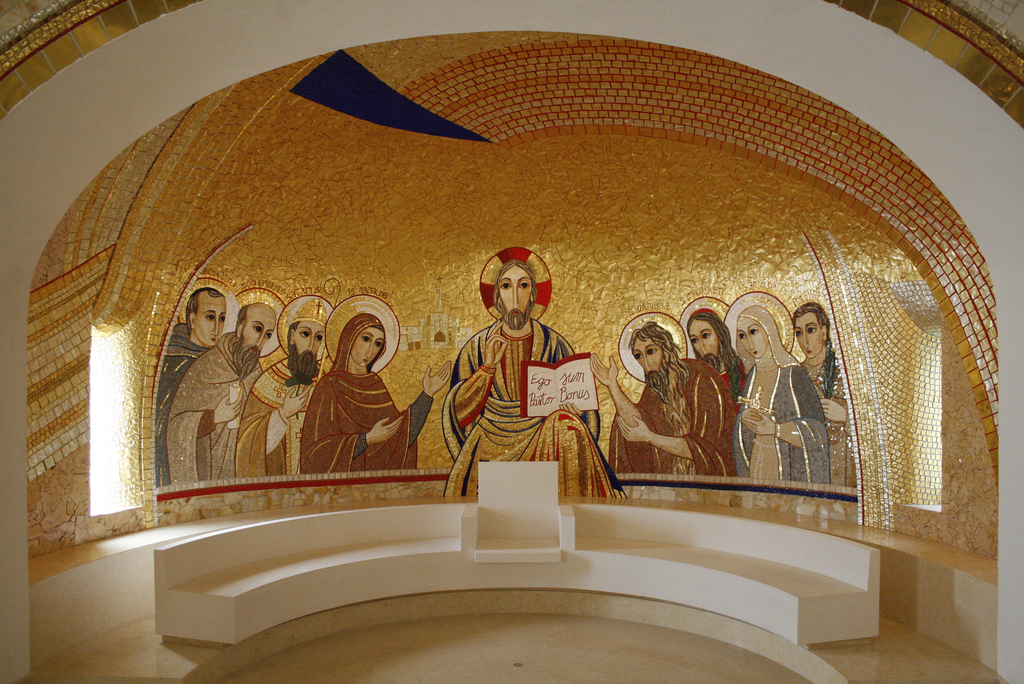
Apse of Chapel, Irish College, Rome
St Columban second from left, Fr Ragheed far right.
An engineer by profession, Ragheed answered God’s call to become a priest and studied theology in Rome, before and after his ordination in 2003. While there he stayed at the Pontifical Irish College where he became known as ‘Paddy the Iraqi’, ‘Paddy’ being a common nickname for men named Patrick, after Ireland’s national patron, and a humorous generic name for any Irishman. As a priest still studying in Rome he spent part of his summers as a member of the staff at Lough Derg, known as St Patrick’s Purgatory, a place of penitential pilgrimage in Ireland.
Mosaic of Fr Ragheed Ganni with palms of martyrdom, Chapel of Irish College, Rome [Source]
Yet this young Iraqi who, according to the statement of one friend after the priests’ murder, ‘knew where the best pizza in Rome was’, chose to go back to his own country, knowing that his life might be in danger. He spoke of this at a Eucharistic Congress in Bari, Italy, two years before his death. The theme of the Congress was Without Sunday We Cannot Live, ‘Sunday’ meaning most especially the celebration of Holy Mass.
Mosul Christians are not theologians; some are even illiterate. And yet inside of us for many generations one truth has become embedded: without the Sunday Eucharist we cannot live.
This is true today when evil has reached the point of destroying churches and killing Christians, something unheard of in Iraq till now. In June 2004, a group of young women were cleaning the church to get it ready for Sunday service. My sister Raghad, who is nineteen, was among them. As she was carrying a pale of water to wash the floor, two men drove up and threw a grenade that blew up just a few yards away from her.
She was wounded but miraculously, survived. And on that Sunday, we still celebrated the Eucharist. My shaken parents were also there. For me and my community, my sister’s wounds were a source of strength so that we, too, may bear our cross.
Last August in St Paul’s Church, a car bomb exploded after the 6 pm Mass. The blast killed two Christians and wounded many others. But that, too, was another miracle – the car was full of bombs but only one exploded. Had they all gone off together, the dead would have been in the hundreds since 400 faithful had come on that day.
People could not believe what had happened. The terrorists might think they can kill our bodies or our spirit by frightening us, but, on Sundays, churches are always full. They may try to take our life, but the Eucharist gives it back.
On 7 December, the eve of the Immaculate Conception, a group of terrorists tried to destroy the Chaldean Bishop’s Residence, which is near Our Lady of the Tigris Shrine, a place venerated by both Christians and Muslims. They placed explosives everywhere, and a few minutes later blew the place up. This and fundamentalist violence against young Christians has forced many families to flee. Yet the churches have remained open and people continue to go to Mass, even among the ruins.
It is among such difficulties that we understand the real value of Sunday, the day when we meet the Risen Christ, the day of our unity and love, of our (mutual) support and help. There are days when I feel frail and full of fear. But when, holding the Eucharist, I say ‘Behold the Lamb of God, who takes away the sin of the world’, I feel His strength in me. When I hold the Host in my hands, it is really He who is holding me and all of us, challenging the terrorists and keeping us united in His boundless love.
In normal times, everything is taken for granted and we forget the greatest gift that is made to us. Ironically, it is thanks to terrorist violence that we have truly learnt that it is the Eucharist, the Christ who died and risen, that gives us life. And this allows us to resist and hope.
Father Ragheed was secretary to Archbishop Rahho, The Chaldean Archbishop of Mosul. Most Catholics in Iraq and Syria belong to the Chaldean Catholic Church, in full communion with Rome. ‘The Eucharist, the Christ who died and risen, that gives us life’ was celebrated every Sunday in Mosul for 1,600 years – until June 2014 when the ISIS forces drove out the remaining Christians.
The words of Jeremiah, ‘I will raise up shepherds over them who will shepherd them’, have surely been fulfilled in the lives and deaths of such priests as Fr Ragheed Ganni and Archbishop Rahho. As we thank God for them and for countless other faithful priest-shepherds, let us continue to pray for all our priests and for Christians who are being persecuted for their faith.
John Rutter‘s setting of The Lord is my shepherd, Psalm 22[23], which is used as today’s Responsorial Psalm.


_mod.jpg/800px-Pope_Benedictus_XVI_january%2C20_2006_(2)_mod.jpg)