The Pilgrims' Inn

  • Welcome to The Pilgrims’ Inn
‘We have come to pay him homage.’ Sunday Reflections, The Epiphany, Years ABC

Fra Angelico

‘We have come to pay him homage.’ Sunday Reflections, The Epiphany, Years ABC

January 5, 2018 by Father Sean Coyle

The Adoration of the Magi, Luís Tristán de Escamilla [Web Gallery of Art]

Readings (New American Bible: Philippines, USA)

Readings (Jerusalem Bible: Australia, England & Wales, India [optional], Ireland, New Zealand, Pakistan, Scotland, South Africa)

Gospel Matthew 2:1-12 (New Revised  Standard Version, Anglicised CatholicEdition) 

In the time of King Herod, after Jesus was born in Bethlehem of Judea, wise men from the East came to Jerusalem, asking, ‘Where is the child who has been born king of the Jews? For we observed his star at its rising, and have come to pay him homage.’ When King Herod heard this, he was frightened, and all Jerusalem with him; and calling together all the chief priests and scribes of the people, he inquired of them where the Messiah was to be born. They told him, ‘In Bethlehem of Judea; for so it has been written by the prophet:

“And you, Bethlehem, in the land of Judah,
    are by no means least among the rulers of Judah;
for from you shall come a ruler
    who is to shepherd my people Israel.”’

Then Herod secretly called for the wise men and learned from them the exact time when the star had appeared. Then he sent them to Bethlehem, saying, ‘Go and search diligently for the child; and when you have found him, bring me word so that I may also go and pay him homage.’ When they had heard the king, they set out; and there, ahead of them, went the star that they had seen at its rising, until it stopped over the place where the child was. When they saw that the star had stopped, they were overwhelmed with joy. On entering the house, they saw the child with Mary his mother; and they knelt down and paid him homage. Then, opening their treasure-chests, they offered him gifts of gold, frankincense, and myrrh. And having been warned in a dream not to return to Herod, they left for their own country by another road.

In countries where the Epiphany is a Holyday of Obligation it is celebrated on Saturday 6 January. Otherwise it is celebrated on Sunday 7 January this year. The Vigil Mass has its own antiphons and prayers but uses the readings above.

Adoration of the Magi, Blessed Fra Angelico [Web Gallery of Art]

While based in Britain from 2000 till 2002 I was able to spend Christmas with my brother and his family in Dublin, a short flight from England, in 2000 and 2001. During the holiday in 2001 I saw a documentary on RTÉ, Ireland’s national broadcasting service, about Filipino nurses in Ireland. These began to arrive in 2000, initially at the invitation of the Irish government to work in government hospitals. Very quickly there was an ‘invasion’ of Filipino nurses and carers, now to be found in hospitals and nursing homes in every part of the country.

One of the nurses interviewed told how many Filipinos, knowing that the Irish celebrate Christmas on the 25th, unlike the Philippines where the culmination of the feast is the family meal, the noche buena, on the night of the 24th, offered to work on Christmas Day so that their Irish companions could be with their families. This also helped to dull the pain of being away from their own families.

I was moved to tears at the testimony of one nurse, from Mindanao as I recall, speaking about her job and her first Christmas in Ireland in 2000. She spoke very highly of her employers, of her working conditions and of her accommodation, which she compared with that of the Holy Family on the first Christmas night. She spoke of Jesus, Mary and Joseph in this situation as if they were members of her own family, as in a very deep sense they are, or we of their family.

Here was a young woman from the East powerfully proclaiming, without being aware of it, that the Word became flesh and lived among us. The fact that she wasn’t aware of it, that she was speaking about her ‘next door neighbours’, made her proclamation of faith all the more powerful. She would have known many in her own place, and very likely knew from her own experience, something of what Joseph and Mary went through in Bethlehem. Her faith in the Word who became flesh and lived among us wasn’t something in her head but part of her very being.

For much of the last century thousands of Catholic priests, religious Sisters and Brothers left Europe and North America to preach and live the Gospel in the nations of Africa, Asia and South America. Some of the countries and regions from which they left, eg, Belgium, the Netherlands, Ireland, Quebec, have to a great extent lost or even rejected the Catholic Christian faith. The Jewish people had, in faith, awaited the coming of the Messiah for many centuries. But when He came it was uneducated shepherds who first recognised him and later Simeon and Anna, two devout and elderly Jews who spent lengthy periods in prayer in the Temple.

Today’s feast highlights wise men from the east, not ‘believers’ in the Jewish sense, led by God’s special grace to Bethlehem to bring gifts in response to that grace, explaining, We . . . have come to pay him homage.They reveal to us that God calls people from every part of the world to do the same and to bring others with them.

Will nurses from the Philippines and from Kerala in India, migrants from Korea and Vietnam, from the east, bring the gift of faith in Jesus Christ once again to the many people in Western Europe and North America who no longer know him in any real sense? Will they by the lives they lead as working immigrants gently invite those in the West who have lost the precious gift of our Catholic Christian faith to once again come to pay him homage?

We Three Kings of Orient Are

The Madrigal Singers, University of the Philippines
Posted in: Sunday Reflections Tagged: Epiphany, Fra Angelico, Luís Tristán de Escamilla, Sunday Reflections, The Madrigal Singers

‘Rejoice and be glad . . .’ Sunday Reflections, All Saints’ Day and All Souls’ Day

October 30, 2015 by Father Sean Coyle

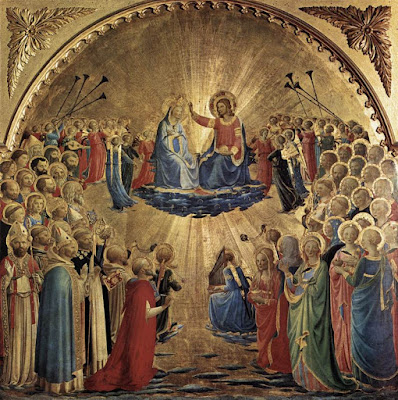
The Coronation of the Virgin, Fra Angelico, 1434-35

Galleria degli Uffizi, Florence, Italy [Web Gallery of Art]

Readings (New American Bible: Philippines, USA) 

Readings (Jerusalem Bible: Australia, England & Wales, India [optional], Ireland, New Zealand, Pakistan, Scotland, South Africa) 

Gospel Matthew 5:1-12a (New Revised Standard Version, CatholicEdition, Canada) 

When Jesus saw the crowds, he went up the mountain; and after he sat down, his disciples came to him. Then he began to speak, and taught them, saying:

“Blessed are the poor in spirit, for theirs is the kingdom of heaven.

“Blessed are those who mourn, for they will be comforted.

“Blessed are the meek, for they will inherit the earth.

“Blessed are those who hunger and thirst for righteousness, for they will be filled.

“Blessed are the merciful, for they will receive mercy.

“Blessed are the pure in heart, for they will see God.

“Blessed are the peacemakers, for they will be called children of God.

“Blessed are those who are persecuted for righteousness’ sake, for theirs is the kingdom of heaven.


“Blessed are you when people revile you and persecute you and utter all kinds of evil against you falsely on my account. Rejoice and be glad, for your reward is great in heaven.”


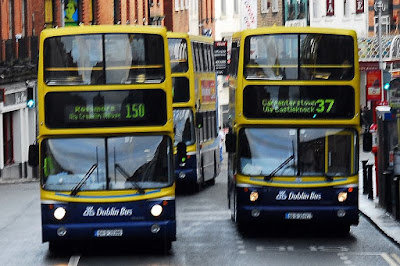
Dublin buses [Wikipedia]

When I go home to my native Dublin I use public transport all the time. I often find God’s presence in in those around me, passengers and drivers. So does Columban Sr Mary Nolan, now based in Dublin, who worked for many years in Peru and also served a term as Congregational Leader of the Missionary Sisters of St Columban. Hereshe shares such a moment on the 150 bus – and by chance Wikipedia has a photo of a 150 bus!

Coming from the city on the 150 bus recently I shared a seat with a woman whom I had never met before. Her name is Breda.  She told me she has been a widow for the past 29 years; her Dad suffers from Alzheimer’s and her Mom cares for him down in their home near Carlow.  Breda’s daughter Ashling was 11 years old when her father died.  There was another little girl four years younger who died of hepatitis at 7 months.  Ashling was traumatized but gradually came through it and did well at her studies.  She is a churchgoer, and a turning point for her was when she attended YOUTH 2000.  At that youth celebration Ashling met her future husband, a young man who is spina bifida.  They’re happily married since last year.

By the time I had heard that story my bus had arrived at St Agnes’ Road, where our convent is, and it was time to part from Breda.  I was amazed that such a happy faith-filled woman could have come through so much suffering.

The Solemnity of All Saints celebrates the countless saints whom the Church has never canonized and never will, people who have gone before us who in their lifetime, like Breda on the 150 bus in Dublin, accepted whatever life brought, sadness and joy, believing in the love of the Lord Jesus Christ for them and in doing so being an inspiration to those around them.

I think that Ashling, Breda’s daughter, attended one of the four-day faith festivals organised each summer by YOUTH 2000. The video above is a promo for this year’s.

Songs for All Saints’ Day

Here is a rousing version of For All the Saints, words by Anglican Bishop William Walsham How and music by Ralph Vaughan Williams. The video is taken from an edition of the BBC’s weekly progamme Songs of Praise, which has been running since 1961.

A poem for All Saints’ and All Souls’ Days

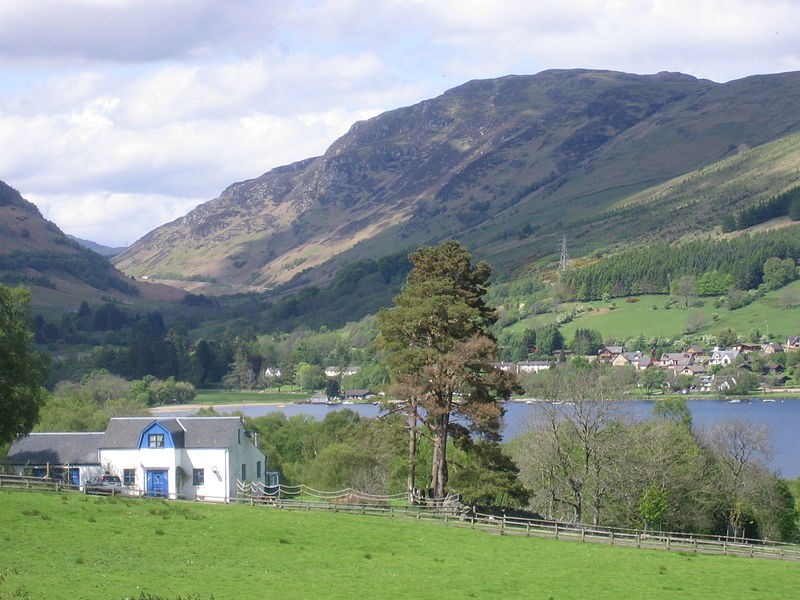
Lochearnhead and Glen Ogle, Scotland [Wikipedia]

I don’t know much about the faith of Scottish poet Norman MacCaig (1910 – 1996). Wikipedia tells us that he described it as ‘Zen Calvinism’ – ‘a comment typical of his half-humorous, half-serious approach to life’.

A favourite poem of mine is Country Postman. It expresses for me something of the reality of the Communion of Saints that we celebrate and remember in a special way on these two days. I’ve no idea if Norman MacCaig was thinking of the Communion of Saints when he wrote it. But it captures something of what holds us all together as a community. With email, Facebook and all the ways of communicating in ‘this digital continent’, as Pope Benedict calls it, perhaps the role of the postman has changed, though he is still vital in rural communities, not only to deliver the mail but to keep an eye on older persons living on their own, some of whom perhaps are reclusive but who still welcome him.

The poem too catches something of the fragility in all of us, especially in those who serve the broader community quietly and generously for so many years. And could Jesus, who turned water into wine at a wedding for people like those whom this mail deliverer served, turn away this poor man who died after probably celebrating a little too much?

It is persons such as MacCaig’s Country Postman whom we remember on All Souls’ Day and it is our prayers that help them move from being numbered among All Souls to being numbered among All Saints.

Country Postman

Before he was drowned, 

his drunk body bumping down the shallows 

of the Ogle Burn, he had walked 

fifteen miles every day 

bringing celebrations and disasters 

and what lies between them to

MacLarens and MacGregors 

and Mackenzies.


Now he has no news to bring 

of celebrations or disasters, 

although, after one short journey, 

he has reached 

all the clans in the world.


[‘Burn’ here means ‘creek’.]


Posted in: Sunday Reflections Tagged: All Saints' Day, All Souls' Day, Bishop William Walsham How, Fra Angelico, L'Arche, Norman MacCaig, Ralph Vaughan Williams, Sunday Reflections, YOUTH 2000

Recent Posts

  • ‘I do choose. Be made clean!’ Sunday Reflections, 6th Sunday in Ordinary Time, Year B
  • ‘They brought to him all who were sick.’ Sunday Reflections, 5th Sunday in Ordinary Time, Year B
  • ‘He taught them as one having authority.’ Sunday Reflections, 4th Sunday in Ordinary Time, Year B
  • Columban Fr Donal O’Farrell RIP
  • Columban Fr Matthew Reilly RIP

Archives

  • February 2018
  • January 2018
  • December 2017
  • November 2017
  • October 2017
  • September 2017
  • August 2017
  • July 2017
  • June 2017
  • May 2017
  • April 2017
  • March 2017
  • February 2017
  • January 2017
  • December 2016
  • November 2016
  • October 2016
  • September 2016
  • August 2016
  • July 2016
  • June 2016
  • May 2016
  • April 2016
  • March 2016
  • February 2016
  • January 2016
  • December 2015
  • November 2015
  • October 2015
  • September 2015
  • August 2015
  • July 2015
  • June 2015
  • May 2015
  • April 2015
  • March 2015
  • February 2015
  • January 2015
  • December 2014
  • November 2014
  • October 2014
  • September 2014
  • August 2014
  • July 2014
  • June 2014
  • May 2014
  • April 2014

Copyright © 2026 The Pilgrims' Inn.

Hotel WordPress Theme by themehall.com