
The Pilgrims' Inn

  • Welcome to The Pilgrims’ Inn
‘My words will not pass away.’ Sunday Reflections, 33rd Sunday in Ordinary Time, Year B

Iraq

‘My words will not pass away.’ Sunday Reflections, 33rd Sunday in Ordinary Time, Year B

November 13, 2015 by Father Sean Coyle

The Adoration of the Name of Jesus, El Greco, 1578-79

Chapter House, Monasterio de San Lorenzo, El Escorial, Spain [Wikipedia]

Readings (New American Bible: Philippines, USA)

Readings (Jerusalem Bible: Australia, England & Wales, India [optional], Ireland, New Zealand, Pakistan, Scotland, South Africa)

Gospel Mark 13:24-32 (New Revised Standard Version, Catholic Edition, Canada) 

Jesus said to his disciples:

 “But in those days, after that suffering,

the sun will be darkened,
and the moon will not give its light,
and the stars will be falling from heaven,
and the powers in the heavens will be shaken.

 Then they will see ‘the Son of Man coming in clouds’ with great power and glory. Then he will send out the angels, and gather his elect from the four winds, from the ends of the earth to the ends of heaven.

 “From the fig tree learn its lesson: as soon as its branch becomes tender and puts forth its leaves, you know that summer is near. So also, when you see these things taking place, you know that he is near, at the very gates. Truly I tell you, this generation will not pass away until all these things have taken place. Heaven and earth will pass away, but my words will not pass away.

“But about that day or hour no one knows, neither the angels in heaven, nor the Son, but only the Father.

In recent months refugees have been in the news almost daily, refugees from the Middle East and from Africa heading for Europe, Rohingya refugees from Bangladesh and Myanmar heading for other countries in Asia. For most of these people, many of whom have died in their efforts to find a better life, the words of Jesus in today’s Gospel, the sun will be darkened, and the moon will not give its light, are already in the past tense.

The Christians of Iraq and Syria, all of them Arabs and with 2,000 years of living the Christian faith behind them, are facing annihilation as a community because of the actions in recent years of ISIS/ISIL/IS. And the Christians of Iraq now face another blow. The Iraqi parliament recently passed a bill that would force some Christian children to become Muslims.

Kiribati

Jesus tells us in the Gospel, From the fig tree learn its lesson. He’s using a simple example from nature that everyone in Israel would have understood. In Ireland, where I’m from, when we see the daffodils in bloom we know for sure that spring is here.

The young men in the photo above and the two girls in the photo below are from Kiribati, a republic in the Pacific that consists mostly of atolls and has a population of about 100,000, more than half of them Catholics.

Kiribati

The people singing joyfully in St Theresa’s Church live on Christmas Island, Republic of Kiribati, which is different from Christmas Island, the Australian territory where many refugees are being held at present.

Fiji-based Columban Fr Frank Hoare recently visited Kiribati. He noted, Kiribati is full of children and young people as it is not unusual for couples to have ten or more children. They have a carefree energy for life.

Fr Hoare pointed out too that the leaders of the country have ‘learned its lesson from the fig tree’. The Kiribati Government bought a property of some thousands of acres from the Anglican Church in Fiji for resettlement of people in the future. The President has said that the sea will cover Kiribati by the end of this century. Government officials have asked Australia and New Zealand to accept Kiribati people as permanent refugees. So global warming is not a matter of inconvenience and of changed conditions for the I Kiribati people. It is a matter of losing their homeland and being cast adrift to find shelter in different foreign countries. This would threaten the survival of their culture. This is one example of those causing least damage to the environment being made to suffer most because if it. 

The leaders’ fears are not without reason. The country is at sea-level, with no hills. The Guardian (London) carries a report as I write this on 13 November 2015, Collapsing Greenland glacier could raise sea levels by half a metre, say scientists. This could well mean that the children of the young people of Kiribati in the photos above will be born elsewhere, their homeland no longer existing.

The Christians of Iraq and Syria and the people of Kiribati will have many descendants but they will almost certainly be living in other countries. And like some of the churches in Syria and Iraq where the Holy Sacrifice of the Mass had been celebrated for centuries, in some cases nearly as far back as the time of the Apostles, St Therese’s Church on Christmas Island, Kiribati, will have no celebration of the birth of Christ, the feast that gave its name to the island, of his Resurrection, of Pentecost. There won’t be any people around.

And there are the daily tragedies where for individuals the sun is darkened and the moon no longer gives its light.

Aleppo, Syria

The two girls in the photo in Kiribati are probably unaware of what may face them in the future. But the two girls in Aleppo know the experience of war and terror. Yet the parish priest of the Latin Catholic Parish of St Francis in Aleppo, Fr Ibrahim Alsabagh OFM, sees hope and finds Christians and Muslims Encountering God while waiting in line for a bucket of water.

Speaking at a meeting in Rimini, Italy, the Damascus-born Franciscan friar says, I am here to share the joy of the faith. He tells the people at the meeting, We are living in chaos and we are lacking everything. Alongside the real problem of security – his neighbourhood is controlled by the Syrian government but the Caliphate troops are just a short distance away – there is also the difficulty of getting hold of things due to rising costs and the scarcity of resources. But whenever a need is satisfied, we appreciate it more, even something as simple as a glass of water.

Father Ibrahim tells a story that reminds one of Jesus meeting the woman at the well – the parish happens to have a well. People queue for hours but despite this, nothing happens. Just cheery and smiling people waiting their turn. A Muslim approached me and whispered in my ear: ‘This is very strange, there is something great here among you. When I walk around the city, I see people fighting, almost killing each other over a bucket of water. But here it’s different.’ Speaking to everyone about Christ is difficult in the context in which we live. But it is through these small gestures of peace of heartfelt joy, of patience and humility that we manage to say so much to those who thirst for something great. A faith that is communicated not with grandiose speeches but simply by using the method Jesus taught us: ‘Come, follow me’.

This is the greatest wish of Father Ibrahim: We don’t know when it will all end, but it doesn’t matter when and how it will end. The important thing is to bear witness to Christ, only then will the political and humanitarian solution come. Bearing testimony to the Christian life by loving, forgiving and taking also into consideration the salvation of those who harm us.

Jesus tells us today, My words will not pass away. They live in the hearts of persons such as Father Ibrahim, in the hearts of the leaders of Kiribati, in the hearts of the young girls and the young men in Kiribati, in the hearts of the young girls in the midst of suffering Aleppo who live in the hope that there is something better.

May the words of Jesus live in the heart of each of us.

Antiphona ad Introitum

Entrance Antiphon  Jeremiah 39: 11, 12, 14

Dicit Dóminus: 

The Lord said:

Ego cógito cogitatiónes pacis, et non afflictiónis:

I think thoughts of peace and not of affliction. 

invocábitis me, et ego exáudiam vos: 

You will call upon me, and I will answer you,

et redúcam captivitátem vestram de cunctis locis.

and I will lead back your captives from every place.

Vs. Benedixísti, Dómine, terram tuam: avertísti captivitátem Jacob.

You have favored, 0 Lord, your land; you have restored the well-being of Jacob.

Gloria Patri, et Filio, et Spiritui Sancto;

Glory to the Father and to the Son and to the Holy Spirit;

et nunc, et semper et in saecula saeculorum. Amen.

as it was, is now and will be for ever. Amen

The Lord said:

Ego cógito cogitatiónes pacis, et non afflictiónis:

I think thoughts of peace and not of affliction.

invocábitis me, et ego exáudiam vos: 

You will call upon me, and I will answer you,

et redúcam captivitátem vestram de cunctis locis.

and I will lead back your captives from every place.

The text in bold is used in the Mass in the Ordinary Form while the longer version is used in the Extraordinary Form, though it may also be used in the Ordinary form.

Posted in: Sunday Reflections Tagged: Aleppo, Iraq, ISIS, Kiribati, Sunday Reflections, Syria

‘I will raise up shepherds . . .’ Sunday Reflections, 16th Sunday in Ordinary Time, Year B

July 15, 2015 by Father Sean Coyle
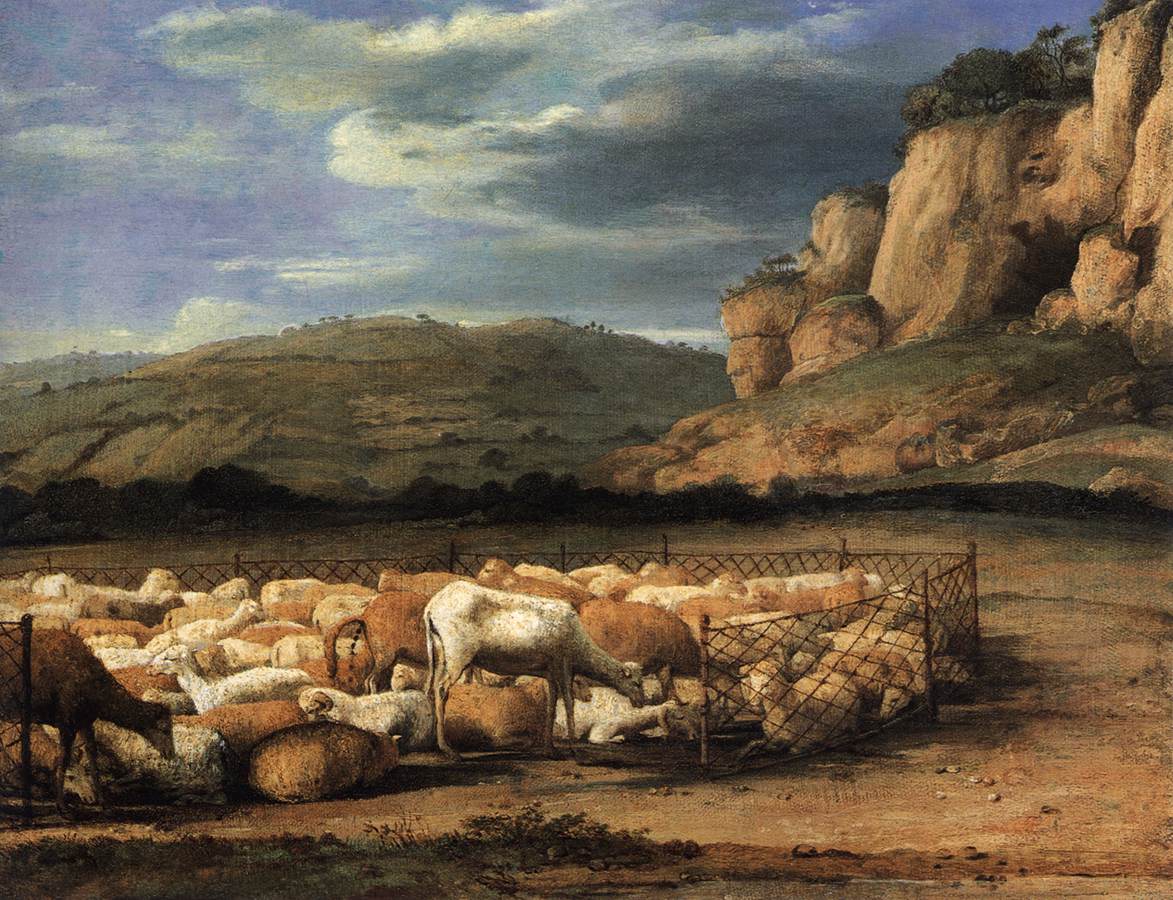
Flock of Sheep in the Campagna, Claude Lorrain
Akademie der bildenden Künste, Vienna [Web Gallery of Art]
‘They were like sheep without a shepherd.’


Readings
(New American Bible:
Philippines, USA)

Readings
(Jerusalem Bible: Australia,
England & Wales, India [optional], Ireland, New Zealand, Pakistan,
Scotland, South Africa)

Gospel Mark 6:30-34 (New Revised Standard Version, Catholic Edition, Canada)   


The apostles gathered around Jesus, and told him
all that they had done and taught.
 He said to them, “Come away to a deserted
place all by yourselves and rest a while.” For many were coming and going, and
they had no leisure even to eat.
 
And they went away in the boat to a
deserted place by themselves.
 
Now many saw them going and recognized
them, and they hurried there on foot from all the towns and arrived ahead of
them.
 
As he went ashore, he saw a great crowd; and he had
compassion for them, because they were like sheep without a shepherd; and he
began to teach them many things.


Fr Ragheed Aziz Ganni 
(20 January 1972 – 3 June 2007)
I will raise up shepherds over them who will shepherd them, and they shall not fear any longer, or be dismayed, nor shall any be missing, says the Lord (Jeremiah
23:4. First Reading).


On at least six occasions during his recent nine-day pastoral visit to Ecuador, Bolivia and Paraguay, Pope Francis asked the people to pray for him, as he did when he addressed the people in St Peter’s Square for the first time as pope in 2013. Perhaps he has constantly in mind two statements in today’s First Reading from the Prophet Jeremiah: ‘Woe to the shepherds who destroy and scatter the sheep of my pasture! says the Lord . . .  I will raise up shepherds over them who will shepherd them, and they shall not fear any longer, or be dismayed, nor shall any be missing, says the Lord.’

Jesus shows his concern for the apostles when they returned from the mission on which he had sent them as shepherds when ‘He said to them, “Come away to a deserted place all by yourselves and rest a while.”’

Ballachulish, Scotland
‘Come away to a deserted place all by yourselves and rest a while.’

Perhaps we can pray in a special way for our priests as we take part in Mass this Sunday. We have countless models of priests who have been worthy shepherds, evening to laying down their lives for the flock they were called to serve. One such shepherd is an Iraqi priest with Irish connections, Fr Ragheed Ganni, assassinated along with three subdeacons, his cousin Basman Yousef Daud, Wahid Hanna Isho, and Gassan Isam Bidawed, after celebrating Mass in Mosul, Iraq, on Trinity Sunday, 3 June 2007.
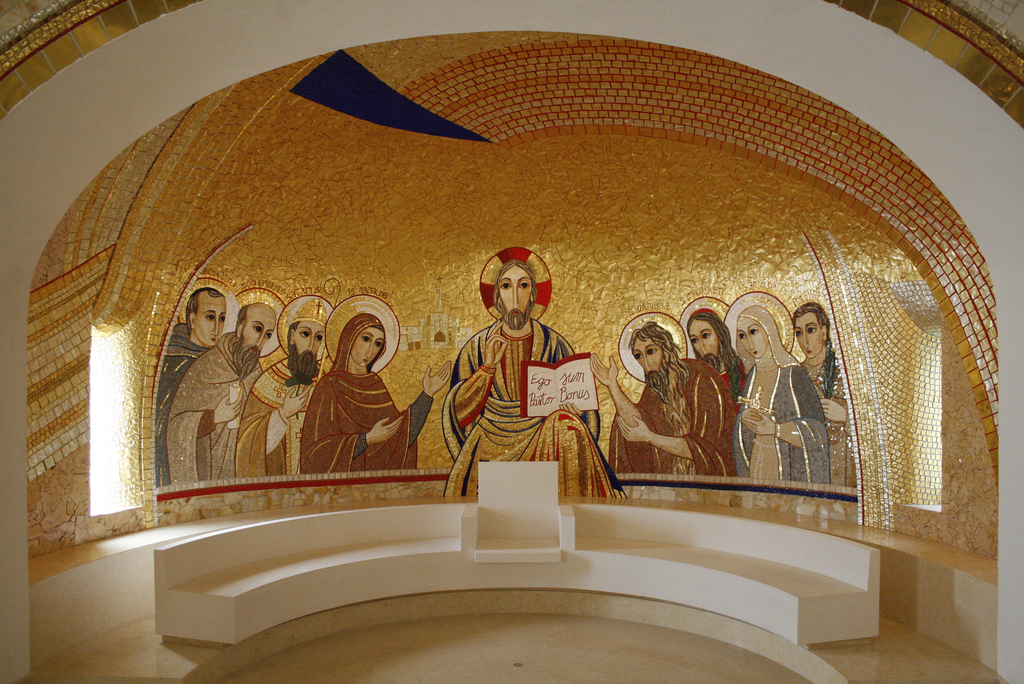
Apse of Chapel, Irish College, Rome
St Columban second from left, Fr Ragheed far right.
[Details at source]

An engineer by profession, Ragheed answered God’s call to become a priest and studied theology in Rome, before and after his ordination in 2003. While there he stayed at the Pontifical Irish College where he became known as ‘Paddy the Iraqi’, ‘Paddy’ being a common nickname for men named Patrick, after Ireland’s national patron, and a humorous generic name for any Irishman. As a priest still studying in Rome he spent part of his summers as a member of the staff at Lough Derg, known as St Patrick’s Purgatory, a place of penitential pilgrimage in Ireland.

Mosaic of Fr Ragheed Ganni with palms of martyrdom, Chapel of Irish College, Rome [Source]

Yet this young Iraqi who, according to the statement of one friend after the priests’ murder, ‘knew where the best pizza in Rome was’, chose to go back to his own country, knowing that his life might be in danger. He spoke of this at a Eucharistic Congress in Bari, Italy, two years before his death. The theme of the Congress was Without Sunday We Cannot Live, ‘Sunday’ meaning most especially the celebration of Holy Mass.

Basilica of St Nicholas, Bari [Wikipedia]

Fr Ragheed Ganni’s Testimony

Mosul Christians are not theologians; some are even illiterate. And yet inside of us for many generations one truth has become embedded: without the Sunday Eucharist we cannot live.
This is true today when evil has reached the point of destroying churches and killing Christians, something unheard of in Iraq till now. In June 2004, a group of young women were cleaning the church to get it ready for Sunday service. My sister Raghad, who is nineteen, was among them. As she was carrying a pale of water to wash the floor, two men drove up and threw a grenade that blew up just a few yards away from her.
She was wounded but miraculously, survived. And on that Sunday, we still celebrated the Eucharist. My shaken parents were also there. For me and my community, my sister’s wounds were a source of strength so that we, too, may bear our cross.
Last August in St Paul’s Church, a car bomb exploded after the 6 pm Mass. The blast killed two Christians and wounded many others. But that, too, was another miracle – the car was full of bombs but only one exploded. Had they all gone off together, the dead would have been in the hundreds since 400 faithful had come on that day.
People could not believe what had happened. The terrorists might think they can kill our bodies or our spirit by frightening us, but, on Sundays, churches are always full. They may try to take our life, but the Eucharist gives it back.
On 7 December, the eve of the Immaculate Conception, a group of terrorists tried to destroy the Chaldean Bishop’s Residence, which is near Our Lady of the Tigris Shrine, a place venerated by both Christians and Muslims. They placed explosives everywhere, and a few minutes later blew the place up. This and fundamentalist violence against young Christians has forced many families to flee. Yet the churches have remained open and people continue to go to Mass, even among the ruins.
It is among such difficulties that we understand the real value of Sunday, the day when we meet the Risen Christ, the day of our unity and love, of our (mutual) support and help. There are days when I feel frail and full of fear. But when, holding the Eucharist, I say ‘Behold the Lamb of God, who takes away the sin of the world’, I feel His strength in me. When I hold the Host in my hands, it is really He who is holding me and all of us, challenging the terrorists and keeping us united in His boundless love.
In normal times, everything is taken for granted and we forget the greatest gift that is made to us. Ironically, it is thanks to terrorist violence that we have truly learnt that it is the Eucharist, the Christ who died and risen, that gives us life. And this allows us to resist and hope. 
[This appeared in The Sacred Heart Messenger (April 2008), a publication of the Irish Jesuits.]
Archbishop Mar Paulos Faraj Rahho 
(20 November 1942 – kidnapped 29 February, body found 13
March 2008) [Photo: The Path to Peace Foundation]

Father Ragheed was secretary to Archbishop Rahho, The Chaldean Archbishop of Mosul. Most Catholics in Iraq and Syria belong to the Chaldean Catholic Church, in full communion with Rome. ‘The Eucharist, the Christ who died and risen, that gives us life’ was celebrated every Sunday in Mosul for 1,600 years – until June 2014 when the ISIS forces drove out the remaining Christians.

The words of Jeremiah, ‘I will raise up shepherds over them who will shepherd them’, have surely been fulfilled in the lives and deaths of such priests as Fr Ragheed Ganni and Archbishop Rahho. As we thank God for them and for countless other faithful priest-shepherds, let us continue to pray for all our priests and for Christians who are being persecuted for their faith.


John Rutter‘s setting of The Lord is my shepherd, Psalm 22[23], which is used as today’s Responsorial Psalm.

Posted in: Sunday Reflections Tagged: Archbishop Mar Paulos Faraj Rahho, Fr Ragheed Ganni, Iraq, John Rutter, persecution, Priests, shepherds, Sunday Reflections

Recent Posts

  • ‘I do choose. Be made clean!’ Sunday Reflections, 6th Sunday in Ordinary Time, Year B
  • ‘They brought to him all who were sick.’ Sunday Reflections, 5th Sunday in Ordinary Time, Year B
  • ‘He taught them as one having authority.’ Sunday Reflections, 4th Sunday in Ordinary Time, Year B
  • Columban Fr Donal O’Farrell RIP
  • Columban Fr Matthew Reilly RIP

Archives

  • February 2018
  • January 2018
  • December 2017
  • November 2017
  • October 2017
  • September 2017
  • August 2017
  • July 2017
  • June 2017
  • May 2017
  • April 2017
  • March 2017
  • February 2017
  • January 2017
  • December 2016
  • November 2016
  • October 2016
  • September 2016
  • August 2016
  • July 2016
  • June 2016
  • May 2016
  • April 2016
  • March 2016
  • February 2016
  • January 2016
  • December 2015
  • November 2015
  • October 2015
  • September 2015
  • August 2015
  • July 2015
  • June 2015
  • May 2015
  • April 2015
  • March 2015
  • February 2015
  • January 2015
  • December 2014
  • November 2014
  • October 2014
  • September 2014
  • August 2014
  • July 2014
  • June 2014
  • May 2014
  • April 2014

Copyright © 2026 The Pilgrims' Inn.

Hotel WordPress Theme by themehall.com