‘The seed of eternal life.’ Sunday Reflections, The Baptism of the Lord, Year B

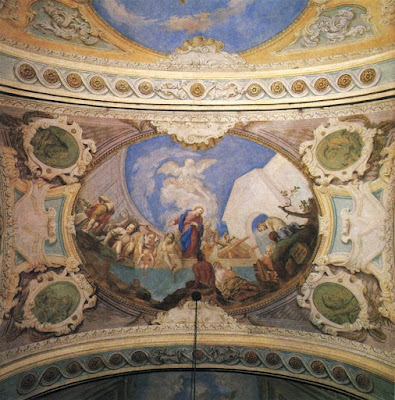
Baptistry, St Mark’s, Venice [Web Gallery of Art]
Readings (New American Bible: Philippines, USA)
Readings (Jerusalem Bible: Australia, England & Wales, India [optional], Ireland, New Zealand, Pakistan, Scotland, South Africa)
Gospel Mark 1:7-11 (New Revised Standard Version, Anglicised CatholicEdition)
John the Baptist proclaimed, ‘The one who is more powerful than I is coming after me; I am not worthy to stoop down and untie the thong of his sandals. I have baptized you with water; but he will baptize you with the Holy Spirit.’
In those days Jesus came from Nazareth of Galilee and was baptized by John in the Jordan. And just as he was coming up out of the water, he saw the heavens torn apart and the Spirit descending like a dove on him. And a voice came from heaven, ‘You are my Son, the Beloved; with you I am well pleased.’
In countries where the Baptism of the Lord is celebrated this year on Monday 8 January, eg the Philippines and the USA, there is only one reading before the Gospel and the Creed is omitted.
Feast of the Baptism of the Lord 2013
FEAST OF THE BAPTISM OF THE LORD
MASS AND ADMINISTRATION OF THE SACRAMENT OF BAPTISM
HOMILY OF HIS HOLINESS BENEDICT XVI
Sistine Chapel, Sunday, 8 January 2012
[I have highlighted parts of the Pope’s homily]
Dear Brothers and Sisters,
It is always a joy to celebrate this Holy Mass with the baptism of children on the Feast of the Baptism of the Lord. I greet you all with affection, dear parents, godparents and all of you, relatives and friends! You have come here — you said so aloud — so that your newborn babies may receive the gift of God’s grace, the seed of eternal life. You, parents, have desired this. You thought of Baptism even before your child was born. Your duty as Christian parents made you think immediately of the sacrament that marks entry into divine life and into the community of the Church. We can say that this was your first educational decision as witnesses of the faith to your children: it is a fundamental decision!
The parents’ task, helped by the godfather and godmother, is to raise their son or daughter. Raising children is very demanding and at times taxes our human capability, which is always limited. However, educating becomes a marvellous mission if it is carried out in collaboration with God who is the first and true educator of every human being.
In the First Reading, we heard from the Book of the Prophet Isaiah, God addresses his people precisely as a teacher. He puts the Israelites on their guard against the danger of quenching their thirst and appeasing their hunger at the wrong sources: “Why”, he says, “do you spend your money for that which is not bread, and your labour for that which does not satisfy?” (Is 55:2). God wants to give us good things to drink and to eat, things that do us good; whereas at times we use our resources mistakenly, we use them for things that are useless, indeed, even harmful. Above all, God wants to give us himself and his Word. He knows that in distancing ourselves from him we will soon run into difficulty — like the Prodigal Son of the parable — and, especially, that we will lose our human dignity. And for this reason he assures us that he is infinite mercy, that his thoughts and ways are unlike ours — fortunately! — and that we can always return to him, to the Father’s house. Thereafter he assures us that if we receive his Word it will bear good fruits in our life, like the rain that waters the earth (cf. Is 55:10-11).
We responded to these words which the Lord has addressed to us through the Prophet Isaiah with the refrain of the Psalm: We will “draw water joyfully from the springs of salvation”. As adults, we have striven to draw from the good springs for our own good and for the good of those entrusted to our responsibility, and you in particular, dear parents and godparents, for the good of these children.
And what are “the springs of salvation”? They are the Word of God and the sacraments. Adults are the first who should nourish themselves at these sources, so as to be able to guide those who are younger in their development. Parents must give much, but in order to give they need in turn to receive, otherwise they are drained, they dry up. Parents are not the spring, just as we priests are not the spring. Rather, we are like channels through which the life-giving sap of God’s love must flow. If we cut ourselves off from his spring, we ourselves are the first to feel the negative effects and are no longer able to educate others. For this reason we have committed ourselves by saying: We will “draw water joyfully from the springs of salvation”.
![The Baptism of Christ, El Greco [Web Gallery of Art]](https://1.bp.blogspot.com/-yprYCDC56_c/Wk_xiLwS-1I/AAAAAAAAGuQ/DlNE7obGWi0JCuCVQxLYYuzYWHWSwvOmgCLcBGAs/s1600/El%2BGreco%252C%2BThe%2BBaptism%2Bof%2BChrist%252C%2BWGA.jpg)
The Baptism of Christ, El Greco [Web Gallery of Art]
And we now come to the Second Reading and to the Gospel. They say that the first and principal education takes place through witness. The Gospel speaks of John the Baptist. John was a great educator of his disciples, because he led them to the encounter with Jesus to whom he bore witness. He did not exalt himself, he did not wish to keep his disciples bound to him. Yet John was a great prophet, his fame was very great. When Jesus arrived John drew back and pointed to him: “After me comes he who is mightier than I…. I have baptized you with water; but he will baptize you with the Holy Spirit” (Mk 1:7-8).
The true teacher does not bind people to himself, he is not possessive. He wants his son or daughter, or disciple, to learn to know the truth and to establish a personal relationship with it. The educator does his duty fully, he assures his attentive and faithful presence because his objective is that the person being educated listen to the voice of truth speaking to his heart and follow it on a personal journey.
Let us return once again to the witness. In the Second Reading, the Apostle John writes: “And the Spirit is the witness” (1 Jn 5:7). He is referring to the Holy Spirit, the Spirit of God, who bears witness to Jesus, testifying that he is the Christ, the Son of God. This is also apparent in the scene of the Baptism in the River Jordan: the Holy Spirit descends upon Jesus as a dove to reveal that he is the Only-Begotten Son of the eternal Father (cf. Mk 1:10). In his Gospel too, John underlines this aspect where Jesus says to the disciples: “When the Counselor comes, whom I shall send to you from the Father, even the Spirit of truth, who proceeds from the Father, he will bear witness to me; and you also are witnesses, because you have been with me from the beginning” (Jn 15:26-27). This is a great comfort to us in the work of educating in faith, because we know that we are not alone and that our witness is sustained by the Holy Spirit.
It is very important for you parents, and also for the godparents, to believe strongly in the presence and in the action of the Holy Spirit, to invoke him and to welcome him within you, through prayer and through the sacraments. It is he, in fact, who illumines the mind and warms the heart of the educator so that he or she can pass on the knowledge and love of Jesus. Prayer is the first condition for teaching because by praying we prepare ourselves to leave the initiative to God, to entrust children to him, who knows them before and better than we, and who knows perfectly what their true good is. And at the same time, when we pray we listen to God’s inspiration in order to do our part well, which in any case is our duty and which we are bound to do. The sacraments, especially the Eucharist and Penance, enable us to carry out our educational action in union with Christ, in communion with him and continuously renewed by his forgiveness. Prayer and the sacraments obtain for us that light of truth thanks to which we are able to be at once tender and strong, gentle and firm, silent and communicative at the right time, admonishing and correcting in the right way.
Dear friends, let us therefore all invoke the Holy Spirit together so that he may come down upon these children in abundance, consecrate them in the image of Jesus Christ and always go with them on their journey through life. Let us entrust them to the motherly guidance of Mary Most Holy, so that they may grow in age, wisdom and grace and become true Christians, faithful and joyful witnesses of God’s love. Amen.

A Catholic baptism [Wikipedia]
May each of us thank God today for our parents and godparents who brought us to be baptized so that we might receive ‘the seed of eternal life’.