The Pilgrims' Inn

  • Welcome to The Pilgrims’ Inn
‘Repent . . . and follow me.’ Sunday Reflections, 3rd Sunday in Ordinary Time, Year B
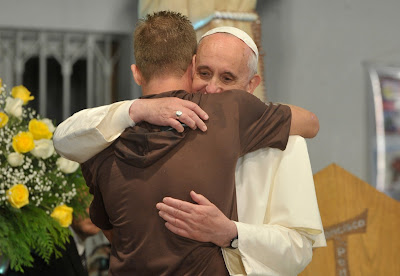
Pope Francis

‘Repent . . . and follow me.’ Sunday Reflections, 3rd Sunday in Ordinary Time, Year B

January 19, 2018 by Father Sean Coyle

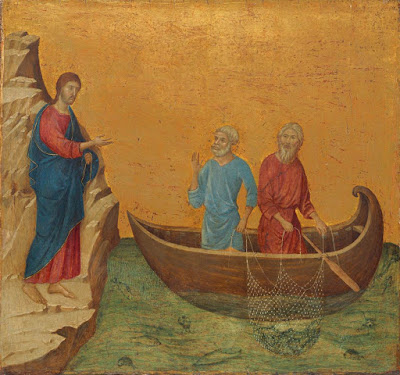
Calling of Peter and Andrew

Duccio di Buoninsegna [Web Gallery of Art]

Readings (New American Bible: Philippines, USA)

Readings (Jerusalem Bible: Australia, England & Wales, India [optional], Ireland, New Zealand, Pakistan, Scotland, South Africa)

Gospel Mark 1:14-20 (New Revised  Standard Version, Anglicised CatholicEdition) 

Now after John was arrested, Jesus came to Galilee, proclaiming the good news of God, and saying, ‘The time is fulfilled, and the kingdom of God has come near; repent, and believe in the good news.’

As Jesus passed along the Sea of Galilee, he saw Simon and his brother Andrew casting a net into the lake—for they were fishermen. And Jesus said to them, ‘Follow me and I will make you fish for people.’ And immediately they left their nets and followed him. As he went a little farther, he saw James son of Zebedee and his brother John, who were in their boat mending the nets. Immediately he called them; and they left their father Zebedee in the boat with the hired men, and followed him.

Speaking in Rome to members of ecclesial movements on the evening of Saturday 17 May 2013, the Vigil of Pentecost, Pope Francis told this story:

One day in particular, though, was very important to me: 21 September 1953. I was almost 17. It was ‘Students’ Day’, for us the first day of spring — for you the first day of autumn. Before going to the celebration I passed through the parish I normally attended, I found a priest that I did not know and I felt the need to go to confession. For me this was an experience of encounter: I found that someone was waiting for me. Yet I do not know what happened, I can’t remember, I do not know why that particular priest was there whom I did not know, or why I felt this desire to confess, but the truth is that someone was waiting for me. He had been waiting for me for some time. After making my confession I felt something had changed. I was not the same. I had heard something like a voice, or a call. I was convinced that I should become a priest.

What is striking is that the young Jorge Mario Bergoglio experienced God’s call to the priesthood unexpectedly and within the context of confession. In today’s Gospel the call of Simon and Peter, of James and John to follow Jesus is within the context of a call to conversion: repent, and believe in the good news. 

In the First Reading God sends a very reluctant Jonah to Nineveh to call the people there to repentance. And the people of Nineveh believed God; they proclaimed a fast, and everyone, great and small, put on sackcloth.
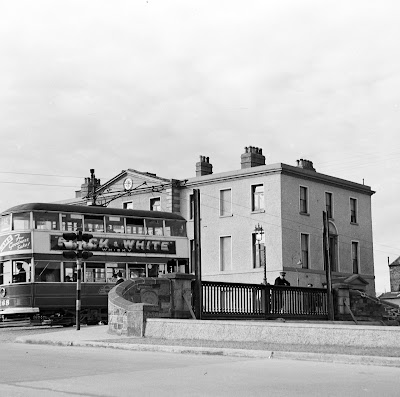
An old photo of Portobello Bridge, Dublin [Wikipedia]

Last Monday on  Nationwide on RTÉ, Ireland’s national radio and TV service, a young Irish Dominican friar, Fr David Barron OP, told how he remembered the very moment when he decided to give up his job in banking, in which he was very happy, to become a Dominican priest: One evening, coming on the bus from Trinity (Dublin University) into Rathmines, coming over Portobello Bridge, I still remember, I finally gave in and said, ‘I’ll give it a go’ [11:17 – 11:29 in the video].
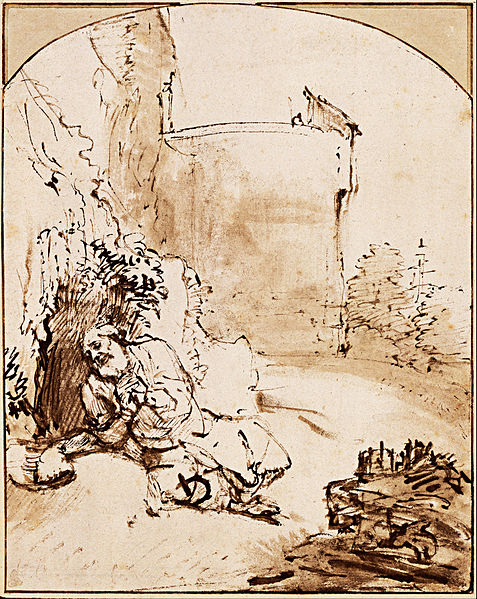
The Prophet Jonah Before the Walls of Jericho

Rembrandt [Wikipedia Commons]

The First Reading, from the Book of Jonah, shows the people of Nineveh, from the King down, believing the reluctant prophet and then fasting and repenting.

In the Gospel Jesus preaches, Repent, and believe in the good news. It is in the context of that proclamation to the people in Galilee that Jesus invites Simon and Andrew, James and John, to follow him. Each of the four could make the words of Pope Francis their own: For me this was an experience of encounter: I found that someone was waiting for me. Yet I do not know what happened . . . I was not the same. I had heard something like a voice, or a call. That call was to lead the four of them to leave everything to follow him, a decision that was to bring three of them to martyrdom. The young Jorge Mario Bergoglio could not have had the slightest idea that listening to God’s call would lead him to Rome.

About 16 years ago I did a mission appeal in a parish in England where the then recently appointed parish priest had inherited a filthy rectory/presbytery/convento from his predecessor. He had managed by then to clean up only his own bedroom. He could not invite me to stay at his place because the guest room was filthy and so had me put up by a neighbouring parish priest.

The people of Nineveh cleaned up the ‘room’ of their inner heart by turning away from sin and allowed the word of God to enter. The Gospel suggests that the two sets of fishermen-brothers had done the same and were able to hear and respond to the call of Jesus there and then.

May we do likewise, with God’s grace, especially through the sacrament of reconciliation / penance / confession.

Jesus calls each of us through baptism into an intimate, personal relationship with him. He eventually reveals to us, within that relationship, the specific vocation to which he invites us – to marriage, to the priesthood, to religious life, to remaining single. We can only hear that specific invitation from Jesus if we constantly repent of our sins and accept his loving forgiveness and mercy.

Posted in: Sunday Reflections Tagged: confession, Dominicans, Duccio di Buoninsegna, Pope Francis, Priesthood, Rembrandt, Sunday Reflections, Vocation

‘Jesus said to them,”Come and see”.’ Sunday Reflections, 2nd Sunday in Ordinary Time, Year B

January 10, 2018 by Father Sean Coyle

From The Gospel of John, directed by Philip Saville

Readings (New American Bible: Philippines, USA)

Readings (Jerusalem Bible: Australia, England & Wales, India [optional], Ireland, New Zealand, Pakistan, Scotland, South Africa)

Gospel John 1:35-42 (New Revised  Standard Version, Anglicised CatholicEdition) 

The next day John again was standing with two of his disciples, and as he watched Jesus walk by, he exclaimed, ‘Look, here is the Lamb of God!’ The two disciples heard him say this, and they followed Jesus. When Jesus turned and saw them following, he said to them, ‘What are you looking for?’ They said to him, ‘Rabbi’ (which translated means Teacher), ‘where are you staying?’ He said to them, ‘Come and see.’ They came and saw where he was staying, and they remained with him that day. It was about four o’clock in the afternoon. One of the two who heard John speak and followed him was Andrew, Simon Peter’s brother. He first found his brother Simon and said to him, ‘We have found the Messiah’ (which is translated Anointed. He brought Simon to Jesus, who looked at him and said, ‘You are Simon son of John. You are to be called Cephas’ (which is translated Peter).

St Andrew the Apostle, El Greco [Web Gallery of Art]

God calls each of us to our particular vocation in life in a unique way. Pope Francis has told us, for example, that it was on the occasion of going to confession when he was 17 that he saw clearly that God was calling him to be a priest. A couple at whose wedding I officiated some years ago were members of the same Catholic organisation in the university they attended. They became an ‘item’, as they say in the Philippines, when they were the only members of the group to turn up at the appointed time for an outing. While waiting for the others to arrive they discovered that they were more than just casual friends. Now they are happily married with four children.

I’m always amused by the Second Reading from the Office of Readings for the feast of St Anthony the Abbot, 17 January. St Athanasius tells us: He went into the church. It happened that the gospel was then being read, and he heard what the Lord had said to the rich man ‘If you would be perfect, go, sell what you possess and give to the poor, and you will have treasure in heaven; and come, follow me.’

The young man Anthony, whose parents had died about six months previously, took these words to heart and went to live in the desert. He became, without planning it, the ‘Father of Monasticism’ in the Church. And perhaps if he had not been late for Mass that day the Gospel might not have struck him as it did. He was to be ‘later’ than most in another sense in that he was 105 when he died, a remarkable age to live to now but even more remarkable in the fourth century! Unlike the married couple above whose punctuality led them to discover God’s call for them, it was through being late for Mass that Anthony discovered what God had in mind for him.

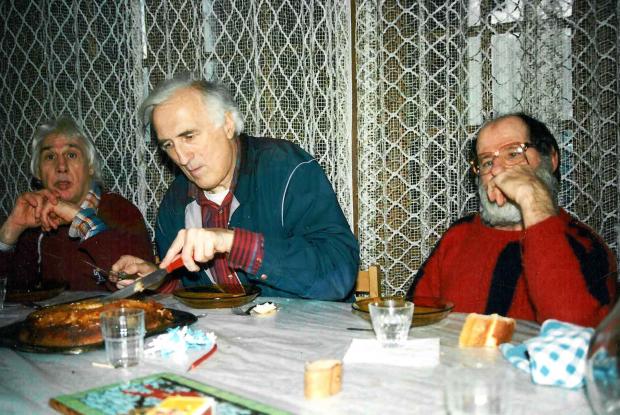
Raphaël Simi, Jean Vanier and Philippe Seux, 2014

In 1964 Jean Vanier invited two men with learning disabilities, Raphael Simi and Philippe Seux, who had been living in institutions, to live with him in a small cottage that he bought and renovated in France. Having done so he realized that he had made a commitment to these two men and that his commitment involved remaining single. He had no intention of founding a movement but, in God’s plan, that’s what came about: L’Arche. Raphaël and Philippe are now considered, with Jean, co-founders of L’Arche.

Fr Hans Urs von Balthasar, a great Swiss theologian much admired by St John Paul II, in reflecting on today’s Gospel from the First Chapter of St John, links it to an incident in the last chapter, John 21: 15 ff [starting at 0:55 in the video below].

Fr von Balthasar writes: In the last chapter of the book Peter will be the foundation stone to such a degree that he will also have to undergird ecclesial love: ‘Simon, do you love me more than these?’

John 21:15-17 was the gospel read at the Pope’s Mass in Manila Cathedral on 16 January 2015 with priests, religious, consecrated persons and seminarians. This passage shows what is at the heart of every call from God, whether to marriage, to the priesthood, to the consecrated life, to the single life. The call is above all to an intimate relationship with Jesus. Pope Francis highlighted this in his homily: For us priests and consecrated persons, conversion to the newness of the Gospel entails a daily encounter with the Lord in prayer. The saints teach us that this is the source of all apostolic zeal! For religious, living the newness of the Gospel also means finding ever anew in community life and community apostolates the incentive for an ever closer union with the Lord in perfect charity. For all of us, it means living lives that reflect the poverty of Christ, whose entire life was focused on doing the will of the Father and serving others.

Pope Francis also said, The poor are at the center of the Gospel, are at heart of the Gospel; if we take away the poor from the Gospel we can’t understand the whole message of Jesus Christ.

Living the Gospel within the context of a deep personal relationship with Jesus the Risen Lord involves seeing reality through the eyes of those with little in life. Pope Francis showed this in a beautiful way by an unplanned – at least it wasn’t on the official schedule – to a group of very poor children at TNK in Manila, near the Cathedral. (‘Tulay ng Kabataan’ means ‘A Bridge to Children’).

Posted in: Sunday Reflections Tagged: El Greco, Jean Vanier, Manila, Pope Francis, Sunday Reflections, Tulay ng Kabataan

‘And the favour of God was upon him.’ Sunday Reflections, Feast of the Holy Family; Mary, Mother of God

December 29, 2017 by Father Sean Coyle

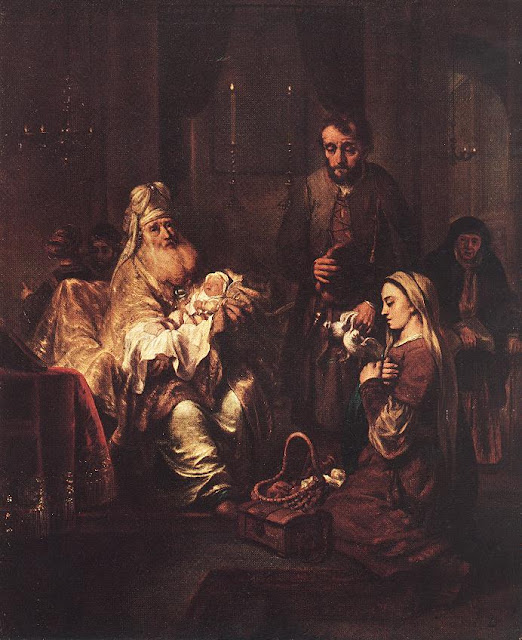
Presentation in the Temple

Gerbrand van de Eeckhout [Web Gallery of Art]

Readings (New American Bible: Philippines, USA)

Readings (Jerusalem Bible: Australia, England & Wales, India [optional], Ireland, New Zealand, Pakistan, Scotland, South Africa)

Gospel Luke 2:22-40 [2:22, 39-40] (NewRevised  Standard Version, AnglicisedCatholic Edition) 

When the time came for their purification according to the law of Moses, they brought him up to Jerusalem to present him to the Lord [ (as it is written in the law of the Lord, ‘Every firstborn male shall be designated as holy to the Lord’), and they offered a sacrifice according to what is stated in the law of the Lord, ‘a pair of turtle-doves or two young pigeons.’

Now there was a man in Jerusalem whose name was Simeon; this man was righteous and devout, looking forward to the consolation of Israel, and the Holy Spirit rested on him. It had been revealed to him by the Holy Spirit that he would not see death before he had seen the Lord’s Messiah. Guided by the Spirit, Simeon came into the temple; and when the parents brought in the child Jesus, to do for him what was customary under the law, Simeon took him in his arms and praised God, saying,

‘Master, now you are dismissing your servant in peace,
    according to your word;
for my eyes have seen your salvation,
     which you have prepared in the presence of all peoples,
a light for revelation to the Gentiles
    and for glory to your people Israel.’

And the child’s father and mother were amazed at what was being said about him. Then Simeon blessed them and said to his mother Mary, ‘This child is destined for the falling and the rising of many in Israel, and to be a sign that will be opposed so that the inner thoughts of many will be revealed—and a sword will pierce your own soul too.’

There was also a prophet, Anna the daughter of Phanuel, of the tribe of Asher. She was of a great age, having lived with her husband for seven years after her marriage, then as a widow to the age of eighty-four. She never left the temple but worshipped there with fasting and prayer night and day. At that moment she came, and began to praise God and to speak about the child to all who were looking for the redemption of Jerusalem.]

When they had finished everything required by the law of the Lord, they returned to Galilee, to their own town of Nazareth. The child grew and became strong, filled with wisdom; and the favour of God was upon him.

Note that there are alternative First Readings, Responsorial Psalms and Second Readings. There are also longer and shorter versions of the Gospel.

[Family Theater Productions]

Before Christmas we listened to the words of St Matthew: Now the birth of Jesus the Messiah took place in this way. When his mother Mary had been engaged to Joseph, but before they lived together, she was found to be with child from the Holy Spirit. Her husband Joseph, being a righteous man and unwilling to expose her to public disgrace, planned to dismiss her quietly. But just when he had resolved to do this, an angel of the Lord appeared to him in a dream and said, ‘Joseph, son of David, do not be afraid to take Mary as your wife, for the child conceived in her is from the Holy Spirit. She will bear a son, and you are to name him Jesus, for he will save his people from their sins’ (Matthew 1:18-21). 

Joseph, by obeying God’s messenger and by naming the Son his wife Mary bore, became the legal father of Jesus. The Church honours him above all as the Husband of Mary. St John XXIII added the words and blessed Joseph, her Spouse to the Roman Canon, now also known as the First Eucharistic Prayer, while Pope Francis has included that phrase in the other three main Eucharistic Prayers. It was as the Husband of Mary that St Joseph took care of her and of Jesus. It was St Joseph whom Jesus knew as Dad/Papa/Tatay. It was from St Joseph that Jesus, God who became Man, learned, in his humanity, to grow into manhood.

St Joseph submitted his whole being, as did his wife Mary, to doing God’s will. Jesus was flesh of her flesh, but not of his. Yet he loved Jesus as if he was his own son, first of all by loving his mother.

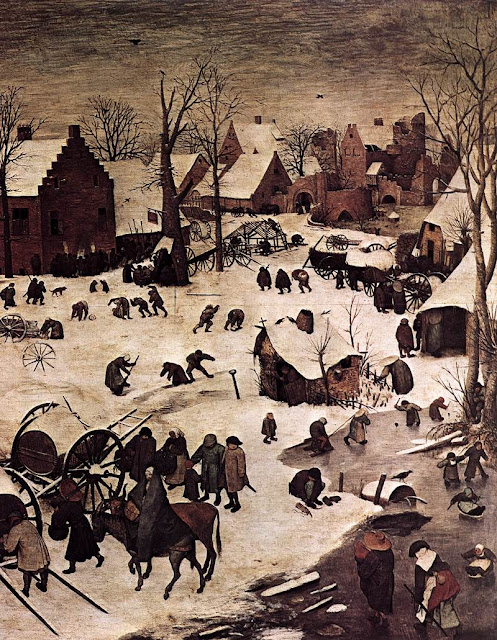
The Census at Bethlehem (detail)

Pieter Bruegel the Elder [Web Gallery of Art]

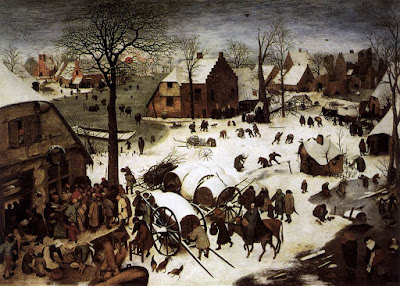
Peter Bruegel the Elder, maybe the first major painter to focus on the lives of ordinary people, captures the quiet responsibility of St Joseph, leading the donkey on which the heavily pregnant Mary is riding. The picture above is a detail of the full painting:

Bruegel has transposed Bethlehem to a village in the Netherlands in the middle of winter. He captures the reality that the Holy Family were ‘nobodies’. None of the people around notices them. They too are caught up in the red tape of their day, having to travel long distances to have their names registered.

Gerbrand van den Eeckhout in the Presentation in the Temple shows St Joseph as a man who is somewhat shy, not wanting to be in the limelight, but standing protectively over Mary as she kneels before Jesus held in the arms of Simeon, with Anna the Prophetess in the background. St Joseph here reminds me very much of my own father.


And in the video of the Presentation what strikes me is that St Joseph is the one carrying Jesus. But before he hands the infant to Simeon he quietly asks Mary’s permission to do so. Mary hands Jesus back to Joseph after receiving him from Simeon and it is St Joseph, as head of the Holy Family, who presents the infant to the priest who offers him to God. The priest has no idea who this child of poor parents really is.


On 17 November 2014 Pope Francis said: It is necessary to insist on the fundamental pillars that govern a nation: its intangible assets. The family is the foundation of co-existence and a guarantee against social fragmentation. Children have a right to grow up in a family with a father and a mother capable of creating a suitable environment for the child’s growth and emotional development. This is why, in the Apostolic Exhortation Evangelii Gaudium, I stressed the ‘indispensable’ contribution of marriage to society, a contribution which ‘transcends the feelings and momentary needs of the couple’ (n. 66). And this is why I am grateful to you for the emphasis that your colloquium has placed on the benefits that marriage can provide children, the spouses themselves, and society.


There have always been children who have grown up without one or both parents. In the Bible they are seen as young persons in need of special care from the wider community. I have known many single parents, some of them widowed, raising their children lovingly and heroically. But this is not the norm.


Incredibly, many within the last three or four decades have come to dismiss the importance of husband/father and wife/mother, have come to dismiss the conception and birth of children in the way that God intended.

Pope Francis with recovering drug addict, Brazil 2013 [Wikipedia]

Though without a family of my own I have for many years experienced the title ‘Father’ as a call to be one in a number of senses: a ‘spiritual father’ who leads others to our Heavenly Father through his Son Jesus Christ, and a father-figure to young persons who may have lost their father or who may even have been abused by their father or by other fatherly figures in whom they should have been able to trust.

As a man, I see today’s Feast of the Holy Family to be a call especially to us men to be like St Joseph, to be responsible, to be loving; if married to love our wives above all, if not, to be like fathers to young persons who come into our lives in whatever way and for whatever reason.

As a priest I am grateful to God for calling me not only to be ‘Father’ but to be a father to many in the sense that St Joseph was truly a father to Jesus.

Parents tell their 6 kids that another is on the way!

Solemnity of Mary, the Holy Mother of God


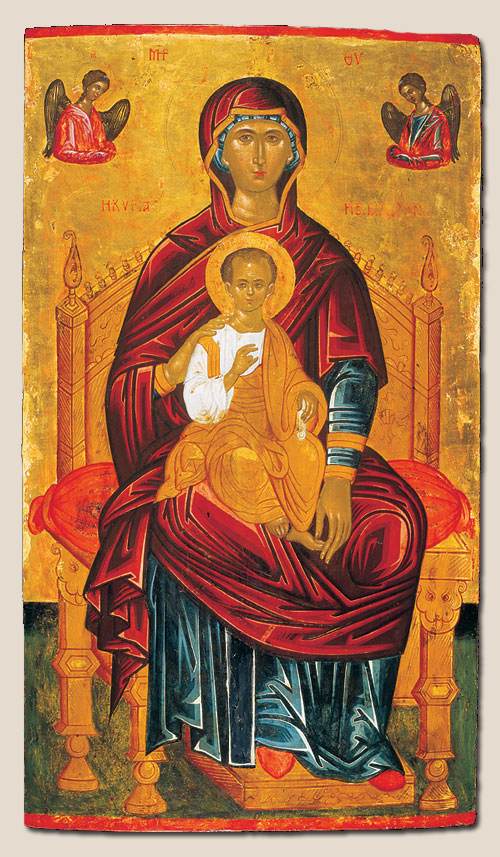
The Mother of God Enthroned, Andreas Ritzos [Web Gallery of Art]

The first day of 2018 is observed by the Church as the Solemnity of Mary, the Holy Mother of God. It is also the last day of the Octave of Christmas and World Day of Peace. In some countries, eg the Philippines, it is a Holy Day of Obligation. In others, eg Ireland, it is not.

Readings (New American Bible: Philippines, USA)

Readings (Jerusalem Bible: Australia, England & Wales, India [optional], Ireland, New Zealand, Pakistan, Scotland, South Africa)

Gospel Luke 2:16-21 (NewRevised  Standard Version, AnglicisedCatholic Edition) 

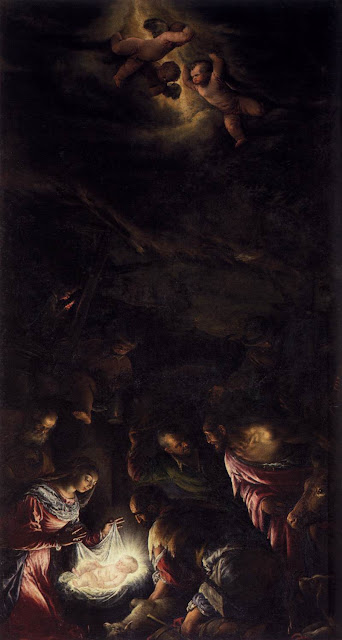
So the shepherds went with haste and found Mary and Joseph, and the child lying in the manger. When they saw this, they made known what had been told them about this child; and all who heard it were amazed at what the shepherds told them. But Mary treasured all these words and pondered them in her heart. The shepherds returned, glorifying and praising God for all they had heard and seen, as it had been told them.

After eight days had passed, it was time to circumcise the child; and he was called Jesus, the name given by the angel before he was conceived in the womb.

Adoration of the Shepherds, Jacopo Bassano [Web Gallery of Art]

MESSAGE OF HIS HOLINESS POPE
FRANCIS

FOR THE CELEBRATION OF THE 
51st WORLD DAY OF PEACE

1 JANUARY 2018

Migrants and refugees: men and women in search of peace

Happy New Year!

Manigong Bagong Taon!

Athbhliain Faoi Mhaise!

Posted in: Sunday Reflections Tagged: Andreas Ritzos, Gerbrand van de Eeckhout, Jacopo Bassano, Pieter Bruegel the Elder, Pope Francis, Sunday Reflections, The Holy Family, Web Gallery of Art

The Immaculate Conception and the Extraordinary Jubilee of Mercy

December 7, 2015 by Father Sean Coyle

The Virgin of the Immaculate Conception

El Greco, 1608-13, Museo de Santa Cruz, Toledo, Spain [Web Gallery of Art]

Gospel Luke 1:26-38 (New Revised Standard Version, Catholic Edition) 

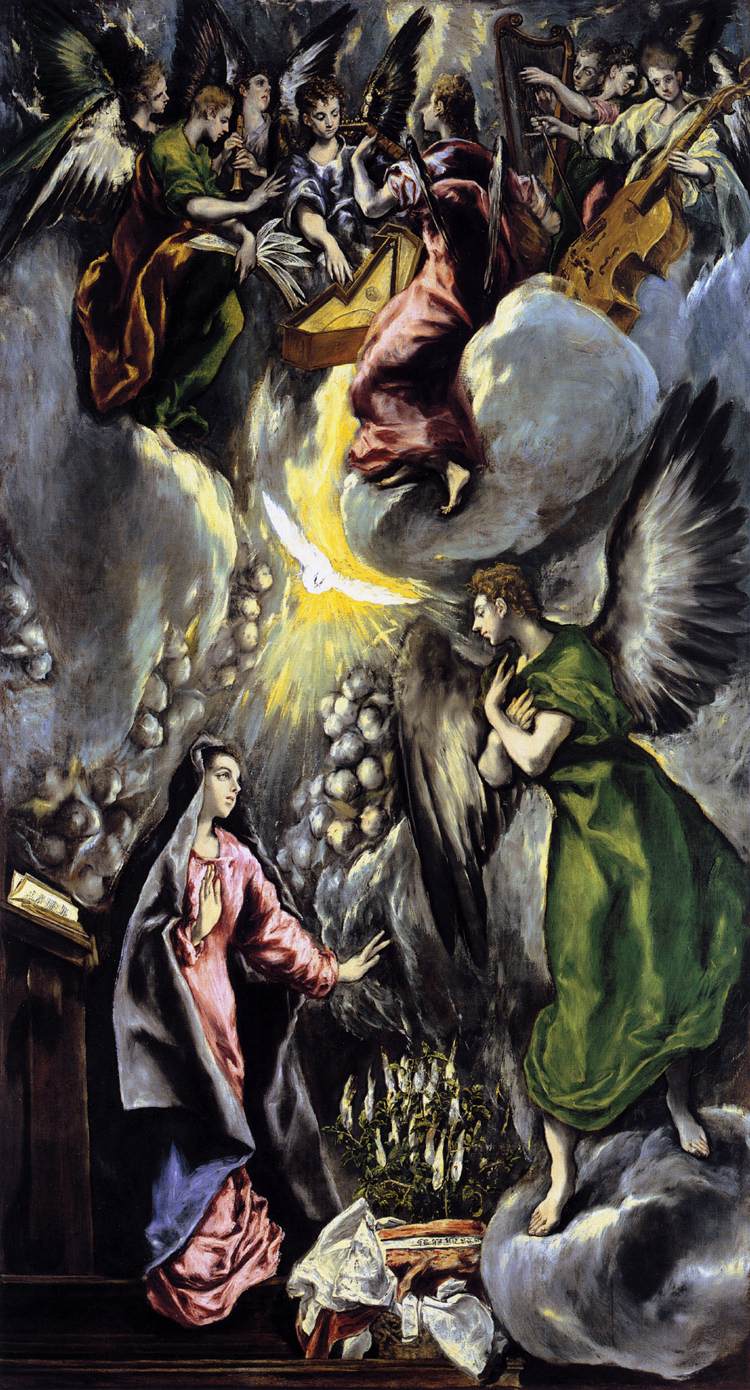
In the sixth month the angel Gabriel was sent by God to a town in Galilee called Nazareth, to a virgin engaged to a man whose name was Joseph, of the house of David. The virgin’s name was Mary. And he came to her and said, “Greetings, favored one! The Lord is with you.” But she was much perplexed by his words and pondered what sort of greeting this might be. The angel said to her, “Do not be afraid, Mary, for you have found favor with God. And now, you will conceive in your womb and bear a son, and you will name him Jesus. He will be great, and will be called the Son of the Most High, and the Lord God will give to him the throne of his ancestor David. He will reign over the house of Jacob forever, and of his kingdom there will be no end.” Mary said to the angel, “How can this be, since I am a virgin?” The angel said to her, “The Holy Spirit will come upon you, and the power of the Most High will overshadow you; therefore the child to be born will be holy; he will be called Son of God. And now, your relative Elizabeth in her old age has also conceived a son; and this is the sixth month for her who was said to be barren. For nothing will be impossible with God.” Then Mary said, “Here am I, the servant of the Lord; let it be with me according to your word.” Then the angel departed from her.

The Annunciation

El Greco, 1596-1600, Museo del Prado, Madrid [Web Gallery of Art]

Logo, Jubilee of Mercy

Misericordiae Vultus

BULL OF INDICTION
OF THE EXTRAORDINARY
JUBILEE OF MERCY

FRANCIS
BISHOP OF ROME
SERVANT OF THE SERVANTS OF GOD
TO ALL WHO READ THIS LETTER
GRACE, MERCY, AND PEACE

Young Jew as Christ 

Rembrandt, c.1648, Staatliche Museen, Berlin [Web Gallery of Art]

Jesus Christ is the face of the Father’s mercy. These words might well sum up the mystery of the Christian faith. Mercy has become living and visible in Jesus of Nazareth, reaching its culmination in him. The Father, ‘rich in mercy’ (Eph 2:4), after having revealed his name to Moses as ‘a God merciful and gracious, slow to anger, and abounding in steadfast love and faithfulness’ (Ex34:6), has never ceased to show, in various ways throughout history, his divine nature. In the ‘fullness of time’ (Gal 4:4), when everything had been arranged according to his plan of salvation, he sent his only Son into the world, born of the Virgin Mary, to reveal his love for us in a definitive way. Whoever sees Jesus sees the Father (cf. Jn 14:9). Jesus of Nazareth, by his words, his actions, and his entire person reveals the mercy of God.

The above are the opening words of Misericordiae Vultus, the proclamation by Pope Francis of the Extraordinary Jubilee of Mercy that starts tomorrow, the Solemnity of the Immaculate Conception, when the Pope opens the Holy Door at St Peter’s Basilica in Rome. The Jubilee Year will end on the Solemnity of Christ the King, 20 November 2016. The Vatican has a website dedicated to the Jubilee Year.

In No 24 of Misericordiae Vultus Pope Francis writes:

My thoughts now turn to the Mother of Mercy. May the sweetness of her countenance watch over us in this Holy Year, so that all of us may rediscover the joy of God’s tenderness. No one has penetrated the profound mystery of the incarnation like Mary. Her entire life was patterned after the presence of mercy made flesh. The Mother of the Crucified and Risen One has entered the sanctuary of divine mercy because she participated intimately in the mystery of His love.

Chosen to be the Mother of the Son of God, Mary, from the outset, was prepared by the love of God to be the Ark of the Covenant between God and man. She treasured divine mercy in her heart in perfect harmony with her Son Jesus. Her hymn of praise, sung at the threshold of the home of Elizabeth, was dedicated to the mercy of God which extends from ‘generation to generation’ (Lk 1:50). We too were included in those prophetic words of the Virgin Mary. This will be a source of comfort and strength to us as we cross the threshold of the Holy Year to experience the fruits of divine mercy.

At the foot of the Cross, Mary, together with John, the disciple of love, witnessed the words of forgiveness spoken by Jesus. This supreme expression of mercy towards those who crucified him show us the point to which the mercy of God can reach. Mary attests that the mercy of the Son of God knows no bounds and extends to everyone, without exception. Let us address her in the words of the Salve Regina, a prayer ever ancient and ever new, so that she may never tire of turning her merciful eyes upon us, and make us worthy to contemplate the face of mercy, her Son Jesus.

Let us address her in the words of the Salve Regina, a prayer ever ancient and ever new (Misericordiae Vultus).

The Crucifixion

El Greco, 1596-1600, Museo del Prado, Madrid [Web Gallery of Art]

At the foot of the Cross, Mary, together with John, the disciple of love, witnessed the words of forgiveness spoken by Jesus (Misericordiae Vultus).

Posted in: Pope Francis Tagged: El Greco, Extraordinary Jubilee of Mercy, Immaculate Conception, Pope Francis, Rembrandt

Pope Francis’s Prayer Intentions for December 2015

December 3, 2015 by Father Sean Coyle
Young Jew as Christ, Rembrandt, c.1648
Staatliche Museen, Berlin [Web Gallery of Art]
 
Jesus Christ is the face of the Father’s mercy. (Pope Francis)
 
Universal: EXPERIENCING GOD’S MERCY
That all may experience the mercy of God, who never tires of forgiving.
The Holy Family with Angels, Rembrandt, 1645
The Hermitage, St Petersburg [Web Gallery of Art]
 
And the Word became flesh and lived among us, and we have seen his glory, the glory as of a father’s only son, full of grace and truth. (John 1:14)
 
Evangelization: FAMILIES
That families, especially those who suffer, may find in the birth of Jesus a sign of certain hope.
Intentions and videos from the website of the Apostleship of Prayer.
Posted in: Pope Francis Tagged: Apostleship of Prayer, family, God's mercy, Pope Francis, Rembrandt, The Holy Family, Year of Mercy

‘Lord, to whom can we go? You have the words of eternal life.’ Sunday Reflections, 21st Sunday in Ordinary Time, Year B

August 20, 2015 by Father Sean Coyle


Saint Peter, El Greco, 1610-13 [Web Gallery of Art]
Monasterio de San Lorenzo, El Escorial, Madrid 

Simon Peter answered him, “Lord, to whom can we go? You have the words of eternal life.  We have come to believe and know that you are the Holy One of God.”


Readings (New American Bible: Philippines, USA)

Readings (Jerusalem Bible: Australia, England & Wales, India [optional], Ireland, New Zealand, Pakistan, Scotland, South Africa)

Gospel John 6:60-69 (New Revised Standard Version, Catholic Edition, Canada) 

When many of Jesus’ disciples heard it, they said, “This teaching is difficult; who can accept it?” But Jesus, being aware that his disciples were complaining about it, said to them, “Does this offend you? Then what if you were to see the Son of Man ascending to where he was before? It is the spirit that gives life; the flesh is useless. The words that I have spoken to you are spirit and life. But among you there are some who do not believe.” For Jesus knew from the first who were the ones that did not believe, and who was the one that would betray him. And he said, “For this reason I have told you that no one can come to me unless it is granted by the Father.”

Because of this many of his disciples turned back and no longer went about with him. So Jesus asked the twelve, “Do you also wish to go away?” Simon Peter answered him, “Lord, to whom can we go? You have the words of eternal life.  We have come to believe and know that you are the Holy One of God.”

Pope Francis in Palo, Leyte, Philippines, 17 January 2015 [Wikipedia] 
This Sunday’s gospel concludes the Eucharistic Discourse of Chapter 6 of St John’s Gospel. The teaching of Jesus that many of his disciples could not accept was what we heard last Sunday: “I am the living bread that came down from heaven. Whoever eats of this bread will live forever; and the bread that I will give for the life of the world is my flesh.”

The Jews then disputed among themselves, saying, “How can this man give us his flesh to eat?” So Jesus said to them, “Very truly, I tell you, unless you eat the flesh of the Son of Man and drink his blood. 

St Peter today speaks on behalf of those who stay with Jesus: Lord, to whom can we go? You have the words of eternal life.  We have come to believe and know that you are the Holy One of God.

In his Angelus audience last Sunday Pope Francis spoke these words which are very relevant to today’s gospel. I have highlightedparts of the text.

In these Sundays, the Liturgy proposes to us, from the Gospel of John, Jesus’ discourse on the Bread of Life, that is He Himself and that is also the Sacrament of the Eucharist. Today’s passage (Jn. 6, 51-58) presents the last part of that discourse, and refers to some of those among the people who are scandalized because Jesus said: “Whoever eats my flesh and drinks my blood has eternal life, and I will raise him on the last day” (Jn. 6,54).

The astonishment of those listening is understandable; in fact,Jesus uses the typical style of the prophets to provoke in the people – and also in us – questions and, in the end, to make a decision. The first of the questions is: What does “eat Jesus’ flesh and drink his blood” mean? Is it only an image, a way of saying, a symbol, or does it indicate something real? To answer this, one needs to guess what is happening in Jesus’ heart while he breaks the bread for the hungry crowd. Knowing that He must die on the cross for us, Jesus identifies Himself with that broken and shared bread, and that becomes for Him the “sign” of the Sacrifice that awaits Him. This process culminates in the Last Supper, where the bread and wine truly become His Body and His Blood.

It is the Eucharist where Jesus leaves us a precise purpose: that we can become one with Him. In fact, he says: “Whoever eats my flesh and drinks my blood remains in me and I in him” (v.56). To remain: Jesus in us and us in Him. Communion is assimilation: eating Him, we become Him. But this requires our “yes”, our adherence to the faith.

At times, during the Holy Mass, it may happen to feel this objection: “What is the purpose of the Mass? I go in Church when I feel like it, and I pray better alone.” But the Eucharist is not a private prayer or a beautiful spiritual experience, it is not a simple commemoration of what Jesus has done in the Last Supper: we say, to understand well, that the Eucharist is a “memorial”, that is, an act that actualizes and makes present the event of the death and resurrection of Jesus: the bread is truly His Body given to us; the wine is truly His Blood that has been shed.

The Eucharist is Jesus who gives Himself entirely to us. By nourishing ourselves from Him and remaining in Him through the Eucharistic Communion, if we do it with faith, it transforms our life; it transforms it into a gift to God and a gift to our brothers. To nourish ourselves from that “bread of life” means being in tune with the heart of Christ, to assimilate His choices, His thoughts, His behavior. It means entering into a dynamic of sacrificial love and become a person of peace, of forgiveness, of reconciliation of sharing in solidarity. It is the same as Jesus has done.

Jesus concludes his discourse with these words; “Whoever eats this bread will live forever” (Jn. 6,58). Yes, living in a concrete, real communion with Jesus on this earth makes us pass from death to life. The heavens begin precisely in this communion with Jesus.

In Heaven, Mary our Mother awaits us – yesterday we celebrated this mystery. May She obtain for us the grace of nourishing ourselves always with faith in Jesus, the Bread of Life.

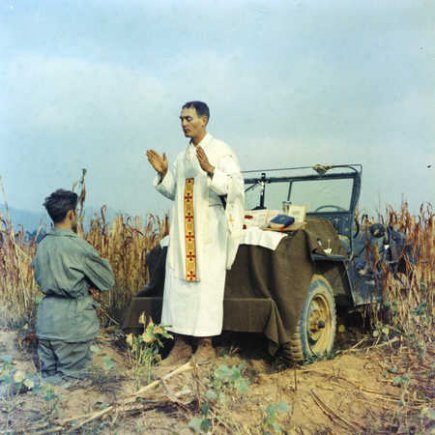
Servant of God Fr Emil Kapaun celebrating Mass during the Korean War [Wikipedia]

I came to know of Fr Emil Kapaun in my teenage years when I read a biography I came across in a public library in Dublin. I was inspired by his heroism as a chaplain in the US forces during the Korean War. I was delighted to discover that this heroic priest shared a birthday with me, 20 April, and ‘cancelled out’ another born on that date – Adolf Hitler. (St Rose of Lima, a secondary patroness of the Philippines whose feast coincides with this Sunday, is another on the ‘plus’ side!)

In the video below it is clear how Father Kapaun, who is being considered for beatification, lived the words of Pope Francis about the Eucharist: To nourish ourselves from that “bread of life” means being in tune with the heart of Christ, to assimilate His choices, His thoughts, His behavior. It means entering into a dynamic of sacrificial love and become a person of peace, of forgiveness, of reconciliation of sharing in solidarity. It is the same as Jesus has done.

In the video [5:38 – 5:56] we hear Fr Kapaun’s own voice echoing the words of St Peter in today’s gospel: We can be sure to expect that in our own lives there will come a time when we must make a choice that between being loyal to the true faith or of giving allegiance to something else which is either opposed to or not in alliance with our faith.

One cannot but be moved by the description of how Fr Kapaun saved Herbert Miller, a wounded American soldier [2:53 – 3:51]. ‘He picked me up and carried me’ . . . ‘So he carried him for 30 miles.’ It means entering into a dynamic of sacrificial love, as Pope Francis said last Sunday.

In the video below it is clear that Chaplain Kapaun utterly believed that in the celebration of the Holy Sacrifice of the Mass Jesus the Risen Lord becomes truly present among us and not just symbolically. He put thousands of miles on his jeep to bring the presence of Christ in the Eucharist to the front lines. He often celebrated Mass for them on the hood of his jeep [0:59 – 1:06].

In the prison of war camp Fr Kapaun was like a mother to all the soldiers . . . He’d help keep them clean. He’d wash their clothes. He’d lead them in prayer services. He’d celebrate Mass in secret when he could [2:27 – 2:53].

The last thing they saw him do in this life was bless the men who were taking him to his death and pray out loud, ‘Father, forgive them for they know not what they do’  [3:33 – 3:44].

The crucifix in the background to those words of Jesus that Fr Kapaun repeated was carved later in his memory by one of his companions in the camp – a Jew.

Surely this heroic priest lived the words of Pope Francis: It means entering into a dynamic of sacrificial love and become a person of peace, of forgiveness, of reconciliation of sharing in solidarity. It is the same as Jesus has done.

The life and death of Fr Emil Joseph Kapaun expressed fully the response of Simon Peter to Jesus, Lord, to whom can we go? You have the words of eternal life.  We have come to believe and know that you are the Holy One of God.

A footnote about Fr Kapaun

Fr Kapaun has a Columban connection. He wrote to the Columbans in Omaha, Nebraska, inquiring about the possibility of becoming one. However, his vocation was to be a diocesan priest. In the chapel of the central house of the Columbans in Seoul is a plaque with the names of priests who died during the Korean War as chaplains in the US forces, some of whom used to visit our house. And some of them surely knew some of the seven Columban priests who died in the Korean War and who are being proposed for beatification by the Catholic Church in Korea.

In the two videos above Fr Kapaun’s surname is pronounced in different ways: ‘capAWN’, ‘CAPE-un’, ‘cape-AWN’. As far as I know, the first is correct.

Posted in: Sunday Reflections Tagged: Fr Emil Kapaun, Holy Sacrifice of the Mass, Korean War, Pope Francis, St Peter, Sunday Reflections

‘Teacher, do you not care that we are perishing?’ Sunday Reflections, 12th Sunday in Ordinary Time, Year B

June 20, 2015 by Father Sean Coyle


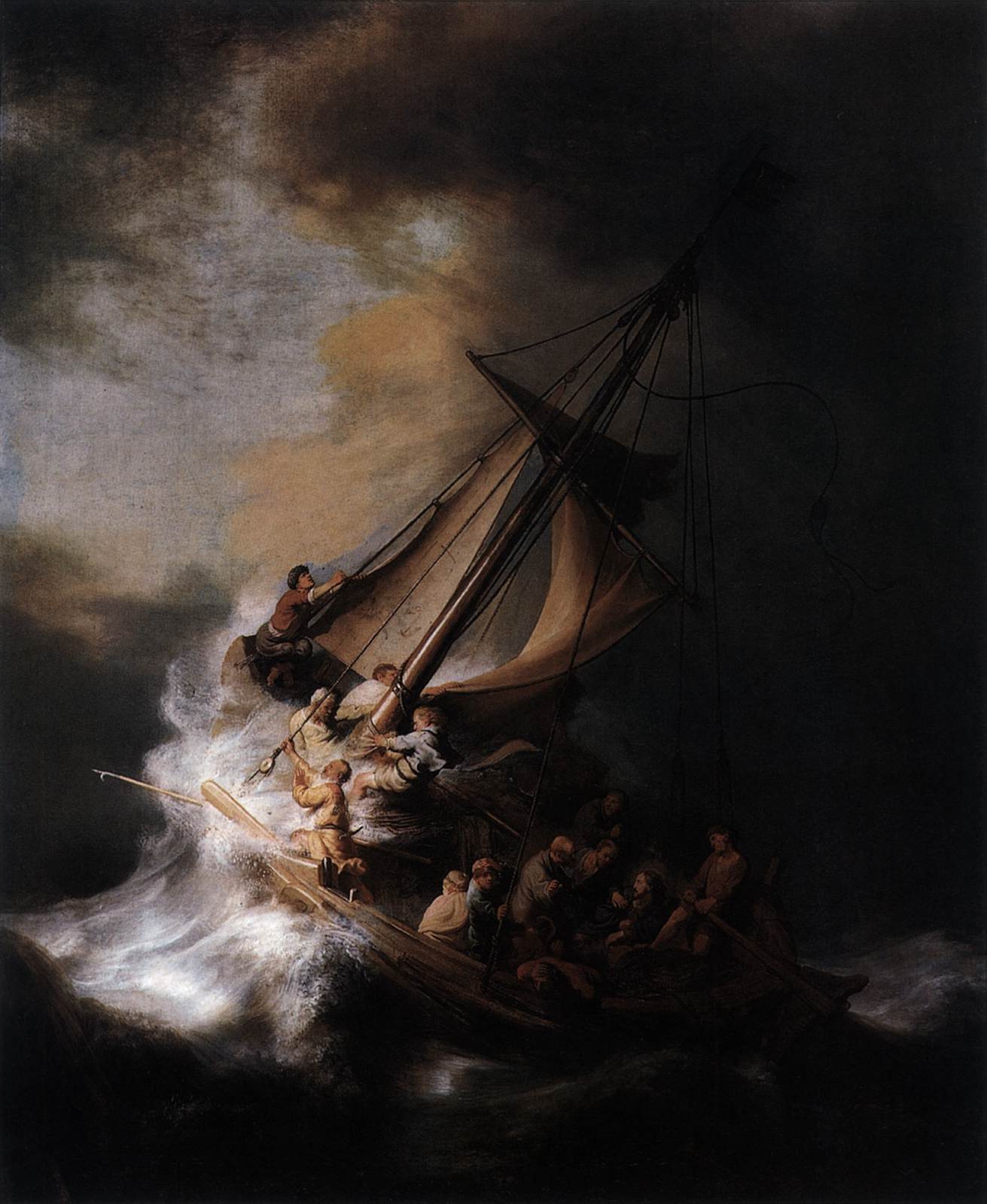
Christ in the Storm on the Sea of Galilee, Rembrandt, 1633
Isabella Stewart Gardner Museum, Boston, USA [Web Gallery of Art]


Readings
(New American Bible:
Philippines, USA)
 
Readings
(Jerusalem Bible: Australia,
England & Wales, India [optional], Ireland, New Zealand, Pakistan,
Scotland, South Africa)
 
Gospel Mark 4:35-41 (New Revised Standard Version, Catholic Edition, Canada) 


On that day, when evening had come, Jesus
said to his disciples, “Let us go across to the other side.” And leaving
the crowd behind, they took him with them in the boat, just as he was. Other
boats were with him. A great windstorm arose, and the waves beat into the
boat, so that the boat was already being swamped. But he was in the stern,
asleep on the cushion; and they woke him up and said to him, “Teacher, do you
not care that we are perishing?” He woke up and rebuked the wind, and said
to the sea, “Peace! Be still!” Then the wind ceased, and there was a dead calm. He
said to them, “Why are you afraid? Have you still no faith?” And they were
filled with great awe and said to one another, “Who then is this, that even the
wind and the sea obey him?”


The very first pastoral visit outside of Rome of Pope Francis was to the small island of Lampedusa, the most southerly part of Italy. He went there on 8 July 2013 because of his concern about the plight many migrants and refugees trying to get from North Africa to Europe through Lampedusa and the many who died in trying to do so. The vast majority of these were exploited ‘boat people’ who had spent all they had, handing over their money to unscrupulous persons who were becoming rich by living off the poor and not caring whether they lived or died.


In his homily that day Pope Francis asked, ‘Has any one of us grieved for the death of these brothers and sisters? Has any one of us wept for these persons who were on the boat? For the young mothers carrying their babies? For these men who were looking for a means of supporting their families?’ 


The question the Pope asked in a way echoes that of the Apostles in the boat to Jesus: ‘Teacher, do you not care that we are perishing?’ 

LÉ Eithne


Since 16 May LÉ Eithne, the flagship of the Irish Naval Service has been engaged, along with ships of navies of other European countries, in the Mediterranean in an effort to rescue ‘boat people’. This one small ship has already rescued 1,620 men women and children. The Irish Naval Service has a total personnel of 1,144.


It is estimated that between 2000 and 2014 around 22,000 undocumented immigrants died trying to reach Italy from North Africa. In April alone this year it is reckoned that more than 1,000 died in a number of incidents.


Something similar is happening in South-East Asia with refugees and asylum seekers from Myanmar/Burma, Rohingya people who are Muslims, and from Bangladesh being shunned.


So this Sunday’s gospel speaks to us of a situation that is all too common in the contemporary world.


The Apostles discovered that Jesus did care: ‘He woke up and rebuked the wind, and said to the sea, “Peace! Be still!”’ And he shows that same care to the refugees in the Mediterranean and in South-East Asia through the authorities, agencies and individuals who are trying to alleviate their immediate dangerous situation while others try to deal with the roots and causes of that situation.


There is an expression in the English language, ‘We’re all in the same boat’, that indicates especially in a difficult or dangerous situation that all are equal and that all are responsible in some way for changing that situation. In his new encyclical, Laudato Si’: On Care for Our Common Home, Pope Francis echoes this (No 13): ‘The urgent challenge to protect our common home includes a concern to bring the whole human family together to seek a sustainable and integral development, for we know that things can change. The Creator does not abandon us; he never forsakes his loving plan or repents of having created us. Humanity still has the ability to work together in building our common home.’ 


We can do two things. We can and should pray for all those caught up in the human tragedy of refugees and asylum seekers desperately seeking a better life as they flee from areas of conflict and hopelessness, being exploited ruthlessly by others in their plight – surely an expression of the reality of evil, of sin and of the Devil that Pope Francis frequently speaks about – and often losing their lives in the process.


And we can start reading the Pope’s encyclical, whether online or in printed form, while reflecting on it, praying while doing so, and asking the Lord how he wants each of us to change the way we live so that the world, all its creatures and especially we humans made in God’s image and likeness will become what God wills for us all.


‘God saw everything that he had made, and indeed, it was very good’ (Genesis 1:31). 


Responsorial Psalm [NAB – Philippines, USA]
Posted in: Sunday Reflections Tagged: asylum seekers, Irish Naval Service, Lampedusa, LÉ Eithne, Mediterranean, Pope Francis, refugees, Sunday Reflections

Columban General Council Welcomes Encyclical Laudato Si’ On Care for our Common Home

June 19, 2015 by Father Sean Coyle

Yesterday, 18 June 2015, the Vatican released Laudato Si’ , the encyclical letter of Pope Francis On Care for our Common Home. The date on which the Holy Father signed the encyclical is 24 May, Pentecost Sunday.

 
As is the tradition with papal documents it gets its title from its opening words:

“LAUDATO SI’, mi’ Signore” – “Praise be to you, my Lord”. In the words of this beautiful canticle, Saint Francis of Assisi reminds us that our common home is like a sister with whom we share our life and a beautiful mother who opens her arms to embrace us. “Praise be to you, my Lord, through our Sister, Mother Earth, who sustains and governs us, and who produces various fruit with colored flowers and herbs”. 

Unusually, the opening words are in Italian rather than Latin, though it’s not the first encyclical to deviate from the norm. Mit Brennender Sorge, the encyclical of Pope Pius XI in 1937 addressing the situation in Nazi Germany, has always been know by its German title, which means “With deep anxiety” and was written in German.
 
The General Council of the Missionary Society issued the following statement in Hong Kong yesterday.
 
Columban Missionaries Welcome Pope
Francis’ Encyclical on the Environment
HONG KONG, June 18, 2015.   Columban
Missionaries welcome and celebrate Pope Francis’ newly released encyclical on
the environment, Laudato Si: On Care for our Common Home.  This encyclical marks a historic
moment in the Church as the first encyclical addressing the human relationship
with all of God’s creation.  Laudato Si deepens
the contributions of previous papal statements and documents which have
addressed the relationship between humans and the natural world. 
Columban Superior General, Fr.
Kevin O’Neill
says of Laudato Si, “We thank Pope Francis for his visionary and
pastoral leadership which invites us as faithful disciples of Jesus to an
ongoing ecological conversion. Our lived experience speaks to us as we see the
impacts of the exploited Earth and exploited peoples. We believe, as stated in
our 2012 General Assembly, ‘that we are called to solidarity with marginalized
people and the exploited Earth [which] are ways we participate in God’s mission’.”
Pope Francis invites us to new
understandings, reflections, and actions
when he says, “I urgently
appeal, then, for a new dialogue about how we are shaping the future of our
planet. We need a conversation which includes everyone, since the environmental
challenge we are undergoing, and its human roots, concern and affect us all.”[1] 
We are reminded in Laudato Si
of the interconnectedness
of the human and natural worlds in these words, “Today,
however, we have to realize that a true ecological approach always becomes a
social approach; it must integrate questions of justice in debates on the
environment, so as to hear both the cry
of the earth
and the cry of the poor.”[2]  For Columbans this interconnectedness and
solidarity can be found in our own Constitutions which say, “The biblical
perspective of stewardship inspires our attitudes and challenges our use of
material resources.  It should lead to a
lifestyle in keeping with Gospel values.”[3]
As pastoral leader Pope Francis
calls us into communion
when he says, “The human person grows more, matures more
and is sanctified more to the extent that he or she enters into relationships,
going out from themselves to live in communion with God, with others and with
all creatures. In this way, they make their own that Trinitarian dynamism which
God imprinted in them when they were created. Everything is interconnected, and
this invites us to develop a spirituality of that global solidarity which flows
from the mystery of the Trinity.”[4]
Internationally
recognized eco-theologian, Columban Fr.
Sean McDonagh
says, “Laudato Si is an important step in the Church’s
understanding of our human relationship with both the Creator and all of
creation. We must continually learn from science, evolve our theology, and
humbly situate ourselves in the wider creation story that began with the
initial flaring forth 13.7 billion years ago to the world in which we live now
and in to the future.  We must be open to
encounter creation and learn from it.”


[1] Pope Francis. Laudato Si, par.14
[2] Ibid. par. 49.
[3] Missionary Society of St. Columban. Constitutions and Directory.
C.401.
[4]Pope Francis. Laudato Si. par. 240. 
 
The Blue Marble [Wikipedia]
Photo of earth by crew of Apollo 17, 7 December 1972
 
Then God said, “Let us make humankind in our image, according to our likeness; and let them have dominion over the fish of the sea, and over the birds of the air, and over the cattle, and over all the wild animals of the earth, and over every creeping thing that creeps upon the earth.”
27 So God created humankind in his image,
    in the image of God he created them;
    male and female he created them.
God blessed them, and God said to them, “Be fruitful and multiply, and fill the earth and subdue it; and have dominion over the fish of the sea and over the birds of the air and over every living thing that moves upon the earth.” God said, “See, I have given you every plant yielding seed that is upon the face of all the earth, and every tree with seed in its fruit; you shall have them for food. And to every beast of the earth, and to every bird of the air, and to everything that creeps on the earth, everything that has the breath of life, I have given every green plant for food.” And it was so. God saw everything that he had made, and indeed, it was very good. 
[Genesis 1:26-31, NRSV, Catholic Edition]
The Heavens are Telling
from The Creation by Joseph Haydn
The Heavens are telling the glory of God,
The
wonder of his work displays the firmament.


Today that is coming speaks it the day,
The night that is gone to following night.
The Heavens are telling the glory of God,
The wonder of his work displays the firmament.

In all the lands resounds the word,
Never unperceived, ever understood.
The Heavens are telling the glory of God, 
The wonder of his work displays the firmament.
Posted in: uncategorized Tagged: Creation, Earth, Haydn, Laudato Si', Pope Francis

Recent Posts

  • ‘I do choose. Be made clean!’ Sunday Reflections, 6th Sunday in Ordinary Time, Year B
  • ‘They brought to him all who were sick.’ Sunday Reflections, 5th Sunday in Ordinary Time, Year B
  • ‘He taught them as one having authority.’ Sunday Reflections, 4th Sunday in Ordinary Time, Year B
  • Columban Fr Donal O’Farrell RIP
  • Columban Fr Matthew Reilly RIP

Archives

  • February 2018
  • January 2018
  • December 2017
  • November 2017
  • October 2017
  • September 2017
  • August 2017
  • July 2017
  • June 2017
  • May 2017
  • April 2017
  • March 2017
  • February 2017
  • January 2017
  • December 2016
  • November 2016
  • October 2016
  • September 2016
  • August 2016
  • July 2016
  • June 2016
  • May 2016
  • April 2016
  • March 2016
  • February 2016
  • January 2016
  • December 2015
  • November 2015
  • October 2015
  • September 2015
  • August 2015
  • July 2015
  • June 2015
  • May 2015
  • April 2015
  • March 2015
  • February 2015
  • January 2015
  • December 2014
  • November 2014
  • October 2014
  • September 2014
  • August 2014
  • July 2014
  • June 2014
  • May 2014
  • April 2014

Copyright © 2026 The Pilgrims' Inn.

Hotel WordPress Theme by themehall.com