
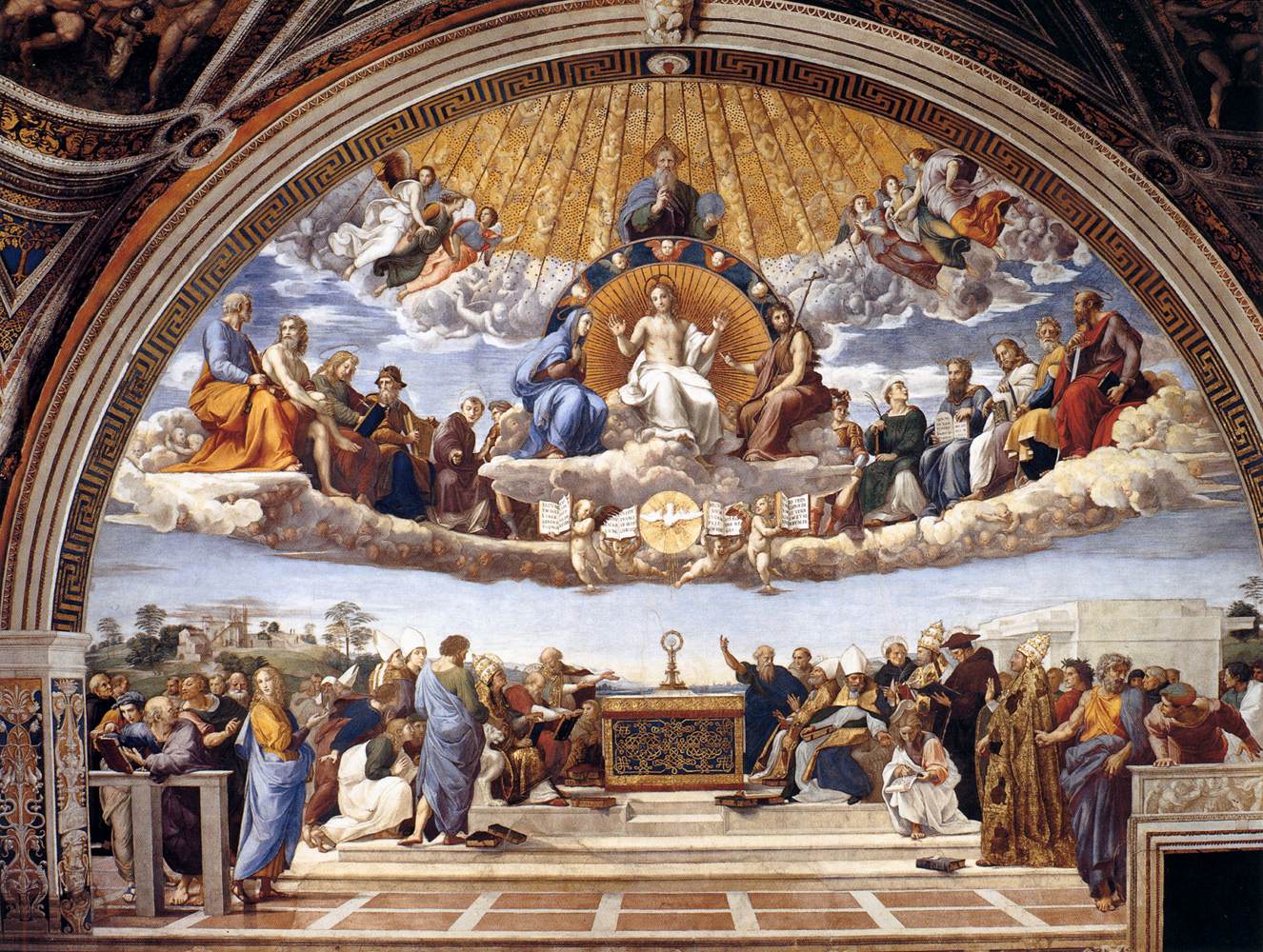
La Disputà (Disputation of the Holy Sacrament), Raffaello Sanzio, painted 1510-11
Stanza della Segnatura, Palazzi Pontifici, Vatican
The Solemnity of the Body and Blood of Christ
Readings (New American Bible: Philippines, USA)
Readings (Jerusalem Bible: Australia, England &Wales, India [optional], Ireland, New Zealand, Pakistan, Scotland, South Africa)
Gospel Mark 14:12-16, 22-26 (New Revised Standard Version – Catholic Edition, Canada)
On the first day of Unleavened Bread, when the Passover lamb is sacrificed, his disciples said to Jesus, “Where do you want us to go and make the preparations for you to eat the Passover?” So he sent two of his disciples, saying to them, “Go into the city, and a man carrying a jar of water will meet you; follow him, and wherever he enters, say to the owner of the house, ‘The Teacher asks, Where is my guest room where I may eat the Passover with my disciples?’ He will show you a large room upstairs, furnished and ready. Make preparations for us there.” So the disciples set out and went to the city, and found everything as he had told them; and they prepared the Passover meal.
Pope Francis leads his first Corpus Christi procession in Rome
‘As a primary school student, each Saturday I would play with my friends in our village but also made time for one hour’s adoration before the Blessed Sacrament in the local church. It was the custom in our village to have exposition of the Blessed Sacrament on Saturday afternoon and the Catholics would spend some time in prayer in the church. I feel that my personal relationship with God has its origin in those hours before the Blessed Sacrament.’ [Emphasis added].
John Wang Zongshe is one of two young Chinese men who came to Manila four uears ago to prepare to be Columban priests, the first candidates from that country. The original missionof the Columbans was China. John tells his vocation story, Life-giving Connections, in Misyononline.com, the online magazine I edit for the Columbans here in the Philippines.John is from a village that is one-third Catholic. but his companion Joseph Li Jiangang is from a village where all 800 inhabitants are Catholic. Joseph, like John became involved actively in the life of the Church when he was young, as he writes in his vocation story, A Church with Room for All: The Franciscan Missionaries of Mary worked in our village and ran a medical clinic. In junior high school, one Sister got us together for religious education during our summer holidays, and at the age of eleven I began to know more about God. I was born after the Cultural Revolution (1966-1976) when so much religious practice had ceased. I used to sit at the back of the church when I went alone, but when I joined the youth group we would sit at the front. As a youth I went of my own free will to church.
At that time, I was timid and afraid to read in public. I became an altar server and at twelve I was leading the congregation in half an hour of prayers before Mass. I liked that and on returning from school I’d drop my bag and head for the church.[Emphasis added].

Joseph, John and Emmannuel Trocino, a Columban seminarian from Negros Occidental, on a visit three years ago to Australian Columban Fr Brian Gore at San Columbano Mission Center, Himamaylan City, Negros Occidental, under the watchful eye of St Columban. Joseph and John have since discovered that God isn’t calling them to be Columban priests. Emmannuel is currently in Peru on his two-year First Mission Assignment as part of his preparation for the priesthood.
The first Columbans went to China in 1920 to bring the Gospel to the millions there who had never heard of Jesus Christ. Fr Paddy O’Connor, one of the first students to join the Columbans and who was ordained in 1923, wrote a poem called The Splendid Cause, which became the Columban anthem for many years, in which he used the line To bring to the nations the sweet, white Host. For Father O’Connor the Eucharist was at the heart of mission.
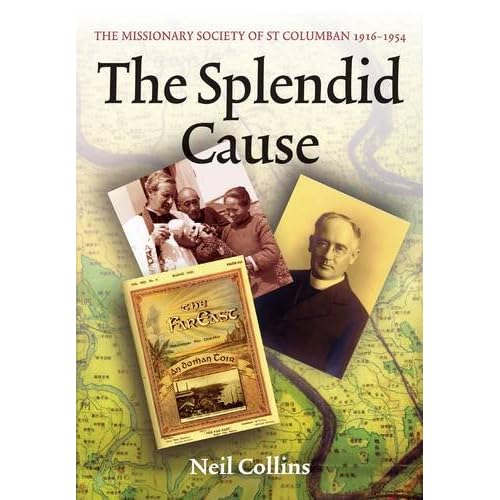
The Splendid Cause is also the title of a history of the Columbans from 1916 to 1954 by Columban Fr Neil Collins, who was one of the speakers at the 50th International Eucharistic Congress held in Dublin from 10 to 17 June 2012. St Columbanus (Columban), the patron saint of the Society of St Columban, was one of the patron saints of the Congress.
Recent polls and studies in Ireland indicate a great loss of faith, even though 84 percent in the 2011 census in the Republic of Ireland identified themselves as Catholics. (About 75 percent in the whole of Ireland would call themselves Catholics). Only about one third attend Mass every Sunday and a large percentage, especially of those who don’t go to Mass regularly, don’t believe that the bread and wine brought up at the offertory of the Mass become the Body and Blood of Christ at the Consecration. If they receive Holy Communion they believe they are receiving only a symbol.
It was a great love for the Mass and a desire to bring the Catholic Christian faith to the people of China that led two young Irish diocesan priests nearly 100 years ago, Fr Edward J. Galvin, later first Bishop of Hanyang, China, and Fr John Blowick to start what initially was ‘The Maynooth Mission to China’ and later became the Society of St Columban.
No Irish Columban has been ordained in the Third Millenium of Christianity nor are there any candidates at present. But the first two seminarians from China, a country where the Church is still being harassed, a country from which Bishop Galvin and all other Columbans were expelled 60 years ago, some after having spent time in prison, have now joined us.
We just don’t know God’s plans. But absolutely central to the spirituality of Bishop Galvin was doing God’s will. He cared little for the trappings of the office of bishop but insisted on his episcopal motto being Fiat voluntas tua, ‘Your will be done’. He would surely be delighted that the call of John and John was awakened in communities focuses on the Eucharist.
The Columbans came to Manila in 1929 at the request of Archbishop Michael O’Doherty, an Irishman. One of the speakers at the Eucharistic Congress is his current successor, Manila-born Archbishop Luis Antonio Tagle. He also spoke at the 49th International Eucharistic Congress in Quebec City, Canada, in 2008.
Please pray that as the Church celebrates the Feast of Corpus Christ, the Body of Christ, which it has done already on Thursday in countries where it is still a holyday of obligation, and that there will be a renewal and deepening of faith in Ireland, a faith centred on the Eucharist, and that the Catholics of China, the Philippines and other countries where Irish missionaries have preached and lived the Gospel, may help re-evangelise the country that produced such missionary giants as St Columban 1,500 years ago and Edward Galvin and John Blowick a 100 years ago.
Lauda Sion Salvatorem
Sequence for Mass on the Solemnity of Corpus Christi
English Version
- Sion, lift up thy voice and sing:
- Praise thy Savior and thy King,
- Praise with hymns thy shepherd true.
- All thou canst, do thou endeavour:
- Yet thy praise can equal never
- Such as merits thy great King.
- See today before us laid
- The living and life-giving Bread,
- Theme for praise and joy profound.
- The same which at the sacred board
- Was, by our incarnate Lord,
- Giv’n to His Apostles round.
- Let the praise be loud and high:
- Sweet and tranquil be the joy
- Felt today in every breast.
- On this festival divine
- Which records the origin
- Of the glorious Eucharist.
- On this table of the King,
- Our new Paschal offering
- Brings to end the olden rite.
- Here, for empty shadows fled,
- Is reality instead,
- Here, instead of darkness, light.
- His own act, at supper seated
- Christ ordain’d to be repeated
- In His memory divine;
- Wherefore now, with adoration,
- We, the host of our salvation,
- Consecrate from bread and wine.
- Hear, what holy Church maintaineth,
- That the bread its substance changeth
- Into Flesh, the wine to Blood.
- Doth it pass thy comprehending?
- Faith, the law of sight transcending
- Leaps to things not understood.
- Here beneath these signs are hidden
- Priceless things, to sense forbidden,
- Signs, not things, are all we see.
- Flesh from bread, and Blood from wine,
- Yet is Christ in either sign,
- All entire, confessed to be.
- They, who of Him here partake,
- Sever not, nor rend, nor break:
- But, entire, their Lord receive.
- Whether one or thousands eat:
- All receive the self-same meat:
- Nor the less for others leave.
- Both the wicked and the good
- Eat of this celestial Food:
- But with ends how opposite!
- Here ‘t is life: and there ‘t is death:
- The same, yet issuing to each
- In a difference infinite.
- Nor a single doubt retain,
- When they break the Host in twain,
- But that in each part remains
- What was in the whole before.
- Since the simple sign alone
- Suffers change in state or form:
- The signified remaining one
- And the same for evermore.
- Lo! bread of the Angels broken,
- For us pilgrims food, and token
- Of the promise by Christ spoken,
- Children’s meat, to dogs denied.
- Shewn in Isaac’s dedication,
- In the manna’s preparation:
- In the Paschal immolation,
- In old types pre-signified.
- Jesu, shepherd of the sheep:
- Thou thy flock in safety keep,
- Living bread, thy life supply:
- Strengthen us, or else we die,
- Fill us with celestial grace.
- Thou, who feedest us below:
- Source of all we have or know:
- Grant that with Thy Saints above,
- Sitting at the feast of love,
- We may see Thee face to face.
- Amen. Alleluia.
-
 Young Jew as Christ, Rembrandt, c.1656
 -
Staatliche Museen, Berlin [Web Gallery of Art]
- In regions where Corpus Christi is celebrated on the previous Thursday the Tenth Sunday in Ordinary Time, Year B, is observed. Here are links to the readings in the New Revised Standard Version – Catholic Edition, the translation used in the English Lectionary in Canada.
- Genesis 3:9-15.
- 2 Corinthians 4:13-5:1.
- Mark 3:19-35.
- Then Jesus went home; and the crowd came together again, so that they could not even eat. When his family heard it, they went out to restrain him, for people were saying, “He has gone out of his mind.” And the scribes who came down from Jerusalem said, “He has Beelzebul, and by the ruler of the demons he casts out demons.” And he called them to him, and spoke to them in parables, “How can Satan cast out Satan? If a kingdom is divided against itself, that kingdom cannot stand. And if a house is divided against itself, that house will not be able to stand. And if Satan has risen up against himself and is divided, he cannot stand, but his end has come. But no one can enter a strong man’s house and plunder his property without first tying up the strong man; then indeed the house can be plundered.
-
“Truly I tell you, people will be forgiven for their sins and whatever blasphemies they utter; but whoever blasphemes against the Holy Spirit can never have forgiveness, but is guilty of an eternal sin”— for they had said, “He has an unclean spirit.”
Then his mother and his brothers came; and standing outside, they sent to him and called him. A crowd was sitting around him; and they said to him, “Your mother and your brothers and sisters are outside, asking for you.” And he replied, “Who are my mother and my brothers?” And looking at those who sat around him, he said, “Here are my mother and my brothers! Whoever does the will of God is my brother and sister and mother.”