The Pilgrims' Inn

  • Welcome to The Pilgrims’ Inn
‘The young boy consented to give Christ his poor offering, not realizing that he would feed the multitude.’ Sunday Reflections, 17th Sunday in Ordinary Time, Year B

Sunday Reflections

‘The young boy consented to give Christ his poor offering, not realizing that he would feed the multitude.’ Sunday Reflections, 17th Sunday in Ordinary Time, Year B

July 22, 2015 by Father Sean Coyle
John 6:1-15, from The Gospel of John (2003) Directed by Philip Saville. Jesus played by Henry Ian Cusick; narrator, Christopher Plummer.


Readings
(New American Bible:
Philippines, USA)
 
Readings
(Jerusalem Bible: Australia,
England & Wales, India [optional], Ireland, New Zealand, Pakistan,
Scotland, South Africa)
Gospel John 6:1-15 (New Revised Standard Version, Catholic Edition, Canada)  
 
After
this Jesus went to the other side of the Sea of Galilee, also called the Sea of Tiberias. A large crowd kept following him, because they saw the signs that he was doing for the sick.
  Jesus
went up the mountain and sat down there with his disciples.
 
Now the Passover, the festival of
the Jews, was near.
 
When he looked up and saw a large crowd coming toward him, Jesus said to Philip, “Where are we to buy bread for these people to eat?” He said this to test him, for he
himself knew what he was going to do.
 
Philip answered him, “Six months’ wages would not buy enough bread for each of them to get a little.” One of his disciples, Andrew, Simon
Peter’s brother, said to him,
“There is a boy here who has five barley loaves and two fish. But
what are they among so many people?”
 Jesus said, “Make the people sit down.” Now there was a great deal of grass in the place; so they sat down, about five thousand in all. 
Then Jesus took the loaves, and when he had given thanks, he distributed them to those who were seated; so also the
fish, as much as they wanted.
 
When they were satisfied, he told his disciples, “Gather up the fragments left over, so that nothing may be lost.” So they gathered them up, and from
the fragments of the five barley loaves, left by those who had eaten, they filled twelve baskets.
 
When the people saw the sign that he had done, they began to say, “This is indeed the prophet who is to come into the world.”

When Jesus realized that they were about to come and take him by force to make him king, he withdrew again to the mountain by himself.
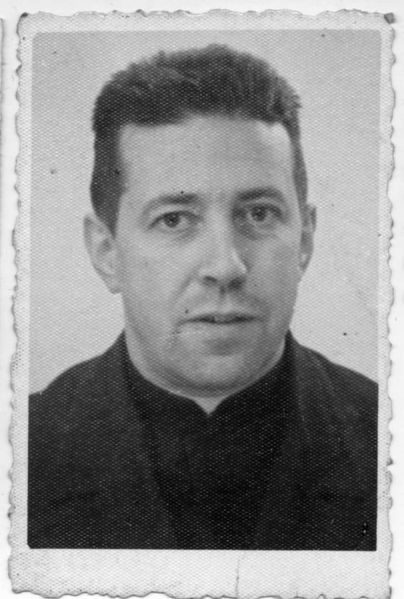

San Alberto Hurtado SJ (1901 – 1951)

St Alberto Hurtado SJ is a man who took today’s gospel very seriously, He established the first Hogar de Cristo, Home of Christ, in Chile in 1944 to care for the many in Santiago who were homeless or had little to eat. There are now many such homes, not only in Chile and in other countries in South America but in the USA. Canonised in 2005 by Pope Benedict, he is still venerated in Chile as he was loved in his lifetime by the simple title of ‘Padre Hurtado’.
 
He can speak to us with authority, as he does in this meditation he gave many years ago. His reference to the Venerable Matt Talbot comes from the time he spent in Dublin learning English.
 
The Multiplication of the Loaves  
Meditation during a retreat on the gift of self and cooperation.
Indecision, faintheartedness is the great obstacle in the plan of cooperation. We think: ‘I’m not worth all that much’, and from this comes discouragement: ‘It makes no difference whether I act or fail to act. Our powers of action are so limited. Is my unpretentious work worthwhile? Does my abstaining from this have any meaning? If I fail to sacrifice myself nothing changes. No one needs me . . . A mediocre vocation?’ How many vocations are lost. It is the advice of the devil that is partly true. The difficulty must be faced.
The solution
Five thousand men along with women and children have been hungry for three days . . . Food? They would need at least 200 denarii to feed them and this is the approximate yearly salary of a labourer.
In the desert! ‘Tell them to go!’ But Andrew, more observant says: ‘There are five loaves and two fish, but what are these among so many?’ Here we have our same problem: the disproportion.
And the loaves. Made of barley, hard as rocks (the Jews used wheat). And the fish. They were from the lake, small, rather mushy in texture, carried by a young boy in a sack that had lain on the ground for three days in the heat . . . not much of a solution. 
Did the Lord despise this offering? No, and with his blessing he fed all the hungry and had leftovers. Neither did he despise the leftovers: twelve baskets of the surplus were gathered, fish heads and bones, but even this he valued. 
The young boy consented to give Christ his poor offering, not realizing that he would feed the multitude. He believed that he had lost his small possession but he found instead that there was even a surplus and that he had cooperated for the good of the others. 
And me . . . like those fish (less than those loaves) bruised and perhaps decomposing but in the hands of Christ my action may have a divine scope a divine reach. 
Remember Ignatius, Augustine, Camillus de Lellis, and Matt Talbot, base sinners whose lives were converted into spiritual nourishment for millions who will continue to feed on their witness. 
My actions and my desires can have a divine scope and can change the face of the earth. I will not know it, the fish did not know it either. I can do a great deal if I remain in Christ; I can accomplish much if I cooperate with Christ . . .

St Alberto Hurtado SJ


Antiphona ad introitum      Entrance Antiphon (Psalm 67[68]: 6-7, 36)
 
Deus in loco sancto suo: 
God is in his holy place,
Deus, qui inhabitare facit unanimes in domo: 
God who unites those who live in his house;
ipse dabit virtutem et fortitudinem plebi suae.
he himself gives might and strength to his people.

Ps 67[68]: 2. Exurgat Deus, et dissipentur inimici eius: et fugiant, qui oderunt eum, a facie eius.
God arises; his enemies are
scattered, and those who hate him flee before him. 
Gloria Patri, et Filio et Spiritu Sancto.
Glory to the Father and to the Son and to the Holy Spirit.  


Deus in loco sancto suo: God is in his holy place,

Deus, qui inhabitare facit unanimes in domo: 

God who unites those who live in his house;

ipse dabit virtutem et fortitudinem plebi suae.

he himself gives might and strength to his people.


The text in bold is that for the Mass of the 17th Sunday in Ordinary Time in the Ordinary Form while the complete text is that for the 11th Sunday after Pentecost in the Extraordinary form (the ‘Old Mass’).
Posted in: Sunday Reflections Tagged: Chile, crSan Alberto Hurtado SJ, Hogar de Cristo, Sunday Reflections

‘I will raise up shepherds . . .’ Sunday Reflections, 16th Sunday in Ordinary Time, Year B

July 15, 2015 by Father Sean Coyle
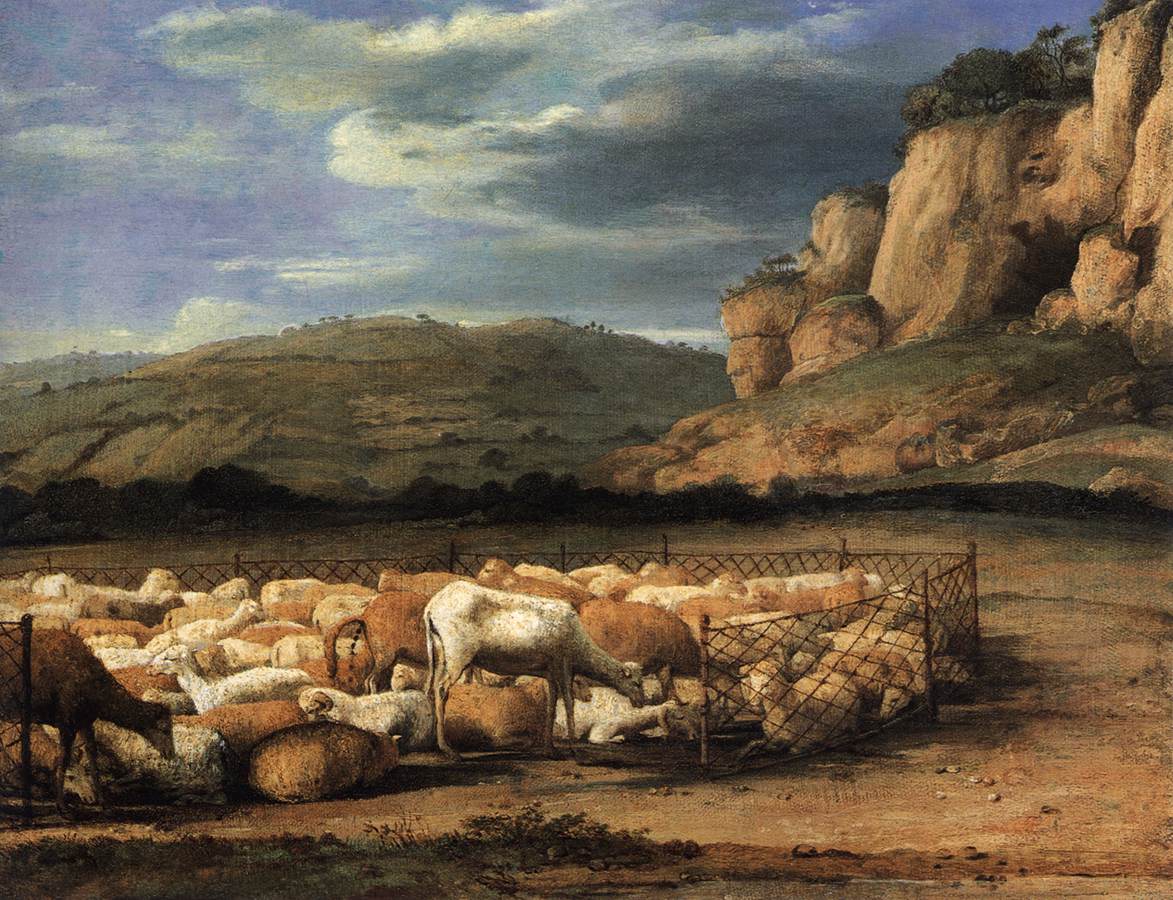
Flock of Sheep in the Campagna, Claude Lorrain
Akademie der bildenden Künste, Vienna [Web Gallery of Art]
‘They were like sheep without a shepherd.’


Readings
(New American Bible:
Philippines, USA)

Readings
(Jerusalem Bible: Australia,
England & Wales, India [optional], Ireland, New Zealand, Pakistan,
Scotland, South Africa)

Gospel Mark 6:30-34 (New Revised Standard Version, Catholic Edition, Canada)   


The apostles gathered around Jesus, and told him
all that they had done and taught.
 He said to them, “Come away to a deserted
place all by yourselves and rest a while.” For many were coming and going, and
they had no leisure even to eat.
 
And they went away in the boat to a
deserted place by themselves.
 
Now many saw them going and recognized
them, and they hurried there on foot from all the towns and arrived ahead of
them.
 
As he went ashore, he saw a great crowd; and he had
compassion for them, because they were like sheep without a shepherd; and he
began to teach them many things.


Fr Ragheed Aziz Ganni 
(20 January 1972 – 3 June 2007)
I will raise up shepherds over them who will shepherd them, and they shall not fear any longer, or be dismayed, nor shall any be missing, says the Lord (Jeremiah
23:4. First Reading).


On at least six occasions during his recent nine-day pastoral visit to Ecuador, Bolivia and Paraguay, Pope Francis asked the people to pray for him, as he did when he addressed the people in St Peter’s Square for the first time as pope in 2013. Perhaps he has constantly in mind two statements in today’s First Reading from the Prophet Jeremiah: ‘Woe to the shepherds who destroy and scatter the sheep of my pasture! says the Lord . . .  I will raise up shepherds over them who will shepherd them, and they shall not fear any longer, or be dismayed, nor shall any be missing, says the Lord.’

Jesus shows his concern for the apostles when they returned from the mission on which he had sent them as shepherds when ‘He said to them, “Come away to a deserted place all by yourselves and rest a while.”’
Ballachulish, Scotland
‘Come away to a deserted place all by yourselves and rest a while.’

Perhaps we can pray in a special way for our priests as we take part in Mass this Sunday. We have countless models of priests who have been worthy shepherds, evening to laying down their lives for the flock they were called to serve. One such shepherd is an Iraqi priest with Irish connections, Fr Ragheed Ganni, assassinated along with three subdeacons, his cousin Basman Yousef Daud, Wahid Hanna Isho, and Gassan Isam Bidawed, after celebrating Mass in Mosul, Iraq, on Trinity Sunday, 3 June 2007.

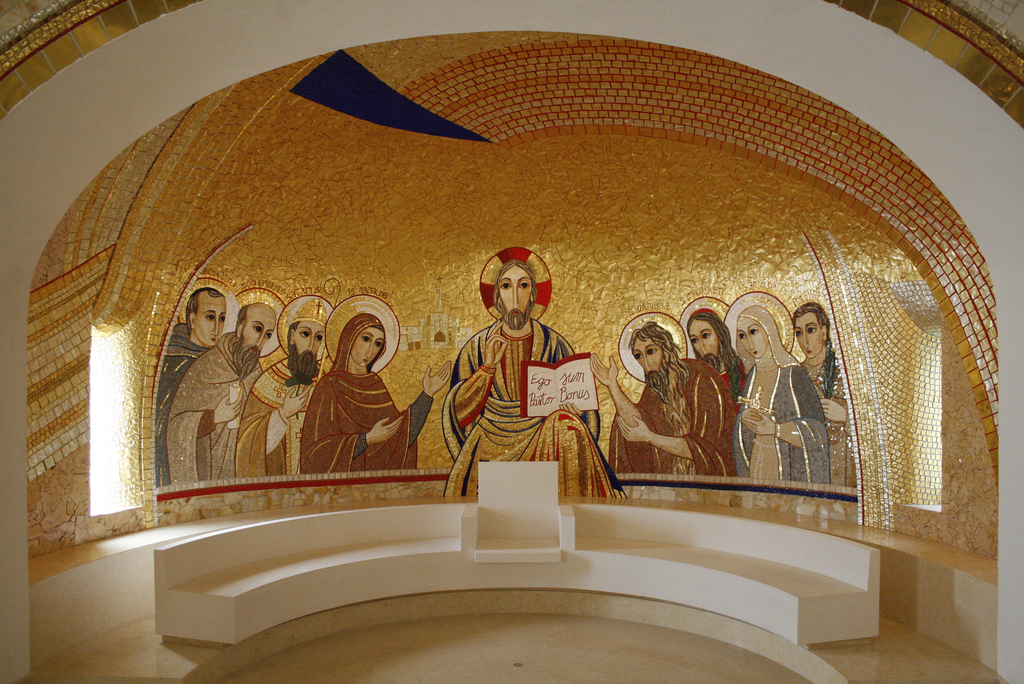
Apse of Chapel, Irish College, Rome
St Columban second from left, Fr Ragheed far right.
[Details at source]

An engineer by profession, Ragheed answered God’s call to become a priest and studied theology in Rome, before and after his ordination in 2003. While there he stayed at the Pontifical Irish College where he became known as ‘Paddy the Iraqi’, ‘Paddy’ being a common nickname for men named Patrick, after Ireland’s national patron, and a humorous generic name for any Irishman. As a priest still studying in Rome he spent part of his summers as a member of the staff at Lough Derg, known as St Patrick’s Purgatory, a place of penitential pilgrimage in Ireland.

Mosaic of Fr Ragheed Ganni with palms of martyrdom, Chapel of Irish College, Rome [Source]

Yet this young Iraqi who, according to the statement of one friend after the priests’ murder, ‘knew where the best pizza in Rome was’, chose to go back to his own country, knowing that his life might be in danger. He spoke of this at a Eucharistic Congress in Bari, Italy, two years before his death. The theme of the Congress was Without Sunday We Cannot Live, ‘Sunday’ meaning most especially the celebration of Holy Mass.

Basilica of St Nicholas, Bari [Wikipedia]

Fr Ragheed Ganni’s Testimony

Mosul Christians are not theologians; some are even illiterate. And yet inside of us for many generations one truth has become embedded: without the Sunday Eucharist we cannot live.
This is true today when evil has reached the point of destroying churches and killing Christians, something unheard of in Iraq till now. In June 2004, a group of young women were cleaning the church to get it ready for Sunday service. My sister Raghad, who is nineteen, was among them. As she was carrying a pale of water to wash the floor, two men drove up and threw a grenade that blew up just a few yards away from her.
She was wounded but miraculously, survived. And on that Sunday, we still celebrated the Eucharist. My shaken parents were also there. For me and my community, my sister’s wounds were a source of strength so that we, too, may bear our cross.
Last August in St Paul’s Church, a car bomb exploded after the 6 pm Mass. The blast killed two Christians and wounded many others. But that, too, was another miracle – the car was full of bombs but only one exploded. Had they all gone off together, the dead would have been in the hundreds since 400 faithful had come on that day.
People could not believe what had happened. The terrorists might think they can kill our bodies or our spirit by frightening us, but, on Sundays, churches are always full. They may try to take our life, but the Eucharist gives it back.
On 7 December, the eve of the Immaculate Conception, a group of terrorists tried to destroy the Chaldean Bishop’s Residence, which is near Our Lady of the Tigris Shrine, a place venerated by both Christians and Muslims. They placed explosives everywhere, and a few minutes later blew the place up. This and fundamentalist violence against young Christians has forced many families to flee. Yet the churches have remained open and people continue to go to Mass, even among the ruins.
It is among such difficulties that we understand the real value of Sunday, the day when we meet the Risen Christ, the day of our unity and love, of our (mutual) support and help. There are days when I feel frail and full of fear. But when, holding the Eucharist, I say ‘Behold the Lamb of God, who takes away the sin of the world’, I feel His strength in me. When I hold the Host in my hands, it is really He who is holding me and all of us, challenging the terrorists and keeping us united in His boundless love.
In normal times, everything is taken for granted and we forget the greatest gift that is made to us. Ironically, it is thanks to terrorist violence that we have truly learnt that it is the Eucharist, the Christ who died and risen, that gives us life. And this allows us to resist and hope. 
[This appeared in The Sacred Heart Messenger (April 2008), a publication of the Irish Jesuits.]
Archbishop Mar Paulos Faraj Rahho 
(20 November 1942 – kidnapped 29 February, body found 13
March 2008) [Photo: The Path to Peace Foundation]

Father Ragheed was secretary to Archbishop Rahho, The Chaldean Archbishop of Mosul. Most Catholics in Iraq and Syria belong to the Chaldean Catholic Church, in full communion with Rome. ‘The Eucharist, the Christ who died and risen, that gives us life’ was celebrated every Sunday in Mosul for 1,600 years – until June 2014 when the ISIS forces drove out the remaining Christians.

The words of Jeremiah, ‘I will raise up shepherds over them who will shepherd them’, have surely been fulfilled in the lives and deaths of such priests as Fr Ragheed Ganni and Archbishop Rahho. As we thank God for them and for countless other faithful priest-shepherds, let us continue to pray for all our priests and for Christians who are being persecuted for their faith.


John Rutter‘s setting of The Lord is my shepherd, Psalm 22[23], which is used as today’s Responsorial Psalm.

Posted in: Sunday Reflections Tagged: Archbishop Mar Paulos Faraj Rahho, Fr Ragheed Ganni, Iraq, John Rutter, persecution, Priests, shepherds, Sunday Reflections

‘Jesus called the twelve and began to send them out two by two.’ Sunday Reflections, 15th Sunday in Ordinary Time, Year B

July 8, 2015 by Father Sean Coyle
Young Jew as Christ, Rembrandt, c.1656
Stattliche Museen, Berlin [Web Gallery of Art]


Readings
(New American Bible:
Philippines, USA)
Readings
(Jerusalem Bible: Australia,
England & Wales, India [optional], Ireland, New Zealand, Pakistan,
Scotland, South Africa)
Gospel Mark 6:7-13 (New Revised Standard Version, Catholic Edition, Canada) 
 
Jesus called the twelve and began to send them out two by
two, and gave them authority over the unclean spirits.
 He ordered them to take nothing for their journey except a
staff; no bread, no bag, no money in their belts;
 
but to wear sandals and
not to put on two tunics.
 
He said to them, “Wherever you enter a house, stay there
until you leave the place.
 
If any place will not welcome you and they refuse to hear
you, as you leave, shake off the dust that is on your feet as a testimony
against them.”
 
So they went out and
proclaimed that all should repent.
 
They cast out many demons, and anointed with oil many who
were sick and cured them.
Green Drove, Pewsey, with the Pewsey White Horse, south of the village
 
Today’s gospel reminds me of experiences as a seminarian while on Peregrinatio pro Christo with the Legion of Mary, in St Anne’s Parish, Edge Hill, Liverpool, in 1963, in St Fergus’ Parish, Paisley, Scotland in 1965 and in Holy Family Parish, Pewsey, Wiltshire, England, in 1966. Peregrinatio pro Christo, or PPC, is a programme of the Legion of Mary that began in 1958 or 1959. Legionaries give up a week or two of their summer vacation to do full-time Legion work in another country. The name comes from the motto that inspired St Columban and many Irish missionary monks, Peregrinari pro Christo, ‘to be a pilgrim for Christ’. Saint Pope John XXIII quoted this in a letter to the Irish Hierarchy in 1961 on the occasion of the Patrician Year, commemorating 1,500 years of the Catholic faith in Ireland. In the same letter he specifically referred to the involvement in this spirit of the Society of St Columban in Latin America. (Thanks to Shane for the link). 
 
Many of us in the seminary, including some of the priests, used to go for a week or two during our summer break. Like the apostles, we depended on the hospitality of parishioners for board and lodging. In my three experiences I was in parishes and the main work was going from house-to-house in pairs, rather like what the Apostles were sent by Jesus to do in today’s gospel. Legionaries never work alone. Occasionally people would close their door once we announced who we were but very few were impolite. Some would give us a warm welcome.    
 
I remember one family we visited in Liverpool. They were lapsed Catholics and the parish records showed they were rather hostile to the Church. However, when the man who opened the door heard our Irish accents he began to tell us about his pleasant experiences on visits to Ireland. I spoke of this as an expression of our faith. We had a very friendly conversation with hi and when we leaving seemed to have let go of his hostility to the Church.
 
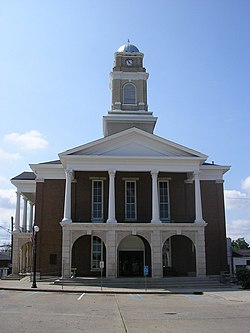
Garrard County Courthouse, Lancaster, Kentucky [Wikipedia]
 
As a young priest studying in the USA I had similar experiences in Lancaster, Kentucky, during the summers of 1969 and 1970. The parish priest, Fr Ralph Beiting, had college students from other parts of the USA work on various projects in his parish that covered nearly four counties and that had very few Catholics. There was still lingering prejudice against Catholics. One of the projects was to visit each home, in pairs, just as the Legion does, and introduce ourselves as being from the Catholic Church, and telling the people about our programmes. Again, the response was generally positive. In some rural homes we’d meet older people sitting on their rocking chairs on the veranda. They’d invite us to sit down and relax and would sometimes share a bit about their Bible-based faith. As we’d leave we’d hear the friendly farewell so common in the area, ‘Y’all come back!’
 
Fr Ralph Beiting
 
Some of the programmes we invited children to were summer Bible schools and five-day vacations for poor children in a summer camp, boys one week and girls another week. Black and white children would be together at a time when this was rare in that part of the USA.
 
Only God knows what can result from going from house to house as a way of carrying the mission that Jesus gave to the Twelve and that he gives to us. He doesn’t guarantee ‘success’ but simply sends us out in trust.
 
One of Father Beiting’s summer apostolates for many years was street-preaching, very often with seminarians. On one occasion years ago he was driven out of one town at gunpoint but returned the next day, not to preach but simply to show himself. He was eventually not only accepted but welcomed. He, a Catholic priest, was continuing an old tradition in the area, the travelling preacher. He was one of the very few left. Fr Beiting, born on 1 January 1924,  was ordained in 1949 and up to his late 80s he was still going strong. Here he is preaching during the summer of 2011. He died the following summer on 9 August 2012. What a wonderful example he was as a disciple of Jesus and as a Catholic priest!


A favourite hymn of Fr Beiting and of the people in Kentucky was The Old Rugged Cross, written in 1912 by Methodist evangelist George Bennard.


Posted in: Sunday Reflections Tagged: Christian Appalachian Project, Fr Ralph Beiting, Kentucky, Legion of Mary, Liverpool, Peregrinatio pro Christo, Pewsey, Sunday Reflections

‘A spring flower in the desert.’ Sunday Reflections, 14th Sunday in Ordinary Time, Year B

July 2, 2015 by Father Sean Coyle

Keiko Shemura on her First Communion Day, December 1971
Keiko died 27 April 1972, aged 14
Readings
(New American Bible:
Philippines, USA)
Readings
(Jerusalem Bible: Australia,
England & Wales, India [optional], Ireland, New Zealand, Pakistan,
Scotland, South Africa)
Gospel Mark 6:1-6 (New Revised Standard Version, Catholic Edition, Canada) 


Jesus left that place and came to his hometown, and his disciples followed him. On the sabbath he began to teach in the synagogue, and many who heard him were astounded. They said, “Where did this man get all this? What is this wisdom that has been given to him? What deeds of power are being done by his hands! Is not this the carpenter, the son of Mary and brother of James and Joses and Judas and Simon, and are not his sisters here with us?” And they took offense at him. Then Jesus said to them, “Prophets are not without honor, except in their hometown, and among their own kin, and in their own house.” And he could do no deed of power there, except that he laid his hands on a few sick people and cured them. And he was amazed at their unbelief.


Cherry blossoms in Fukushima [Wikipedia]
Both the New American Bible and the Jerusalem Bible lectionaries read, He was amazed at their lack of faith. Jesus was among his own people, in the town where his brothers and sisters, ie, his cousins, lived. Perhaps his amazement was a form of frustration. Missionaries are men and women who are often ‘amazed’ at what seems to be their lack of ‘success’ in changing the situation, whether it is leading people to faith in Jesus Christ or working among baptised people for the justice that the Gospel demands but evidently isn’t there.
 
Yet Jesus laid his hands on a few sick people and cured them. In other words, he found some who responded in faith.
 
One Columban priest who found faith in Keiko, a very sick 14-year-old girl in Japan, was Fr James Norris, a New Zealander who died on 6 October 2007. Japan is still a country where fewer than one in two hundred are Catholics. He wrote about his experience in Far East, the magazine of the Columbans in Ireland and Britain, in 1973. Father Jim’s article made a profound impact on me and I reprinted it in Misyon in March-April 2008. our last printed edition. It is a story that moves me each time I think about it. Maybe the few who believed and were healed consoled Jesus in his humanity. Maybe he felt something of what Father Norris describes in the closing paragraph of his article.

The story of Keiko and her parents shows us that our Catholic Christian faith is a gift from God, a gift for which we should thank him every day.
 
A Spring Flower
by Fr James Norris 
 
Cherry blossoms at the Tokyo Imperial Palace [Wikipedia]
 
There is a high school in our parish for nearly 2,000 girls conducted by the Sisters of the Infant of Jesus. Very few of these girls are baptized Christians. As a means of contact, I teach English to the junior high school pupils three times a week. My classes are very informal and I am afraid the young ladies don’t take me very seriously, possibly because I give them no homework or exams. My specialty is supposed to be pronunciation and intonation.
 
One day, early in November 1971, I received a summons from one of my little pupils, Keiko Uemura, aged 14. She was very sick in the hospital and wished to be baptized. I hadn’t noticed her absence at school. The nuns were full of apologies for not letting me know, but they hadn’t thought her illness was serious; moreover, she had never shown any real interest in religion but on the contrary, during religious classes seemed to take a delight in trying to tie the Sister up in knots with embarrassing questions.
 
When I visited her she seemed in good spirits. After ascertaining that she really did believe and had sufficient knowledge to realize what she was doing, I baptized her. A few days later I returned to the hospital with several books that explained the faith simply and would help her to pray. She began to prepare for her first Holy Communion. I discovered that despite her seemingly frivolous behavior during religion classes, she had retained quite a lot and what was more, in her present crisis could believe, simply and totally, with no reservations. 
 
In December she was moved to the University hospital, the largest in town and the best equipped. Keiko herself was not aware of it, but she was suffering from a rare type of bone cancer that sometimes afflicted children. The doctor gave her three months to live. Her parents were wonderful. One of them was always near her, day and night. In her case this devoted warm parental love was an actual grace that served to open out and expand her soul to receive the grace of God’s love. As Keiko responded to God’s love, the change in her thinking and outlook, her values, could not fail to impress her parents who in turn were drawn along by the girl towards God.
 
About Christmas time she made her first Holy Communion. She was radiantly happy that day, as is evident from the photo. Present for the occasion were her parents and some of the Sisters from the school. I made a tape recording for future use. Each week I took her Holy Communion. Her mother prepared the altar and with Keiko read the book on doctrine explaining the faith.
 
Home for the New Year
The girl was permitted to return home for three days over the New Year. As a result of an operation she had recovered so well that she could walk about slowly with the aid of crutches. She believed she was on the way to complete recovery; she was full of roseate plans for her future, a trip to Lourdes followed by a life of service as a nurse to crippled children. Her father hoped against hope for a miracle, but on the quiet he assured me that it was only a question of time.
 
Spiritual progress
During the next three months she made tremendous spiritual progress. Her mother told me that she herself was sometimes concerned by the flood of visitors, who often outstayed their welcome, even when Keiko was in pain. But the girl never showed it; she always put on a cheerful front and showed her gratitude to all-comers. Later when her mother grumbled about the inconsiderateness of some people, the girl stopped her with: ‘Mother, it may be alright for you to complain because you are not a Christian, but I am one now and must love everybody. Besides, the visitors come because they are interested in me and I am grateful for this.’ Apart from the occasional sigh or moan that escaped her lips, she never complained of the pain.
 
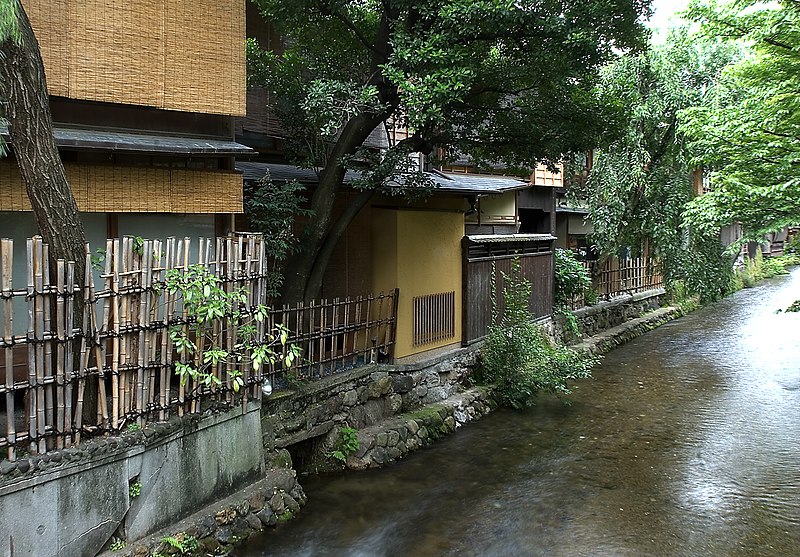
Shirakawa River [Wikipedia]
 
As the long winter faded, the cherry blossom trees along the Shirakawa River responded to the warm April sun and flooded the banks with a soft pink mist. I could see the blossoms from the window of her room, but the girl was too young to appreciate the pathos of their beauty – those petals whose destiny was to diffuse their delicate beauty for a brief span, only to be caught by the slightest breeze and flutter to the earth from which they sprang. Keiko never saw her own life and destiny in those blossoms.
 
About the middle of April she began to weaken. Within a week, she had lost consciousness and was given oxygen. She died peacefully on 27 April. The church was filled at her funeral. Her classmates were heartbroken and inconsolable, far more emotionally upset than her family. Indeed, I was surprised at how calmly her parents bore their great loss. I discovered it was because they had received the grace of the faith through the girl’s influence, even before they had begun any formal instructions. They were convinced that she still lived on in God and that they would meet her again.
 
Whole family converted
A week after the funeral her parents and her brother began their study of the doctrine. They were model catechumens. Every night before the family altar, united to Keiko in spirit, they said the rosary and read a chapter from the Scriptures. I baptized them on 6 November, the anniversary of Keiko’s baptism. There were tears of joy in their eyes that day as they realized they were united to their daughter by grace within the bosom of God the Father.
 
One of Keiko’s closest friends who was shattered by her death but very impressed by the spiritual change in the girl before her death, has resolved to follow in her footsteps and pursue the ideal of service Keiko set for herself had she lived. She is now under instructions and intends to become a nurse.
 
Fr James Norris after officiating at the joint wedding ceremony of three brothers in Japan
Testimony of her faith
There was nothing sensational about this girl’s short life. She did nothing that would merit notice in the mass media; her life created no more of a stir in society than a petal falling to the ground. But I am convinced her story is real news and a genuine success story. In these days of superficial sensationalism, even we Christians tend to forget that the real battles of life are won or lost within the depths of the heart where a man meets his God and says yes or no.
 
Moreover, in a country like Japan, a missioner seldom sees the grace of God’s action working so powerfully and swiftly in a soul. Such tangible evidence of God’s presence is almost a physical sign of His love which bolsters one’s hope no end, enabling the missioner to keep going. This slip of a girl was a candle in the darkness, a spring flower in the desert.
 Mater Dei, Mother of God, Japan
Unknown artist, c.1900-05, painting on silk
 
Ave Maria in Japanese
Composer: Saburo Takada; singer: Atsuko Azuma
Posted in: Sunday Reflections Tagged: faith, Fr James Norris, Japan, Keiko Uemura, Sunday Reflections

‘Give her something to eat.’ Sunday Reflections, 13th Sunday in Ordinary Time, Year B

June 22, 2015 by Father Sean Coyle

‘Give her something to eat.’ Sunday Reflections, 13th Sunday in Ordinary Time, Year B


Raising of the Daughter of Jairus, Paolo Veronese,  c.1546
Musée du Louvre, Paris  [Web Gallery of Art]

Readings (New American Bible: Philippines, USA)

Readings(Jerusalem Bible: Australia, England & Wales, India [optional], Ireland, New Zealand, Pakistan, Scotland, South Africa)

Gospel Mark 5:21-43 (New Revised Standard Version, Catholic Edition, Canada) 

When Jesus had crossed again in the boat to the other side, a great crowd gathered around him; and he was by the sea.  Then one of the leaders of the synagogue named Jairus came and, when he saw him, fell at his feet and begged him repeatedly, “My little daughter is at the point of death. Come and lay your hands on her, so that she may be made well, and live.” So he went with him.

And a large crowd followed him and pressed in on him. Now there was a woman who had been suffering from hemorrhages for twelve years. She had endured much under many physicians, and had spent all that she had; and she was no better, but rather grew worse. She had heard about Jesus, and came up behind him in the crowd and touched his cloak, for she said, “If I but touch his clothes, I will be made well.” Immediately her hemorrhage stopped; and she felt in her body that she was healed of her disease. Immediately aware that power had gone forth from him, Jesus turned about in the crowd and said, “Who touched my clothes?” And his disciples said to him, “You see the crowd pressing in on you; how can you say, ‘Who touched me?’” He looked all around to see who had done it. But the woman, knowing what had happened to her, came in fear and trembling, fell down before him, and told him the whole truth. He said to her, “Daughter, your faith has made you well; go in peace, and be healed of your disease.”

While he was still speaking, some people came from the leader’s house to say, “Your daughter is dead. Why trouble the teacher any further?” But overhearing[ what they said, Jesus said to the leader of the synagogue, “Do not fear, only believe.” He allowed no one to follow him except Peter, James, and John, the brother of James. When they came to the house of the leader of the synagogue, he saw a commotion, people weeping and wailing loudly. When he had entered, he said to them, “Why do you make a commotion and weep? The child is not dead but sleeping.”  And they laughed at him. Then he put them all outside, and took the child’s father and mother and those who were with him, and went in where the child was. He took her by the hand and said to her, “Talitha cum,” which means, “Little girl, get up!” And immediately the girl got up and began to walk about (she was twelve years of age). At this they were overcome with amazement. He strictly ordered them that no one should know this, and told them to give her something to eat.


Forest Landscape with Two of Christ’s Miracles
David Vinckboons, 1600-10
Metropolitan Museum of Art, New York [Web Museum of Art]

Because I will be on a pilgrimage to Malta from 24 to 30 June I am posting this early. This reflection, slightly edited, is what I posted three years ago for the same Sunday.

Lyn was someone I met when she was about 15. Three years later, when she was only halfway through her four-year college course, she quit to marry Roberto. (I’m not using their real names). Lyn was madly in love with Roberto, who had a good job and came from a relatively wealthy family.  Lyn’s family could not be described as poor either. I celebrated the wedding Mass and attended the reception in a classy hotel. In the Philippines it’s the groom’s father who pays for the reception. the young couple went to live in Manila, where Roberto was from. About a year later a daughter, whom I’ll call Gloria, was born. She had a mental disability. Another daughter, ‘Gabriela’, arrived a year or two later.

Then tragedy struck. Roberto discovered that his kidneys weren’t working properly and that he needed dialysis. Over the next couple of years Roberto and Lyn spent practically all they had on this and it ended in Roberto’s death. Meanwhile, Lyn’s parents both had serious illnesses and had to spend most of their resources on treatment.

Lyn returned to her own city with her two young daughters. She couldn’t find a job and had no qualifications since she hadn’t finished in college. With much embarrassment she came to see me and asked if I could give her an ‘allowance’. She was able to survive the next few years with help from her siblings and friends and eventually remarried.

I’ve met so many ‘Lyns’ in the Philippines who are like the woman in today’s gospel, who have spent all their resources on doctors and medicine and are still sick. I’ve met families who have pawned their little bit of land in order to enable an aged parent to have surgery that ultimately leaves the whole family impoverished and the person on whom  they had spent the money, out of a perhaps misplaced love, ending up in the cemetery.

Most Filipinos have little access to good health care. Even those who have government health insurance have to come up with ready cash if they go to hospital, unlike in Ireland or the United Kingdom. They are eventually reimbursed but have to pay interest on money they have borrowed in the meantime. I’ve heard people in Ireland and in the UK complain about the poor health services they have and their complaints are often justified. I have also heard many unsolicited words of praise for nurses from the Philippines working in hospitals in those countries.

Bu the sad reality is that most of these nurses, if they were still in the Philippines, would not have access to the kind of care they provide in Ireland and the UK. They would be like the woman in the gospel.

I met a Filipina in Reykjavík in 2000 who told me that she had had a kidney transplant in Denmark, paid for by the taxpayers of Iceland, a country of only 300,000 people or so. Had she been at home she would probably have ended up like Roberto.

Twenty-two years ago in a parish in Mindanao I buried Eileen, like the daughter of Jairus,  a 12-year-old. Again, poverty was a significant factor in her illness and death, despite the efforts of the doctors and nurses in the small government hospital where she died.

So the two stories interwoven by St Mark are stories that many Filipinos have lived or are living.

But sometimes persons experience healing. I once gave a recollection day to a group of 11- and 12-year old children in a Catholic school in Cebu City. We reflected on the story of Jesus staying behind in the Temple when he was 12 and that of the daughter of Jairus, also 12. Before the afternoon session a group of the boys and girls came to tell me that Maria, one of their classmates, had a bad toothache and asked if we could pray with her. Maybe Jesus would heal her as he had healed ‘Talitha’. They thought that that was the name of the girl in the gospel! We prayed with Maria – and her toothache disappeared. The children were delighted.

St Mark gives us illustrations of the humanity of Jesus more than do St Matthew and St Luke when they recount the same stories. Scholars tell us that St Mark’s was the first gospel to be written and that the other two drew on his in writing theirs. St Matthew omits the detail of Jesus perceiving in himself that power had gone forth from him. This shows us that Jesus wasn’t a ‘magician’. When he healed a sick person he gave of himself.

St Matthew leaves out another beautiful detail about the humanity of our Saviour. Jesus says to the people in the house, Give her something to eat. I can imagine the joy of everyone, including Jesus. I picture him with a smile on his face, a smile that reflects his joy – and his awareness that the girl’s family had forgotten the very practical detail that she was starving, as is anyone who has come through a serious illness. This detail of St Mark brings home to me the great reality that St John expressed in his gospel and that we pray in the Angelus, The Word became flesh and lived among us (John 1:14).

Posted in: Sunday Reflections Tagged: Daughter of Jairus, Filipino nurses, healing, Philippines, Sunday Reflections

‘Teacher, do you not care that we are perishing?’ Sunday Reflections, 12th Sunday in Ordinary Time, Year B

June 20, 2015 by Father Sean Coyle


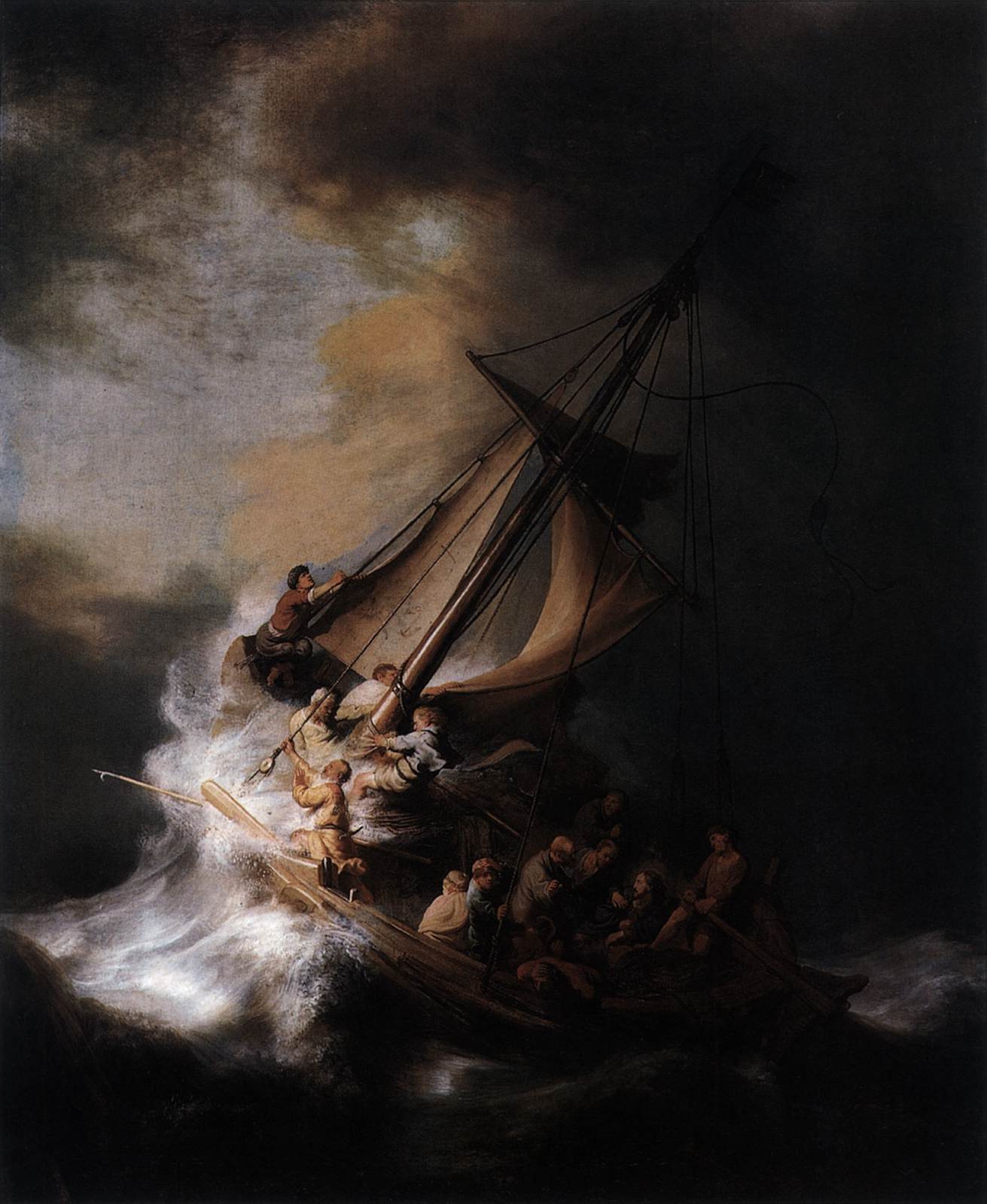
Christ in the Storm on the Sea of Galilee, Rembrandt, 1633
Isabella Stewart Gardner Museum, Boston, USA [Web Gallery of Art]


Readings
(New American Bible:
Philippines, USA)
 
Readings
(Jerusalem Bible: Australia,
England & Wales, India [optional], Ireland, New Zealand, Pakistan,
Scotland, South Africa)
 
Gospel Mark 4:35-41 (New Revised Standard Version, Catholic Edition, Canada) 


On that day, when evening had come, Jesus
said to his disciples, “Let us go across to the other side.” And leaving
the crowd behind, they took him with them in the boat, just as he was. Other
boats were with him. A great windstorm arose, and the waves beat into the
boat, so that the boat was already being swamped. But he was in the stern,
asleep on the cushion; and they woke him up and said to him, “Teacher, do you
not care that we are perishing?” He woke up and rebuked the wind, and said
to the sea, “Peace! Be still!” Then the wind ceased, and there was a dead calm. He
said to them, “Why are you afraid? Have you still no faith?” And they were
filled with great awe and said to one another, “Who then is this, that even the
wind and the sea obey him?”


The very first pastoral visit outside of Rome of Pope Francis was to the small island of Lampedusa, the most southerly part of Italy. He went there on 8 July 2013 because of his concern about the plight many migrants and refugees trying to get from North Africa to Europe through Lampedusa and the many who died in trying to do so. The vast majority of these were exploited ‘boat people’ who had spent all they had, handing over their money to unscrupulous persons who were becoming rich by living off the poor and not caring whether they lived or died.


In his homily that day Pope Francis asked, ‘Has any one of us grieved for the death of these brothers and sisters? Has any one of us wept for these persons who were on the boat? For the young mothers carrying their babies? For these men who were looking for a means of supporting their families?’ 


The question the Pope asked in a way echoes that of the Apostles in the boat to Jesus: ‘Teacher, do you not care that we are perishing?’ 

LÉ Eithne


Since 16 May LÉ Eithne, the flagship of the Irish Naval Service has been engaged, along with ships of navies of other European countries, in the Mediterranean in an effort to rescue ‘boat people’. This one small ship has already rescued 1,620 men women and children. The Irish Naval Service has a total personnel of 1,144.


It is estimated that between 2000 and 2014 around 22,000 undocumented immigrants died trying to reach Italy from North Africa. In April alone this year it is reckoned that more than 1,000 died in a number of incidents.


Something similar is happening in South-East Asia with refugees and asylum seekers from Myanmar/Burma, Rohingya people who are Muslims, and from Bangladesh being shunned.


So this Sunday’s gospel speaks to us of a situation that is all too common in the contemporary world.


The Apostles discovered that Jesus did care: ‘He woke up and rebuked the wind, and said to the sea, “Peace! Be still!”’ And he shows that same care to the refugees in the Mediterranean and in South-East Asia through the authorities, agencies and individuals who are trying to alleviate their immediate dangerous situation while others try to deal with the roots and causes of that situation.


There is an expression in the English language, ‘We’re all in the same boat’, that indicates especially in a difficult or dangerous situation that all are equal and that all are responsible in some way for changing that situation. In his new encyclical, Laudato Si’: On Care for Our Common Home, Pope Francis echoes this (No 13): ‘The urgent challenge to protect our common home includes a concern to bring the whole human family together to seek a sustainable and integral development, for we know that things can change. The Creator does not abandon us; he never forsakes his loving plan or repents of having created us. Humanity still has the ability to work together in building our common home.’ 


We can do two things. We can and should pray for all those caught up in the human tragedy of refugees and asylum seekers desperately seeking a better life as they flee from areas of conflict and hopelessness, being exploited ruthlessly by others in their plight – surely an expression of the reality of evil, of sin and of the Devil that Pope Francis frequently speaks about – and often losing their lives in the process.


And we can start reading the Pope’s encyclical, whether online or in printed form, while reflecting on it, praying while doing so, and asking the Lord how he wants each of us to change the way we live so that the world, all its creatures and especially we humans made in God’s image and likeness will become what God wills for us all.


‘God saw everything that he had made, and indeed, it was very good’ (Genesis 1:31). 


Responsorial Psalm [NAB – Philippines, USA]
Posted in: Sunday Reflections Tagged: asylum seekers, Irish Naval Service, Lampedusa, LÉ Eithne, Mediterranean, Pope Francis, refugees, Sunday Reflections

‘This is my body . . .’ Sunday Reflections, Corpus Christi, Year B

May 29, 2015 by Father Sean Coyle


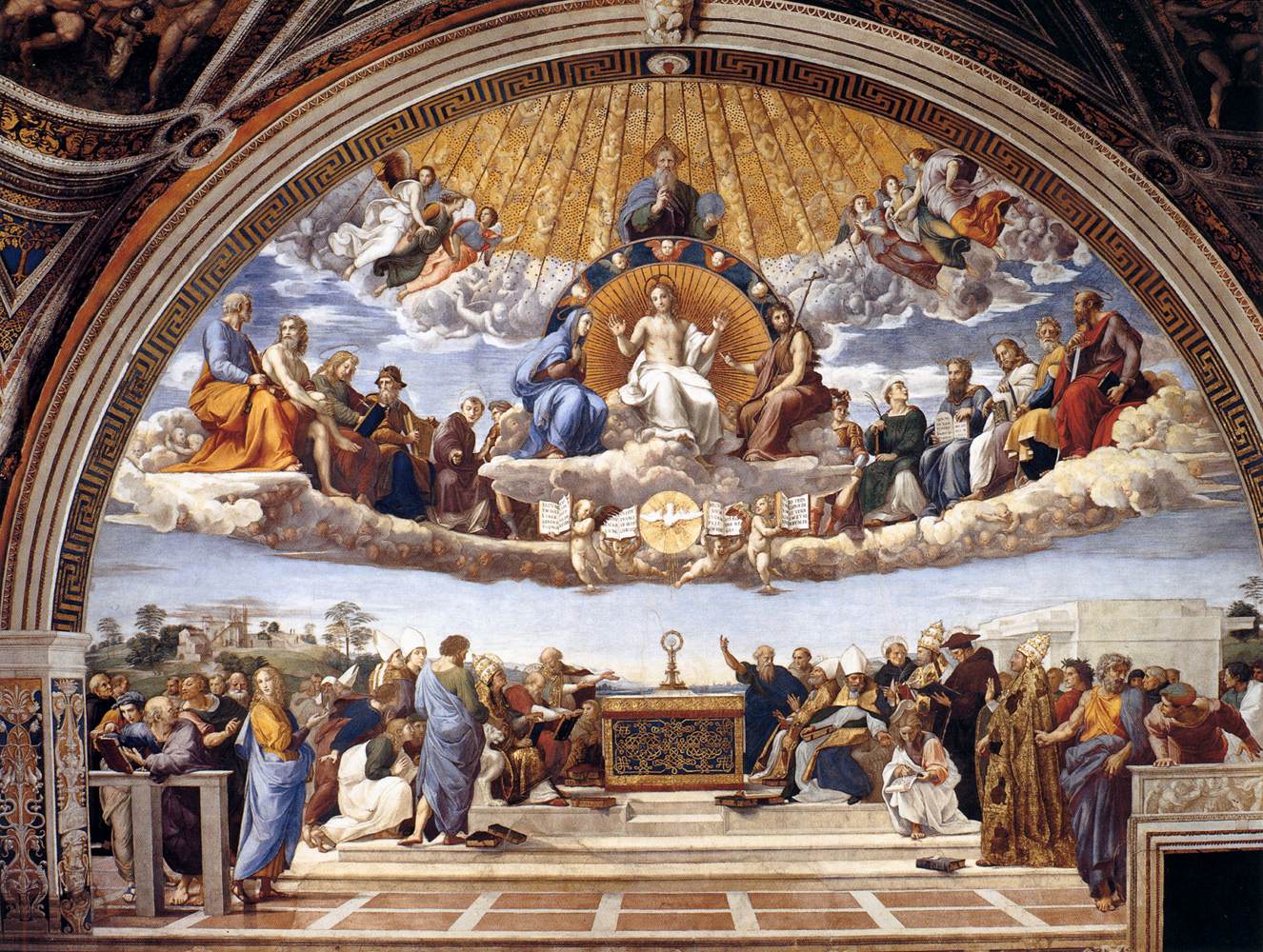
La Disputà (Disputation of the Holy Sacrament), Raffaello Sanzio, painted 1510-11
Stanza della Segnatura, Palazzi Pontifici, Vatican 
[Web Gallery of Art]
 
You will find a description of this magnificent fresco here and a video on its restorationhere.
 
The Solemnity of the Body and Blood of Christ


Readings (New American Bible: Philippines, USA) 

 
Readings (Jerusalem Bible: Australia, England &Wales, India [optional], Ireland, New Zealand, Pakistan, Scotland, South Africa) 
 
Gospel Mark 14:12-16, 22-26 (New Revised Standard Version – Catholic Edition, Canada)
 
On the first day of Unleavened Bread, when the Passover lamb is sacrificed, his disciples said to Jesus, “Where do you want us to go and make the preparations for you to eat the Passover?” So he sent two of his disciples, saying to them, “Go into the city, and a man carrying a jar of water will meet you; follow him, and wherever he enters, say to the owner of the house, ‘The Teacher asks, Where is my guest room where I may eat the Passover with my disciples?’ He will show you a large room upstairs, furnished and ready. Make preparations for us there.” So the disciples set out and went to the city, and found everything as he had told them; and they prepared the Passover meal.
Pope Francis leads his first Corpus Christi procession in Rome
 
‘As a primary school student, each Saturday I would play with my friends in our village but also made time for one hour’s adoration before the Blessed Sacrament in the local church. It was the custom in our village to have exposition of the Blessed Sacrament on Saturday afternoon and the Catholics would spend some time in prayer in the church.  I feel that my personal relationship with God has its origin in those hours before the Blessed Sacrament.’  [Emphasis added].
 
John Wang Zongshe is one of two young Chinese men who came to Manila four uears ago to prepare to be Columban priests, the first candidates from that country. The original missionof the Columbans was China. John tells his vocation story, Life-giving Connections, in Misyononline.com, the online magazine I edit for the Columbans here in the Philippines.John is from a village that is one-third Catholic. but his companion Joseph Li Jiangang is from a village where all 800 inhabitants are Catholic.  Joseph, like John became involved actively in the life of the Church when he was young, as he writes in his vocation story, A Church with Room for All: The Franciscan Missionaries of Mary worked in our village and ran a medical clinic. In junior high school, one Sister got us together for religious education during our summer holidays, and at the age of eleven I began to know more about God.  I was born after the Cultural Revolution (1966-1976) when so much religious practice had ceased. I used to sit at the back of the church when I went alone, but when I joined the youth group we would sit at the front. As a youth I went of my own free will to church.

 
At that time, I was timid and afraid to read in public. I became an altar server and at twelve I was leading the congregation in half an hour of prayers before Mass. I liked that and on returning from school I’d drop my bag and head for the church.[Emphasis added].


Joseph, John and Emmannuel Trocino, a Columban seminarian from Negros Occidental, on a visit three years ago to Australian Columban Fr Brian Gore at San Columbano Mission Center, Himamaylan City, Negros Occidental, under the watchful eye of St Columban. Joseph and John have since discovered that God isn’t calling them to be Columban priests. Emmannuel is currently in Peru on his two-year First Mission Assignment as part of his preparation for the priesthood.

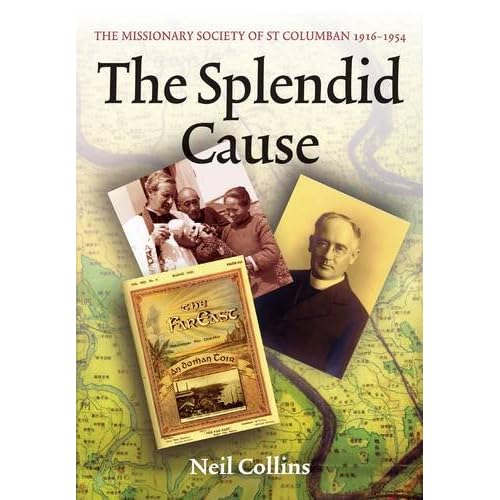
The first Columbans went to China in 1920 to bring the Gospel to the millions there who had never heard of Jesus Christ. Fr Paddy O’Connor, one of the first students to join the Columbans and who was ordained in 1923, wrote a poem called The Splendid Cause, which became the Columban anthem for many years, in which he used the line To bring to the nations the sweet, white Host
. For Father O’Connor the Eucharist was at the heart of mission. 
The Splendid Cause is also the title of a history of the Columbans from 1916 to 1954 by Columban Fr Neil Collins, who was one of the speakers at the 50th International Eucharistic Congress held in Dublin from 10 to 17 June 2012. St Columbanus (Columban), the patron saint of the Society of St Columban,  was one of the patron saints of the Congress.
 
Recent polls and studies in Ireland indicate a great loss of faith, even though 84 percent in the 2011 census in the Republic of Ireland identified themselves as Catholics. (About 75 percent in the whole of Ireland would call themselves Catholics). Only about one third attend Mass every Sunday and a large percentage, especially of those who don’t go to Mass regularly, don’t believe that the bread and wine brought up at the offertory of the Mass become the Body and Blood of Christ at the Consecration. If they receive Holy Communion they believe they are receiving only a symbol.
 
It was a great love for the Mass and a desire to bring the Catholic Christian faith to the people of China that led two young Irish diocesan priests nearly 100 years ago, Fr Edward J. Galvin, later first Bishop of Hanyang, China, and Fr John Blowick to start what initially was ‘The Maynooth Mission to China’ and later became the Society of St Columban.
 
No Irish Columban has been ordained in the Third Millenium of Christianity nor are there any candidates at present. But the first two  seminarians from China, a country where the Church is still being harassed, a country from which Bishop Galvin and all other Columbans were expelled 60 years ago, some after having spent time in prison, have now joined us.
 
We just don’t know God’s plans. But absolutely central to the spirituality of Bishop Galvin was doing God’s will. He cared little for the trappings of the office of bishop but insisted on his episcopal motto being Fiat voluntas tua, ‘Your will be done’. He would surely be delighted that the call of John and John was awakened in communities focuses on the Eucharist.
 
The Columbans came to Manila in 1929 at the request of Archbishop Michael O’Doherty, an Irishman. One of the speakers at the Eucharistic Congress is his current successor, Manila-born Archbishop Luis Antonio Tagle. He also spoke at the 49th International Eucharistic Congress in Quebec City, Canada, in 2008.
 
Please pray that as the Church celebrates the Feast of Corpus Christ, the Body of Christ, which it has done already on Thursday in countries where it is still a holyday of obligation, and that there will be a renewal and deepening of faith in Ireland, a faith centred on the Eucharist, and that the Catholics of China, the Philippines and other countries where Irish missionaries have preached and lived the Gospel, may help re-evangelise the country that produced such missionary giants as St Columban 1,500 years ago and Edward Galvin and John Blowick a 100 years ago.
Lauda Sion Salvatorem
Sequence for Mass on the Solemnity of Corpus Christi
 
English Version
 
Sion, lift up thy voice and sing:
Praise thy Savior and thy King,
Praise with hymns thy shepherd true.
All thou canst, do thou endeavour:
Yet thy praise can equal never
Such as merits thy great King.
See today before us laid
The living and life-giving Bread,
Theme for praise and joy profound.
The same which at the sacred board
Was, by our incarnate Lord,
Giv’n to His Apostles round.
Let the praise be loud and high:
Sweet and tranquil be the joy
Felt today in every breast.
On this festival divine
Which records the origin
Of the glorious Eucharist.
On this table of the King,
Our new Paschal offering
Brings to end the olden rite.
Here, for empty shadows fled,
Is reality instead,
Here, instead of darkness, light.
His own act, at supper seated
Christ ordain’d to be repeated
In His memory divine;
Wherefore now, with adoration,
We, the host of our salvation,
Consecrate from bread and wine.
Hear, what holy Church maintaineth,
That the bread its substance changeth
Into Flesh, the wine to Blood.
Doth it pass thy comprehending?
Faith, the law of sight transcending
Leaps to things not understood.
Here beneath these signs are hidden
Priceless things, to sense forbidden,
Signs, not things, are all we see.
Flesh from bread, and Blood from wine,
Yet is Christ in either sign,
All entire, confessed to be.
They, who of Him here partake,
Sever not, nor rend, nor break:
But, entire, their Lord receive.
Whether one or thousands eat:
All receive the self-same meat:
Nor the less for others leave.
Both the wicked and the good
Eat of this celestial Food:
But with ends how opposite!
Here ‘t is life: and there ‘t is death:
The same, yet issuing to each
In a difference infinite.
Nor a single doubt retain,
When they break the Host in twain,
But that in each part remains
What was in the whole before.
Since the simple sign alone
Suffers change in state or form:
The signified remaining one
And the same for evermore.
Lo! bread of the Angels broken,
For us pilgrims food, and token
Of the promise by Christ spoken,
Children’s meat, to dogs denied.
Shewn in Isaac’s dedication,
In the manna’s preparation:
In the Paschal immolation,
In old types pre-signified.
Jesu, shepherd of the sheep:
Thou thy flock in safety keep,
Living bread, thy life supply:
Strengthen us, or else we die,
Fill us with celestial grace.
Thou, who feedest us below:
Source of all we have or know:
Grant that with Thy Saints above,
Sitting at the feast of love,
We may see Thee face to face.
Amen. Alleluia.
 
Young Jew as Christ, Rembrandt, c.1656
Staatliche Museen, Berlin [Web Gallery of Art]
 
In regions where Corpus Christi is celebrated on the previous Thursday the Tenth Sunday in Ordinary Time, Year B, is observed. Here are links to the readings in the New Revised Standard Version – Catholic Edition, the translation used in the English Lectionary in Canada.
 
Genesis 3:9-15.
 
2 Corinthians 4:13-5:1.
 
Mark 3:19-35.
 
Then Jesus went home; and the crowd came together again, so that they could not even eat. When his family heard it, they went out to restrain him, for people were saying, “He has gone out of his mind.” And the scribes who came down from Jerusalem said, “He has Beelzebul, and by the ruler of the demons he casts out demons.” And he called them to him, and spoke to them in parables, “How can Satan cast out Satan? If a kingdom is divided against itself, that kingdom cannot stand. And if a house is divided against itself, that house will not be able to stand. And if Satan has risen up against himself and is divided, he cannot stand, but his end has come. But no one can enter a strong man’s house and plunder his property without first tying up the strong man; then indeed the house can be plundered.
 
“Truly I tell you, people will be forgiven for their sins and whatever blasphemies they utter; but whoever blasphemes against the Holy Spirit can never have forgiveness, but is guilty of an eternal sin”— for they had said, “He has an unclean spirit.”

Then his mother and his brothers came; and standing outside, they sent to him and called him. A crowd was sitting around him; and they said to him, “Your mother and your brothers and sisters are outside, asking for you.” And he replied, “Who are my mother and my brothers?” And looking at those who sat around him, he said, “Here are my mother and my brothers! Whoever does the will of God is my brother and sister and mother.”


Posted in: Sunday Reflections Tagged: China, Columbans, Corpus Christi, Philippines, St Columban, Sunday Reflections

‘Go therefore and make disciples of all nations . . .’ Sunday Reflections, Trinity Sunday, Year B

May 27, 2015 by Father Sean Coyle


HolyTrinity, Jusepe de Ribera, painted 1635-36 
Museo del Prado, Madrin [Web Gallery of Art]
 
Readings (New American Bible: Philippines, USA) 
 
Readings (Jerusalem Bible: Australia, England & Wales, India [optional], Ireland, New Zealand, Pakistan, Scotland, South Africa) 
 
Gospel Matthew 28:16-20 (New Revised Standard Version – Catholic Edition, Canada)
 

Now the eleven disciples went to Galilee, to the mountain to which Jesus had directed them. When they saw him, they worshiped him; but some doubted. And Jesus came and said to them, “All authority in heaven and on earth has been given to me. Go therefore and make disciples of all nations, baptizing them in the name of the Father and of the Son and of the Holy Spirit, and teaching them to obey everything that I have commanded you. And remember, I am with you always, to the end of the age.”

Holy, holy, holy! Lord God almighty!
 
From the evening of 23 May until the morning of 1 June in 2012 I was giving a retreat to a group of Canossian Sisters, also known as Daughters of Charity, Servants of the Poor. They included four novices and seven professed Sisters, including one from Malaysia.Their foundress, St Magdalene of Canossa bequeathed to the Sisters the mission of ‘making Jesus known and loved above all’. This comes from a stance of standing at the foot of the Cross with Mary.
 
During my talks each morning I shared many stories of individuals who had made Jesus known to me, usually with no awareness that they were doing so. Some were persons I knew. Some are now dead. Some I met only once in passing, never learning their names. Most were poor. I know that my stories triggered off similar memories among the Sisters of people who had made Jesus known to them as the Sisters in turn had made him known to those they were serving.
 
I saw all of this in the context of the Communion of Saints, the angels and saints in heaven, the members of the Church on earth, the souls in purgatory. The story of creation tells us that we are made in the image of God. But what the author of that first account of creation didn’t know is that God is a Community of Three Persons. Made in God’s image, we are made to be in community with others.
 
Jusepe de Ribera’s painting of the Holy Trinity above, like a number of other paintings, shows the dead Christ. The expression on the face of the Father shows suffering. It is very similar to the face of the father in Rembrandt’s The Return of the Prodigal Son, painted about thirty years later. I don’t know if Rembrandt was familiar with de Ribera’s painting.


The Blessed Trinity call us into the circle of their life through suffering. We know the suffering of Jesus. Some of the great artists show to us something of the suffering of the Father.

One of the stories I told involved two persons I met only once, a mother and her daughter aged about 13. When they first approached me outside a retreat house in Cebu City on the morning of Holy Thursday 1990. I made an excuse that I was only visiting. When I went inside I later saw the two of them sitting on the steps. The daughter had her head on her mother’s shoulder. Clearly, they were tired and hungry. When I was leaving I gave them enough to buy breakfast. The young girl looked at me with the most beautiful smile I’ve ever seen and said to me, Salamat sa Ginoo! ‘Thanks to the Lord!’ She wasn’t thanking me but inviting me to thank the Lord with her and her mother for his goodness. Through her hunger and tiredness she had come to know something of God’s bountiful love.

That young girl has been calling me into the life of the Holy Trinity for more than 25 years now. I’ve no idea what became of her. I came to the Philippines in 1971 to do my part in making disciples of all nations and have baptised many in the name of the Father and of the Son and of the Holy Spirit. But that young girl, and many others like her, have been constantly teaching me to observe all that I have commanded you and assuring me in the name of Jesus, I am with you always, to the close of the age.

Introit (Entrance Antiphon of Mass)
 
Benedíctus sit Deus Pater,
unigenitúsque Dei Fílius,
Sanctus quoque Spíritus,
quia fecit nobíscum misericórdiam suam.


Blest be God the Father, 
and the Only Begotten Son of God, 
and also the Holy Spirit,
for he has shown us his merciful love.
 
Mozart’s setting of the Latin text at the age of 12 sung by the  Meninos Cantores de Campinas, many of them around the same age as Mozart when he wrote the music. Campinas is in São Paolo State, Brazil.
 
Benedictus sit Deus
 
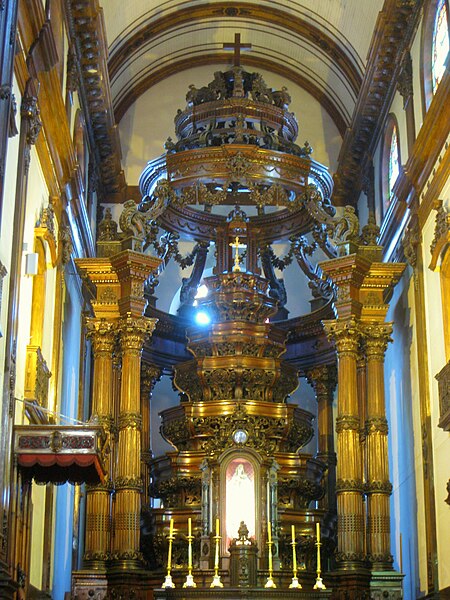
High Altar of the Metropolitan Cathedral of the Immaculate Conception, Campinas, Brazil [Wikipedia]
Posted in: Sunday Reflections Tagged: Canossian Sisters, Jusepe de Ribera, Mozart, Rembrandt, Sunday Reflections, Trinity Sunday

‘Go into all the world and proclaim the good news to the whole creation.’ Solemnity of the Ascension of the Lord, Year B

May 15, 2015 by Father Sean Coyle

Pentecost El Greco, painted 1596-1600

Museo del Prado, Madrid [Web Gallery of Art]

 
Readings (New American Bible: Philippines, USA)
 
Vigil Mass 
 
Mass during the Day
 
Readings (Jerusalem Bible: Australia, England & Wales, India [optional], Ireland, New Zealand, Pakistan, Scotland, South Africa) [This page gives the readings for both the Vigil Mass and the Mass during the Day]


Liturgical Note. Pentecost, like Easter and some other solemnities, has a Vigil, properly so-called. This is not an ‘anticipated Mass’ but a Vigil Mass in its own right, with its own set of prayers and readings. It fulfils our Sunday obligation. There may be an extended Liturgy of the Word,er similar to the Easter Vigil, with all the Old Testament readings used. 

 
The prayers and readings of the Mass During the Day should not be used for the Vigil Mass, nor those of the Vigil Mass for the Mass During the Day. 


Gospel John 20:19-23 (New Revised Standard Version – Catholic Edition, Canada)
 
When it was evening on that day, the first day of the week, and the doors of the house where the disciples had met were locked for fear of the Jews, Jesus came and stood among them and said, “Peace be with you.”#8221; After he said this, he showed them his hands and his side. Then the disciples rejoiced when they saw the Lord. Jesus said to them again, “Peace be with you. As the Father has sent me, so I send you.” When he had said this, he breathed on them and said to them, “Receive the Holy Spirit. If you forgive the sins of any, they are forgiven them; if you retain the sins of any, they are retained.”


Alternative Gospel


Gospel John 15:26-27; 16:12-15 (New Revised Standard Version – Catholic Edition, Canada)

 
Jesus said to his disciples:
 
“When the Advocate comes, whom I will send to you from the Father, the Spirit of truth who comes from the Father, he will testify on my behalf. You also are to testify because you have been with me from the beginning.
 
 “I still have many things to say to you, but you cannot bear them now. When the Spirit of truth comes, he will guide you into all the truth; for he will not speak on his own, but will speak whatever he hears, and he will declare to you the things that are to come. He will glorify me, because he will take what is mine and declare it to you. All that the Father has is mine. For this reason I said that he will take what is mine and declare it to you.”


Fr Ralph W. Beiting (1 January 1924 – 24 August 2012) street preaching in July 2011

 
I’m quite happy to live in the present and to look forward to the future without worrying too much. That is all grace from God. There is, however, one event in my life that I would, perhaps, like to relive, if that were possible, which it’s not. It was the summer of 1969, less than two years after my ordination in Ireland, when I was studying in a college north of New York City where I was also one of the chaplains.
 
One day during Lent of that year while walking across the campus to class I met Betty, a student who was in some classes with me, and asked her what she was doing for Easter. I was just making small talk. But when she told me that she and some other students were going to work in a parish in rural Kentucky as volunteers for that week I got interested – and ended up going with them. I spent most of Easter week in Lancaster, Kentucky, cleaning up buildings, getting them ready for summer programmes such as Bible classes and summer camps for local children. The parish priest, Fr Ralph Beiting, had many projects and invited students, most at college level bu some still in high school, to come during the summer for a week, two weeks, a month or longer, to help run the Bible schools in the four towns in his parish, to staff the two camps for children to spend a five-day vacation in, to do house-to-house visitation in pairs, and some other things. He had also founded the Christian Appalachian Project to help the development of this predominantly poor corner of the USA, and an area where there was only a handful of Catholics. There were still remnants of anti-Catholicism.
 
Fr Beiting used to go around preaching in towns during the summer, accompanied by seminarians and other male college students. They’d park their truck at a place where people could gather and he’d preach basic Christian truths from the back of the lorry. He was following an old Protestant tradition in the area but one that was dying out. On one occasion he was driven out at gunpoint but next day turned up again, not to preach but simply to show himself.
 
This great diocesan priest had the great gift of organising and inspiring young people in the service of the Gospel. These gifts of his helped me to discover a gift I was unaware of – the ability to listen to people. When I went back to Kentucky for six weeks in the summer of 1969 he asked me to divide my time between the activities in Lancaster and those in Cliffview Camp, where each week a group of local youngsters went on Monday morning and went home on Friday afternoon, with lots of activities to keep them, and the student volunteers, occupied. Cliffview is now a retreat and conference centre for the Diocese of Lexington.
 
 
Part of Cliffview as it looked in 1969.
 
Father Beiting wasn’t a person you would go to if you had a problem or wanted to talk about something. He was an ‘action man’, though a prayerful one. However, I discovered that many of the young volunteers I was working with, and some persons older than me, found in me somebody who could listen to them. I had never been aware of that ability but it was to become very important in my life as a priest. Indeed, in the case of one young volunteer who became a close friend and to whom I was to be a mentor, that ability that God gave me became helped, 12 years later, to draw her back from the brink of suicide. And in that episode I discovered that sometimes a person of deep and generous faith can also be very fragile. My friend died the following year, aged only 29, peacefully and from natural causes. Some months before her death she told me that she thought she didn’t have long to live. I had the good sense to listen to her and we spoke to each other as persons of faith as to what her death would mean. There was nothing morbid about our conversation and we went for an Italian lunch afterwards – my friend was pure Italian – and had a joyful time together.It was to be our last time to meet.
 
But what I still marvel at, and thank God for, is that ‘casual’ meeting with another student and a conversation that I didn’t see as having any importance at all. A question that expressed friendliness rather than curiosity was to receive a profound and life-long answer, not from Betty, but from the Holy Spirit.
 
Receive the Holy Spirit . . . as the Father has sent me, even so I send you.
 
Veni, Sancte Spiritus (Sequence) 
 
Veni Sancte Spiritus (Sequence for Mass on Pentecost Sunday)
 
Veni, Sancte Spiritus,
et emitte caelitus
lucis tuae radium.
Come, Holy Spirit,
send forth the heavenly
radiance of your light.
Veni, pater pauperum,
veni, dator munerum
veni, lumen cordium.
Come, father of the poor,
come giver of gifts,
come, light of the heart
Consolator optime,
dulcis hospes animae,
dulce refrigerium.
Greatest comforter,
sweet guest of the soul,
sweet consolation.
In labore requies,
in aestu temperies
in fletu solatium.
In labor, rest,
in heat, temperance,
in tears, solace.
O lux beatissima,
reple cordis intima
tuorum fidelium.
O most blessed light,
fill the inmost heart
of your faithful.
Sine tuo numine,
nihil est in homine,
nihil est innoxium.
Without your grace,
there is nothing in us,
nothing that is not harmful.
Lava quod est sordidum,
riga quod est aridum,
sana quod est saucium.
Cleanse that which is unclean,
water that which is dry,
heal that which is wounded.
Flecte quod est rigidum,
fove quod est frigidum,
rege quod est devium.
Bend that which is inflexible,
fire that which is chilled,
correct what goes astray.
a tuis fidelibus,
in te confidentibus,
sacrum septenarium.
Give to your faithful,
those who trust in you,
the sevenfold gifts.
Da virtutis meritum,
da salutis exitum,
da perenne gaudium,
Grant the reward of virtue,
grant the deliverence of salvation,
grant eternal joy.
Posted in: Sunday Reflections Tagged: Brazil, Easter, Indonesia, Ireland, Mary Jane Veloso, May devotions. Our Blessed Mother. Frank Patterson., Philippines, Pope Benedict, Sunday Reflections
« Previous 1 2 3

Recent Posts

  • ‘I do choose. Be made clean!’ Sunday Reflections, 6th Sunday in Ordinary Time, Year B
  • ‘They brought to him all who were sick.’ Sunday Reflections, 5th Sunday in Ordinary Time, Year B
  • ‘He taught them as one having authority.’ Sunday Reflections, 4th Sunday in Ordinary Time, Year B
  • Columban Fr Donal O’Farrell RIP
  • Columban Fr Matthew Reilly RIP

Archives

  • February 2018
  • January 2018
  • December 2017
  • November 2017
  • October 2017
  • September 2017
  • August 2017
  • July 2017
  • June 2017
  • May 2017
  • April 2017
  • March 2017
  • February 2017
  • January 2017
  • December 2016
  • November 2016
  • October 2016
  • September 2016
  • August 2016
  • July 2016
  • June 2016
  • May 2016
  • April 2016
  • March 2016
  • February 2016
  • January 2016
  • December 2015
  • November 2015
  • October 2015
  • September 2015
  • August 2015
  • July 2015
  • June 2015
  • May 2015
  • April 2015
  • March 2015
  • February 2015
  • January 2015
  • December 2014
  • November 2014
  • October 2014
  • September 2014
  • August 2014
  • July 2014
  • June 2014
  • May 2014
  • April 2014

Copyright © 2026 The Pilgrims' Inn.

Hotel WordPress Theme by themehall.com