
The Pilgrims' Inn

  • Welcome to The Pilgrims’ Inn
‘They brought to him all who were sick.’ Sunday Reflections, 5th Sunday in Ordinary Time, Year B

Web Gallery of Art

‘They brought to him all who were sick.’ Sunday Reflections, 5th Sunday in Ordinary Time, Year B

January 31, 2018 by Father Sean Coyle

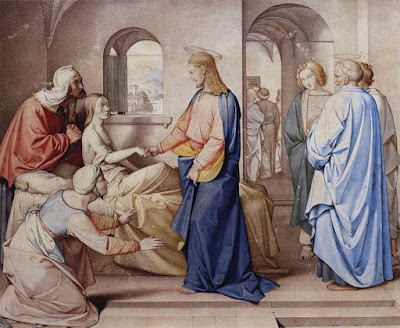
Christ Raises the Daughter of Jairus

Friedrich Overbeck [Web Gallery of Art]

Readings (New American Bible: Philippines, USA)

Readings (Jerusalem Bible: Australia, England & Wales, India [optional], Ireland, New Zealand, Pakistan, Scotland, South Africa)

Gospel Mark 1:29-39 (New Revised StandardVersion, Anglicised Catholic Edition) 

As soon as they left the synagogue, Jesus entered the house of Simon and Andrew, with James and John. Now Simon’s mother-in-law was in bed with a fever, and they told him about her at once. He came and took her by the hand and lifted her up. Then the fever left her, and she began to serve them.

That evening, at sunset, they brought to him all who were sick or possessed with demons. And the whole city was gathered around the door. And he cured many who were sick with various diseases, and cast out many demons; and he would not permit the demons to speak, because they knew him.

In the morning, while it was still very dark, he got up and went out to a deserted place, and there he prayed. And Simon and his companions hunted for him. When they found him, they said to him, ‘Everyone is searching for you.’ He answered, ‘Let us go on to the neighbouring towns, so that I may proclaim the message there also; for that is what I came out to do.’ And he went throughout Galilee, proclaiming the message in their synagogues and casting out demons.

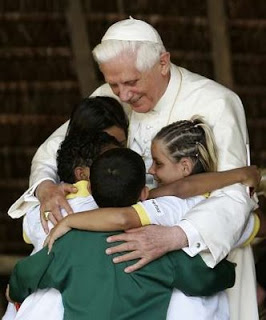
Pope Benedict with children [Source]

This week I will simply copy Pope Benedict’s words on today’s gospel during his Angelus talk on this same Sunday in 2012. I will highlight what particularly strikes me. 

Dear Brothers and Sisters,

This Sunday’s Gospel presents to us Jesus who heals the sick: first Simon Peter’s mother-in-law who was in bed with a fever and Jesus, taking her by the hand, healed her and helped her to her feet; then all the sick in Capernaum, tried in body, mind and spirit, and he “healed many… and cast out many demons” (Mk 1:34). The four Evangelists agree in testifying that this liberation from illness and infirmity of every kind was — together with preaching — Jesus’ main activity in his public ministry.

Illness is in fact a sign of the action of Evil in the world and in people, whereas healing shows that the Kingdom of God, God himself, is at hand. Jesus Christ came to defeat Evil at the root and instances of healing are an anticipation of his triumph, obtained with his death and Resurrection.

Jesus said one day: “those who are well have no need of a physician, but those who are sick” (Mk 2:17). On that occasion he was referring to sinners, whom he came to call and to save. It is nonetheless true that illness is a typically human condition in which we feel strongly that we are not self-sufficient but need others. In this regard we might say paradoxically that illness can be a salutary moment in which to experience the attention of others and to pay attention to others!

However illness is also always a trial that can even become long and difficult. When healing does not happen and suffering is prolonged, we can be as it were overwhelmed, isolated, and then our life is depressed and dehumanized. How should we react to this attack of Evil? With the appropriate treatment, certainly — medicine in these decades has taken giant strides and we are grateful for it — but the Word of God teaches us that there is a crucial basic attitude with which to face illness and it is that of faith in God, in his goodness. Jesus always repeats this to the people he heals: your faith has made you well (cf. Mk 5:34, 36).

Even in the face of death, faith can make possible what is humanly impossible. But faith in what? In the love of God. This is the real answer which radically defeats Evil. Just as Jesus confronted the Evil One with the power of the love that came to him from the Father, so we too can confront and live through the trial of illness, keeping our heart immersed in God’s love.

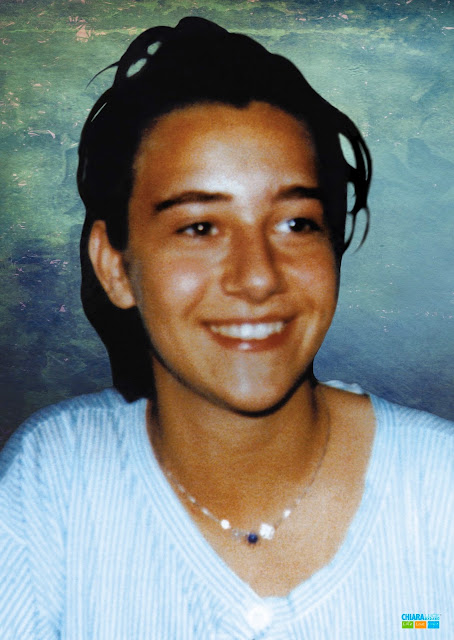
Blessed Chiara Luce Badano [Source]

(29 October 1971 – 7 October 1990)

We all know people who were able to bear terrible suffering because God gave them profound serenity. I am thinking of the recent example of Blessed Chiara Badano, cut off in the flower of her youth by a disease from which there was no escape: all those who went to visit her received light and confidence from her! Nonetheless, in sickness we all need human warmth: to comfort a sick person what counts more than words is serene and sincere closeness.


Dear friends, next Saturday, 11 February, the Memorial of Our Lady of Lourdes, is the World Day of the Sick. Let us too do as people did in Jesus’ day: let us present to him spiritually all the sick, confident that he wants to and can heal them. And let us invoke the intercession of Our Lady, especially for the situations of greater suffering and neglect. Mary, Health of the Sick, pray for us!


Next Sunday, 11 February, is this year’s World Day of the Sick.


Blessed Chiara [Source]

On a pastoral visit to Palermo, Italy, on 3 October 2010 Pope Benedict had this to say about Blessed Chiara [emphases added]: I do not want to start with a discussion but with a testimonial, a true and very timely life story. I believe you know that last Saturday, 25 September, a young Italian girl, called Chiara, Chiara Badano, was declared Blessed in Rome. I invite you to become acquainted with her. Her life was a short one but it is a wonderful message. Chiara was born in 1971 and died in 1990 from an incurable disease. Nineteen years full of life, love and faith. Her last two years were also full of pain, yet always of love and light, a light that shone around her, that came from within: from her heart filled with God! How was this possible? How could a 17 or 18-year-old girl live her suffering in this way, humanly without hope, spreading love, serenity, peace and faith? This was obviously a grace of God, but this grace was prepared and accompanied by human collaboration as well: the collaboration of Chiara herself, of course, but also of her parents and friends.


You may read more about Blessed Chiara Luce Badano in The Saint Who Failed Math by Richelle Verdeprado  published in the September-October 2010 issue of MISYONonline.com, the magazine of the Columbans in the Philippines of which I used to be editor. 

The whole of Pope Benedict’s address to the young people and families of Sicily is well worth reading and reflecting on in the context of this year’s World Meeting of Families in Ireland in August.

Posted in: Sunday Reflections Tagged: Benedict XVI, Blessed Chiara Luce Badano, Friedrich Overbeck, Sunday Reflections, Web Gallery of Art

‘And the favour of God was upon him.’ Sunday Reflections, Feast of the Holy Family; Mary, Mother of God

December 29, 2017 by Father Sean Coyle

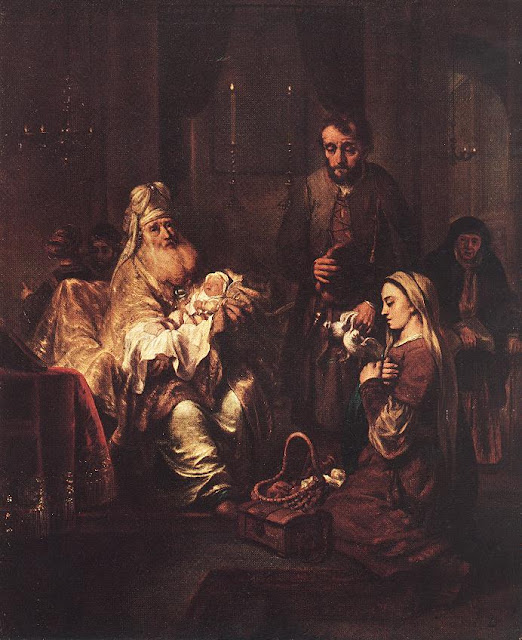
Presentation in the Temple

Gerbrand van de Eeckhout [Web Gallery of Art]

Readings (New American Bible: Philippines, USA)

Readings (Jerusalem Bible: Australia, England & Wales, India [optional], Ireland, New Zealand, Pakistan, Scotland, South Africa)

Gospel Luke 2:22-40 [2:22, 39-40] (NewRevised  Standard Version, AnglicisedCatholic Edition) 

When the time came for their purification according to the law of Moses, they brought him up to Jerusalem to present him to the Lord [ (as it is written in the law of the Lord, ‘Every firstborn male shall be designated as holy to the Lord’), and they offered a sacrifice according to what is stated in the law of the Lord, ‘a pair of turtle-doves or two young pigeons.’

Now there was a man in Jerusalem whose name was Simeon; this man was righteous and devout, looking forward to the consolation of Israel, and the Holy Spirit rested on him. It had been revealed to him by the Holy Spirit that he would not see death before he had seen the Lord’s Messiah. Guided by the Spirit, Simeon came into the temple; and when the parents brought in the child Jesus, to do for him what was customary under the law, Simeon took him in his arms and praised God, saying,

‘Master, now you are dismissing your servant in peace,
    according to your word;
for my eyes have seen your salvation,
     which you have prepared in the presence of all peoples,
a light for revelation to the Gentiles
    and for glory to your people Israel.’

And the child’s father and mother were amazed at what was being said about him. Then Simeon blessed them and said to his mother Mary, ‘This child is destined for the falling and the rising of many in Israel, and to be a sign that will be opposed so that the inner thoughts of many will be revealed—and a sword will pierce your own soul too.’

There was also a prophet, Anna the daughter of Phanuel, of the tribe of Asher. She was of a great age, having lived with her husband for seven years after her marriage, then as a widow to the age of eighty-four. She never left the temple but worshipped there with fasting and prayer night and day. At that moment she came, and began to praise God and to speak about the child to all who were looking for the redemption of Jerusalem.]

When they had finished everything required by the law of the Lord, they returned to Galilee, to their own town of Nazareth. The child grew and became strong, filled with wisdom; and the favour of God was upon him.

Note that there are alternative First Readings, Responsorial Psalms and Second Readings. There are also longer and shorter versions of the Gospel.

[Family Theater Productions]

Before Christmas we listened to the words of St Matthew: Now the birth of Jesus the Messiah took place in this way. When his mother Mary had been engaged to Joseph, but before they lived together, she was found to be with child from the Holy Spirit. Her husband Joseph, being a righteous man and unwilling to expose her to public disgrace, planned to dismiss her quietly. But just when he had resolved to do this, an angel of the Lord appeared to him in a dream and said, ‘Joseph, son of David, do not be afraid to take Mary as your wife, for the child conceived in her is from the Holy Spirit. She will bear a son, and you are to name him Jesus, for he will save his people from their sins’ (Matthew 1:18-21). 

Joseph, by obeying God’s messenger and by naming the Son his wife Mary bore, became the legal father of Jesus. The Church honours him above all as the Husband of Mary. St John XXIII added the words and blessed Joseph, her Spouse to the Roman Canon, now also known as the First Eucharistic Prayer, while Pope Francis has included that phrase in the other three main Eucharistic Prayers. It was as the Husband of Mary that St Joseph took care of her and of Jesus. It was St Joseph whom Jesus knew as Dad/Papa/Tatay. It was from St Joseph that Jesus, God who became Man, learned, in his humanity, to grow into manhood.

St Joseph submitted his whole being, as did his wife Mary, to doing God’s will. Jesus was flesh of her flesh, but not of his. Yet he loved Jesus as if he was his own son, first of all by loving his mother.

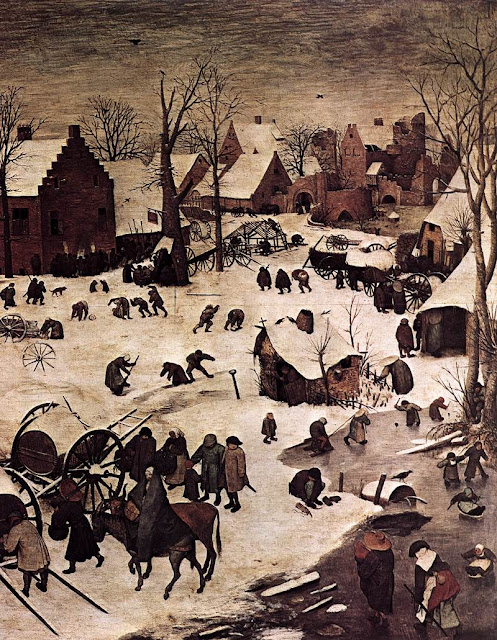
The Census at Bethlehem (detail)

Pieter Bruegel the Elder [Web Gallery of Art]

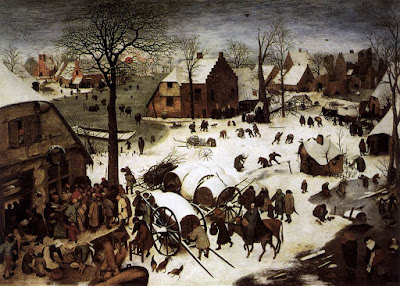
Peter Bruegel the Elder, maybe the first major painter to focus on the lives of ordinary people, captures the quiet responsibility of St Joseph, leading the donkey on which the heavily pregnant Mary is riding. The picture above is a detail of the full painting:

Bruegel has transposed Bethlehem to a village in the Netherlands in the middle of winter. He captures the reality that the Holy Family were ‘nobodies’. None of the people around notices them. They too are caught up in the red tape of their day, having to travel long distances to have their names registered.

Gerbrand van den Eeckhout in the Presentation in the Temple shows St Joseph as a man who is somewhat shy, not wanting to be in the limelight, but standing protectively over Mary as she kneels before Jesus held in the arms of Simeon, with Anna the Prophetess in the background. St Joseph here reminds me very much of my own father.


And in the video of the Presentation what strikes me is that St Joseph is the one carrying Jesus. But before he hands the infant to Simeon he quietly asks Mary’s permission to do so. Mary hands Jesus back to Joseph after receiving him from Simeon and it is St Joseph, as head of the Holy Family, who presents the infant to the priest who offers him to God. The priest has no idea who this child of poor parents really is.


On 17 November 2014 Pope Francis said: It is necessary to insist on the fundamental pillars that govern a nation: its intangible assets. The family is the foundation of co-existence and a guarantee against social fragmentation. Children have a right to grow up in a family with a father and a mother capable of creating a suitable environment for the child’s growth and emotional development. This is why, in the Apostolic Exhortation Evangelii Gaudium, I stressed the ‘indispensable’ contribution of marriage to society, a contribution which ‘transcends the feelings and momentary needs of the couple’ (n. 66). And this is why I am grateful to you for the emphasis that your colloquium has placed on the benefits that marriage can provide children, the spouses themselves, and society.


There have always been children who have grown up without one or both parents. In the Bible they are seen as young persons in need of special care from the wider community. I have known many single parents, some of them widowed, raising their children lovingly and heroically. But this is not the norm.


Incredibly, many within the last three or four decades have come to dismiss the importance of husband/father and wife/mother, have come to dismiss the conception and birth of children in the way that God intended.

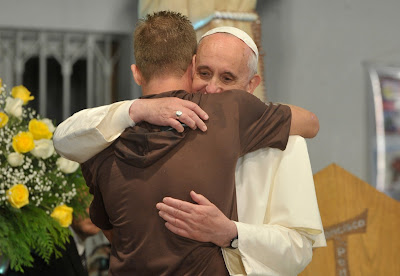
Pope Francis with recovering drug addict, Brazil 2013 [Wikipedia]

Though without a family of my own I have for many years experienced the title ‘Father’ as a call to be one in a number of senses: a ‘spiritual father’ who leads others to our Heavenly Father through his Son Jesus Christ, and a father-figure to young persons who may have lost their father or who may even have been abused by their father or by other fatherly figures in whom they should have been able to trust.

As a man, I see today’s Feast of the Holy Family to be a call especially to us men to be like St Joseph, to be responsible, to be loving; if married to love our wives above all, if not, to be like fathers to young persons who come into our lives in whatever way and for whatever reason.

As a priest I am grateful to God for calling me not only to be ‘Father’ but to be a father to many in the sense that St Joseph was truly a father to Jesus.

Parents tell their 6 kids that another is on the way!

Solemnity of Mary, the Holy Mother of God


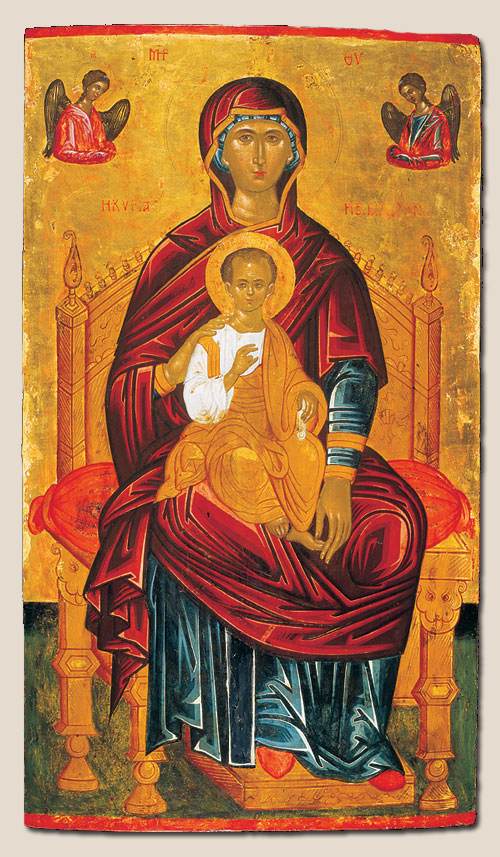
The Mother of God Enthroned, Andreas Ritzos [Web Gallery of Art]

The first day of 2018 is observed by the Church as the Solemnity of Mary, the Holy Mother of God. It is also the last day of the Octave of Christmas and World Day of Peace. In some countries, eg the Philippines, it is a Holy Day of Obligation. In others, eg Ireland, it is not.

Readings (New American Bible: Philippines, USA)

Readings (Jerusalem Bible: Australia, England & Wales, India [optional], Ireland, New Zealand, Pakistan, Scotland, South Africa)

Gospel Luke 2:16-21 (NewRevised  Standard Version, AnglicisedCatholic Edition) 

So the shepherds went with haste and found Mary and Joseph, and the child lying in the manger. When they saw this, they made known what had been told them about this child; and all who heard it were amazed at what the shepherds told them. But Mary treasured all these words and pondered them in her heart. The shepherds returned, glorifying and praising God for all they had heard and seen, as it had been told them.

After eight days had passed, it was time to circumcise the child; and he was called Jesus, the name given by the angel before he was conceived in the womb.

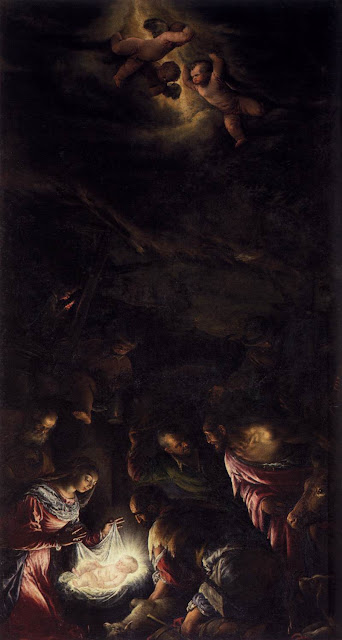
Adoration of the Shepherds, Jacopo Bassano [Web Gallery of Art]

MESSAGE OF HIS HOLINESS POPE
FRANCIS

FOR THE CELEBRATION OF THE 
51st WORLD DAY OF PEACE

1 JANUARY 2018

Migrants and refugees: men and women in search of peace

Happy New Year!

Manigong Bagong Taon!

Athbhliain Faoi Mhaise!

Posted in: Sunday Reflections Tagged: Andreas Ritzos, Gerbrand van de Eeckhout, Jacopo Bassano, Pieter Bruegel the Elder, Pope Francis, Sunday Reflections, The Holy Family, Web Gallery of Art

‘Because of our traditions, every one of us knows who he is.’ Sunday Reflections, 22nd Sunday in Ordinary Time, Year B

August 29, 2015 by Father Sean Coyle
Christ, El Greco, c.1606
Cathedral, Toledo, Spain [Web Gallery of Art]


Readings (New American Bible: Philippines, USA)

 
Readings (Jerusalem Bible: Australia, England & Wales, India [optional], Ireland, New Zealand, Pakistan, Scotland, South Africa)
 
Gospel Mark 7:1-8, 14-15, 21-23 (New Revised Standard Version, Catholic Edition, Canada) 
   
Now when the Pharisees and some of the scribes who had come from Jerusalem gathered around Jesus, they noticed that some of his disciples were eating with defiled hands, that is, without washing them. (For the Pharisees, and all the Jews, do not eat unless they thoroughly wash their hands, thus observing the tradition of the elders;  and they do not eat
anything from the market unless they wash it;
 and there are also many other traditions that they observe, the washing of cups, pots, and bronze kettles.) So the Pharisees and the scribes asked
him, “Why do your disciples not live
 according to the tradition of the elders, but eat with defiled hands?” He said to them, “Isaiah prophesied rightly about you hypocrites, as it is written,
‘This people honors me with their lips,
    but their hearts are far from me;
in vain do they worship me,
teaching human precepts as doctrines.’
You abandon the commandment of God and hold to human tradition.”
Then he called the crowd again and said to them, “Listen to me, all of you, and understand: there is nothing outside a person that by going in can defile, but the things that come out are what defile.”

For it is from within, from the human heart, that evil intentions come: fornication, theft, murder, adultery, avarice, wickedness, deceit, licentiousness, envy, slander, pride, folly. All these evil things come from within, and they defile a person.”

 
Silver Torah Case [Wikipedia]
 
Moses said to the people: ‘So now, Israel, give heed to the statutes and ordinances that I am teaching you to observe, so that you may live to enter and occupy the land that the Lord, the God of your ancestors, is giving you. You must neither add anything to what I command you nor take away anything from it, but keep the commandments of the Lord your God with which I am charging you.’ (First Reading).
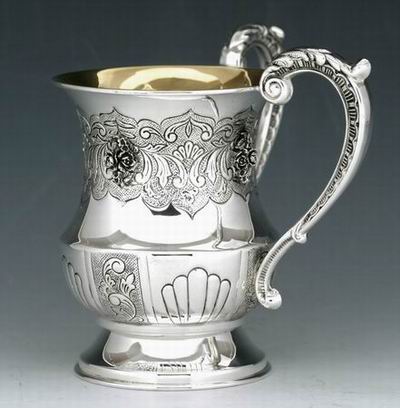
 
A silver cup for for netilat yadayim, the Jewish ritual washing of hands [Wikipedia]
 
Because of lack of time I shall use, with adaptations, some of the material I used for this Sunday three years ago.
 
 
The Indian Rupees 9,000 monthly rent mentioned in the video is the equivalent of about US$135 or Php6,000.

More than three years ago I was speaking to a Filipino seminarian who had worked in Dubai for some years. He had been quite involved in his parish at home and wanted to visit a group of Catholics from Kerala, India, who lived in a labour camp in Dubai. His friends thought he was crazy but he went anyway. He simply wanted to befriend these men whose living conditions he had heard about.

What he described was what I’ve found subsequently in videos such as the one above, which is from an Indian TV station, except that in my imagination I had pictured World War II-type wooden huts instead of big buildings not unlike apartment blocks in large cities.

The men made him most welcome. The air inside was just as the reporter in the video described. His hosts were preparing a meal outside their crowded bedroom. They didn’t see much need to wash their hands or their utensils and what they were preparing was somewhat more spicy than what Filipinos normally eat.

But the young Filipino enjoyed being with his fellow Catholics, whom he knew were his brothers. He could see clearly their living conditions and was able to understand some of their stories. But what struck him most of all was their hospitality.

The Pharisees and scribes in today’s gospel ask Jesus, Why do your disciples not live according to the tradition of the elders, but eat with hands defiled?
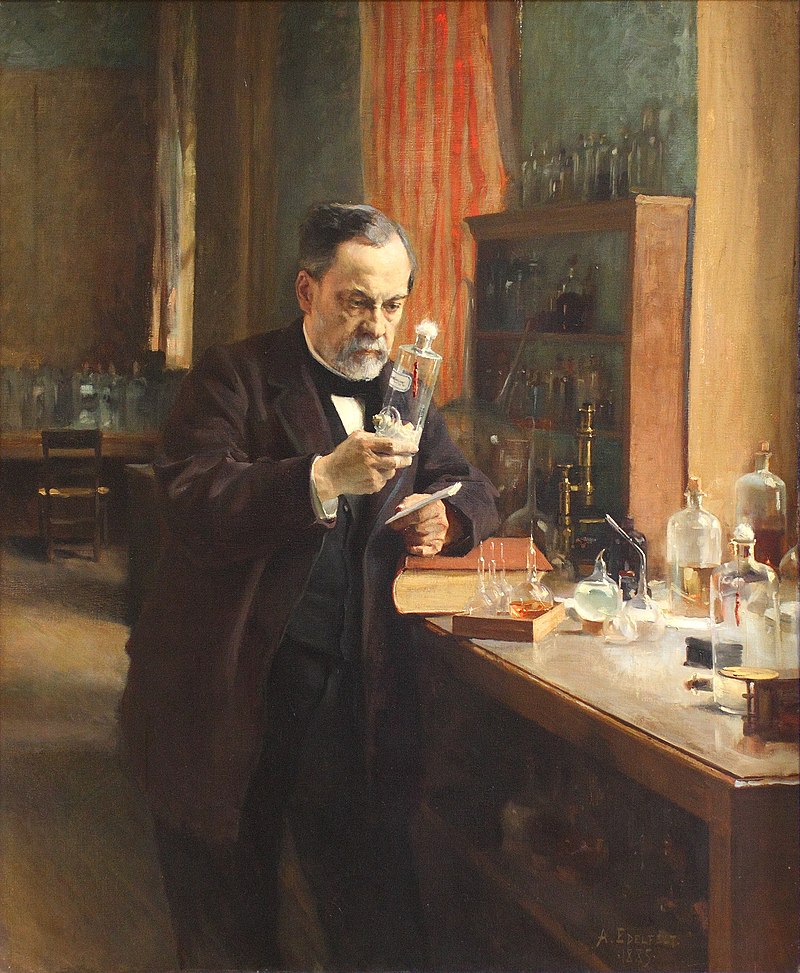
 
Louis Pasteur in his laboratory, Albert Ederfelt, 1885
[Wikipedia]
 
I don’t think that Jesus is telling us to be careless with food, in preparing it or eating it. Scientists such as Louis Pasteur have shown us the importance of doctors washing their hands and equipment before surgery, a connection that hadn’t been seen before. But what Jesus is on about, I think, is the attitude of someone who would notice that the workers from Kerala in a ‘villa’ in Dubai didn’t wash their hands before cooking and eating and would be critical of them – instead of asking why the washing facilities they shared with so many others were lacking. Someone who would fail to see the overcrowded living quarters and the underpaid workers, separated from their families, being exploited by their employers and by recruiting agencies in their own countries.

The situation my young Filipino friend came across in Dubai can be found in many countries. The term ‘OFW’ is widely used here in the Philippines. It means ‘Overseas Filipino Worker’. OFWs are often described by politicians as modern-day heroes. But too few politicians and others are asking why so many, probably a minority in the overall picture but yet a large number of individual real persons, are exploited by some agencies at home and by employers abroad. In reality, these are treated as anything but heroes.

Nor is Jesus opposing tradition or traditions. He was a faithful Jew, as were Joseph and Mary and understood their importance. Tradition and traditions, even if we don’t know their origins, are basically life-giving. The Pharisees and scribes  in today’s gospel – not all Pharisees and scribes were like these – have turned them into ways of sucking the lifeblood out of people.

Reb Tevye in the extract from Fiddler on the Roof below says, And because of our traditions, every one of us knows who he is. The exploited workers from Kerala carried with them the tradition of hospitality they had inherited from their ancestors and welcomed a stranger from the Philippines in Dubai. Despite their appalling conditions they knew who they were. They lacked freedom in so many ways but they had the freedom to be welcoming. Hospitality is one of the most cherished experiences in the Bible, in both the Old and New Testaments. It is cherished in every culture and it is at the heart of following Jesus, who showed hospitality to others, rich and poor, and who graciously accepted it from others, rich and poor. Indeed, he was sometimes criticised for eating with the poor, as he is in today’s gospel because his companions didn’t wash their hands.

I don’t know if the workers from Kerala whom my friend met had a chance to go to Mass – he did as he lived very near a church. But the Prayer after Communion today fits in with their meeting in Dubai.

Renewed by this bread from the heavenly table, 
we beseech you, Lord, 
that, being the food of charity, 
it may confirm our hearts 
and stir us to serve you in our neighbour. 
Through Christ our Lord.


Antiphona ad introitum     Entrance Antiphon  Ct Ps 85 [86]: 3, 5


Miserere mihi Domine, 
Have mercy on me, OLord,
quoniam ad te clamavi tota die:
for I cry to you all the day long.
quia tu Domine suavis ac mitis es,
O Lord, you are good and forgiving,
et copiosus in misericordia omnibus invocantibus te.
full of mercy to all who call on you.
Posted in: Sunday Reflections Tagged: Dieric Bouts the Elder, Palestrina, Sunday Reflections, Web Gallery of Art

Recent Posts

  • ‘I do choose. Be made clean!’ Sunday Reflections, 6th Sunday in Ordinary Time, Year B
  • ‘They brought to him all who were sick.’ Sunday Reflections, 5th Sunday in Ordinary Time, Year B
  • ‘He taught them as one having authority.’ Sunday Reflections, 4th Sunday in Ordinary Time, Year B
  • Columban Fr Donal O’Farrell RIP
  • Columban Fr Matthew Reilly RIP

Archives

  • February 2018
  • January 2018
  • December 2017
  • November 2017
  • October 2017
  • September 2017
  • August 2017
  • July 2017
  • June 2017
  • May 2017
  • April 2017
  • March 2017
  • February 2017
  • January 2017
  • December 2016
  • November 2016
  • October 2016
  • September 2016
  • August 2016
  • July 2016
  • June 2016
  • May 2016
  • April 2016
  • March 2016
  • February 2016
  • January 2016
  • December 2015
  • November 2015
  • October 2015
  • September 2015
  • August 2015
  • July 2015
  • June 2015
  • May 2015
  • April 2015
  • March 2015
  • February 2015
  • January 2015
  • December 2014
  • November 2014
  • October 2014
  • September 2014
  • August 2014
  • July 2014
  • June 2014
  • May 2014
  • April 2014

Copyright © 2026 The Pilgrims' Inn.

Hotel WordPress Theme by themehall.com